Which event photos actually help you win bookings, and how to get them legally when someone else took them. You will learn who owns event photos under Canadian copyright law, how to ask for and record permission, and how to handle the people who appear in your images.
Read the transcript
Event photos that market you, and who owns them.
Every event produces hundreds of photographs, and almost none of them market the vendors in the room.
The photographer shoots for the client: faces, moments, family groups.
The photos that actually market you.
A marketing photo answers a buyer's question at a glance.
Different vendors need different answers.
Who owns an event photo in Canada.
This is where many event businesses get it wrong.
Under the Copyright Act, the author of a work is the first owner of the copyright.
How to ask for permission.
Most event photographers are glad to license images to vendors, because a credited photo on a venue or planner website brings them work too.
Ask early, ask in writing and be specific.
The people in the photos.
Copyright is only half the question.
The other half is the people.
Worked example: the cost of usable photos.
Lantern and Lane needs fresh marketing images each season.
Option one: license from event photographers.
That is the lesson. The worksheet and the quiz are just below this video.
What you will be able to do
- Write a shot list of the photos that market your specific service
- Explain who owns copyright in an event photo in Canada and what a written licence must cover
- Request, record and respect permissions from photographers and the people in the photos
Every event produces hundreds of photographs, and almost none of them market the vendors in the room. The photographer shoots for the client: faces, moments, family groups. The centrepieces appear blurred behind a hug, the bar appears as a backdrop, and the magician appears mid-blink. If you want photos that sell your service, you have to plan for them, and you have to know whose they are before you post.
The photos that actually market you
A marketing photo answers a buyer’s question at a glance. Different vendors need different answers.
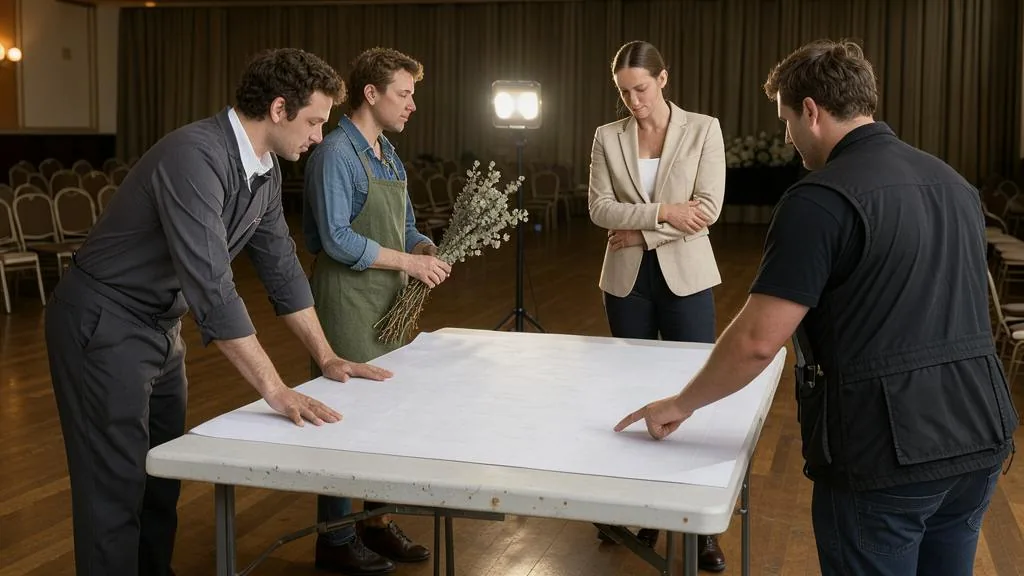
| Vendor | Photos that sell | Photos that do not |
|---|---|---|
| Planner | The room before guests arrive, the timeline in action, the planner cueing a moment, a calm client | Generic couple portraits with no sign of planning |
| Caterer | Plated dishes in good light, stations in use, servers at work, the scale of a buffet for 300 | Empty chafing dishes, food under purple uplighting |
| Performer | The audience reacting, the performer in context, a full room | Close-ups with no audience in sight |
| Venue | Each room set for ceremony, dinner and dancing, with people for scale | Wide empty shots on a grey day |
| Décor, florals, rentals | Details, the finished room, the same space before and after | Pieces cropped out by guests’ heads |
Write a short shot list for your service and keep it on your phone. Lantern & Lane’s list has eight lines: the ceremony space before seating, the reception room before doors, one detail per table design, Priya cueing the processional, the vendor team at load-in, the timeline on the clipboard, the couple’s exit, and one wide shot of the full dance floor. When the event photographer is friendly and has time, Priya shares the list in advance and asks whether any of those frames fit their plan.
Who owns an event photo in Canada
This is where many event businesses get it wrong. Under the Copyright Act, the author of a work is the first owner of the copyright. Until 2012, a special rule gave ownership of a commissioned photograph to the person who ordered and paid for it. That rule was repealed, and the change took effect on November 7, 2012.
The practical result: for photos taken on or after November 7, 2012, the photographer owns the copyright by default, even when the client paid for the shoot, unless there is a written agreement that says otherwise. Three consequences follow for every vendor.
- The couple or corporate client does not usually own the photos. They normally have a licence from the photographer, often for personal use. An individual may also use a photo they commissioned for personal purposes for private or non-commercial uses, but that exception does not cover a business using the photo in its marketing.
- A client cannot give you permission they do not have. “The bride said we could use them” is not a licence from the copyright owner.
- Ownership can change only in writing. An assignment of copyright is valid only in writing signed by the owner or the owner’s agent.
Two further points. If an employee takes photos in the course of their employment, the employer is the first owner unless there is an agreement to the contrary, so photos your staff shoot on the job are generally yours. And photographers have moral rights, including the right to be associated with their work by name, which they can waive but not assign. Credit them.
How to ask for permission
Most event photographers are glad to license images to vendors, because a credited photo on a venue or planner website brings them work too. Ask early, ask in writing and be specific. A request you can copy:

“Hi Daniel, thank you for a wonderful day at the Ruiz wedding on June 14. Would you be willing to license us a few images for our marketing? We would like to use up to ten images showing the reception design on our website, Google Business Profile and Instagram, for an indefinite period, with a credit to you and a link to your site in every use. We will not alter the images beyond cropping, or use them in paid advertising without asking you first. Please let me know your terms, including any fee. Priya, Lantern & Lane.”
The reply is your written permission. Keep it. The points every licence should cover are:
- Which images, by file name or gallery link.
- Where you may use them: website, social, Business Profile, print, paid ads, award entries.
- For how long.
- The credit wording and whether a link or tag is expected.
- Whether you may crop, edit or add text.
- Any fee.
The people in the photos
Copyright is only half the question. The other half is the people. A guest who did not expect to appear on your Instagram, a child at a bar mitzvah, a corporate executive at a closed-door event or a guest at a religious ceremony may all have good reasons not to be shown. Build permission into your process:
- Add a marketing-use clause to your client contract that explains how you may use event images and lets the client opt out.
- For corporate events, ask the client whether any guests, speakers or areas are off limits for publicity.
- Prefer images where guests are at a distance, from behind or not identifiable, especially children.
- Remove any image promptly if someone in it asks, and say thank you for telling you.
Worked example: the cost of usable photos
Lantern & Lane needs fresh marketing images each season. Option one: license from event photographers. Over a season, Priya asks after 12 events, gets yes on 9, and receives an average of 8 usable images each, with fees on three of them at $150 each. That gives 9 x 8 = 72 images for $450, or about $6.25 per image.
Option two: hire a photographer for two hours before doors at four events, at $350 per session, for about 25 images each. That gives 4 x 25 = 100 images for $1,400, or $14 per image, but every image is shot for Lantern & Lane’s own shot list and licensed for marketing from the start.
They do both. Licensed images fill the feed. The commissioned sessions supply the service pages and the Business Profile, where each image does the most work. Whatever you choose, keep a photo log with the file, the event, the photographer, the licence terms, the credit line and the date of permission.
In Canada and the GTA
The Copyright Act in brief. The rules above come straight from the federal Copyright Act. Section 13(1) makes the author the first owner. Former section 13(2), which gave ownership of commissioned photographs and portraits to the person who commissioned them, now reads “Repealed, 2012”, and the repeal took effect on November 7, 2012. Section 13(4) says an assignment or grant of an interest in copyright is valid only in writing signed by the owner. Section 13(3) gives the employer first ownership of works made in the course of employment, absent an agreement to the contrary. Section 32.2(1)(f) lets an individual use a photo they commissioned for personal purposes, and paid for, for private or non-commercial purposes, unless agreed otherwise. Commercial use by a business sits outside that exception.
Moral rights and term. Under section 14.1, photographers have a right to the integrity of their work and a right to be associated with it by name or pseudonym, or to remain anonymous. Moral rights may not be assigned but may be waived in whole or in part. Heavy edits, added text or filters on a licensed photo should therefore be agreed in advance. Copyright generally lasts for the author’s life, plus the rest of the calendar year of death, plus 70 years. Registration with CIPO is voluntary: a photo is protected as soon as it is taken. CIPO’s guide to copyright is a clear plain-language summary.
Older photos. For photos taken before November 7, 2012, under a commission, the old rule may mean the client who commissioned them owns the copyright. If you want to use older images, ask both the photographer and the client, and get the answer in writing.
Privacy and the people in your images. PIPEDA applies to private-sector organizations that collect, use or disclose personal information in the course of commercial activity, and it generally applies to businesses in Ontario. Personal information is information about an identifiable individual, in any form, and the OPC has treated photographs of identifiable people as personal information. The OPC’s guidance on meaningful consent says express consent is generally required when a use is outside a person’s reasonable expectations. A guest at a private wedding may not reasonably expect to appear in a vendor’s advertising. A clear contract clause, a client who has told guests that a photographer is present, and a habit of choosing images where guests are not identifiable will cover most situations. When in doubt, leave the image out.
Local practice. Many GTA venues and places of worship have their own photography rules. Some gurdwaras, mosques, churches, synagogues and temples restrict photography during parts of a ceremony, or ask that images of the ceremony not be used commercially. Corporate clients in finance, law and government often prohibit publicity photos entirely, or allow them only after approval. Ask before the event, write the answer in your file, and honour it even if the photos are beautiful. Cultural celebrations that span several days, such as a mehndi, a ceremony and a reception, may each come with different rules from different families or venues.
Credits that work in the GTA vendor community. The GTA wedding and event industry is a referral economy, and photographers notice who credits them. A consistent credit line, such as “Photo: [photographer’s business name]” with a link, and a tag on social posts make it far more likely that photographers will share images with you next time. Many photographers send vendor galleries within a few weeks of an event. Reply with thanks, use the images as agreed, and send the photographer a link when their work goes up on your site.
This is general information, not legal advice. Check the Copyright Act, CIPO’s guidance or a lawyer for your situation.
Worksheet
Download the worksheet and complete it for your own business, using Lantern & Lane as the model where it helps. Keep it with your marketing plan. It takes about 10 minutes.

Check your understanding
Related guides, venues and vendors
Types of events and who plans them
Module 1: Foundations · 15 min
Social, wedding, cultural, corporate and public events share one process but differ in who decides, who pays and what success means. Knowing…
Read more
The entertainment market in the GTA
Specialist · Entertainment Booking · 15 min
Act categories, agencies vs direct booking, price ranges and lead times.
Read more
Your list is the asset you own
Module 10: Email, CRM and Follow-Up · 15 min
Why an email list of past clients, inquiries and partners is the one marketing asset no platform can take away, and how…
Read more