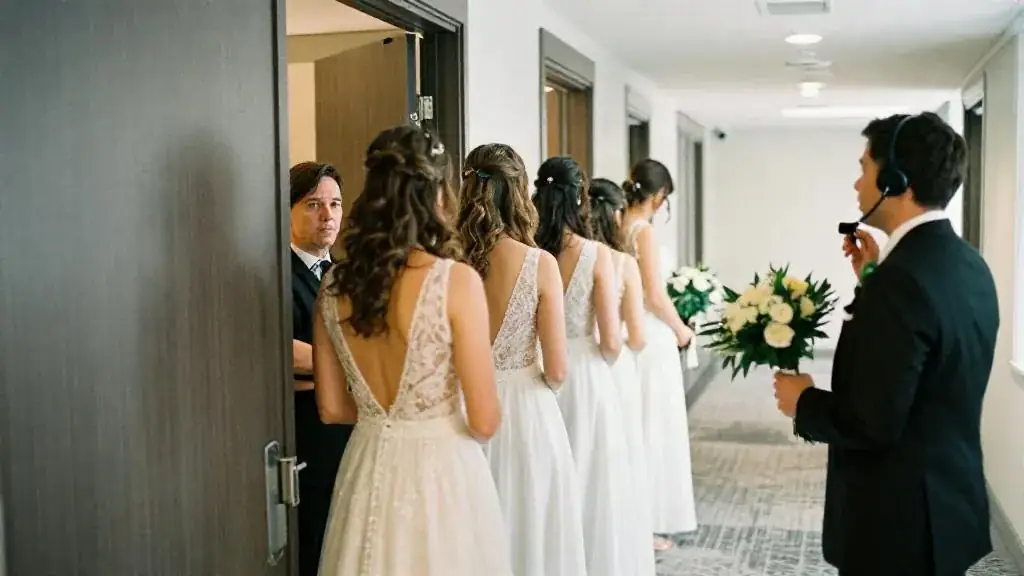
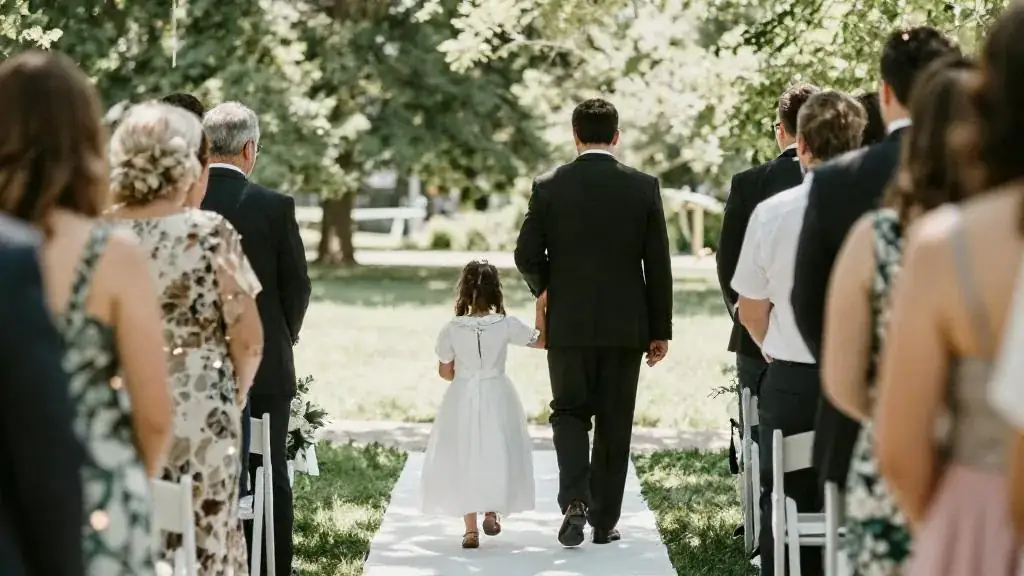
The entrance of the wedding party and the couple at the start of a ceremony.
Read the transcript
Processional.
The entrance of the wedding party and the couple at the start of a ceremony.
How it works in practice.
The processional is the most choreographed few minutes of a wedding.
Every person who walks has a cue, a pace, a destination and a seat or standing mark at the front.
How to handle it.
Write the processional order as a numbered list, with each person, their escort, and their music cue.
Mark where each person stands or sits at the front, on a simple diagram.
In Ontario and the GTA.
Many Toronto venues hold the rehearsal slot for another event, so ask early whether the ceremony space is free the evening before.
Outdoor ceremonies on grass or a slope need a check for heels and mobility aids.
More detail, examples and common mistakes are on this page, below the video.
How it works in practice
The processional is the most choreographed few minutes of a wedding. Every person who walks has a cue, a pace, a destination and a seat or standing mark at the front. The order depends on tradition, faith, family structure and the couple. In many Christian ceremonies the officiant and one partner wait at the front while attendants walk in. In Jewish ceremonies both partners are often escorted by both parents. Hindu and Sikh ceremonies have their own entrance customs. Many couples now walk in together.
None of these are rules a planner should assume. Ask the couple and, where relevant, the officiant, then write down the order.
How to handle it
- Write the processional order as a numbered list, with each person, their escort, and their music cue.
- Mark where each person stands or sits at the front, on a simple diagram.
- Agree the spacing between walkers; a common working gap is about halfway down the aisle before the next person starts.
- Give the musician or DJ the exact cue points: which song starts, when it changes, and when it fades.
- Rehearse it in the ceremony space, ideally the day before, with everyone who walks.
- Station a coordinator at the back to send each walker on cue, and one at the front to place them.
- Check the aisle: width, surface, any step, and that no décor sits in the walking line.
In Ontario and the GTA
Many Toronto venues hold the rehearsal slot for another event, so ask early whether the ceremony space is free the evening before. Outdoor ceremonies on grass or a slope need a check for heels and mobility aids. Keep the route step-free where any walker or guest uses a wheelchair or walker; the step-free route is part of a practical AODA checklist for any event. The marriage itself must be solemnized by a registered officiant, with two witnesses present.
Questions to ask
- Who walks, who escorts whom, and is anyone uncomfortable with the arrangement?
- Will any children walk, and who collects them at the front?
- Is the music live or recorded, and who controls the fade?
- Does the officiant have requirements about where people stand?
Pair this with the recessional and put both on the run of show. The timeline generator helps place the rehearsal.
Why it matters
Its order varies by tradition and family; agree it in writing and rehearse it.
Example
Grandparents, parents, attendants, then the couple, each to a different piece of music.
Common mistakes
- No rehearsal
- Music cues not on the run of show