A modular display built from LED panels, brighter and more flexible than projection.
Read the transcript
LED wall.
A modular display built from LED panels, brighter and more flexible than projection.
How it works in practice.
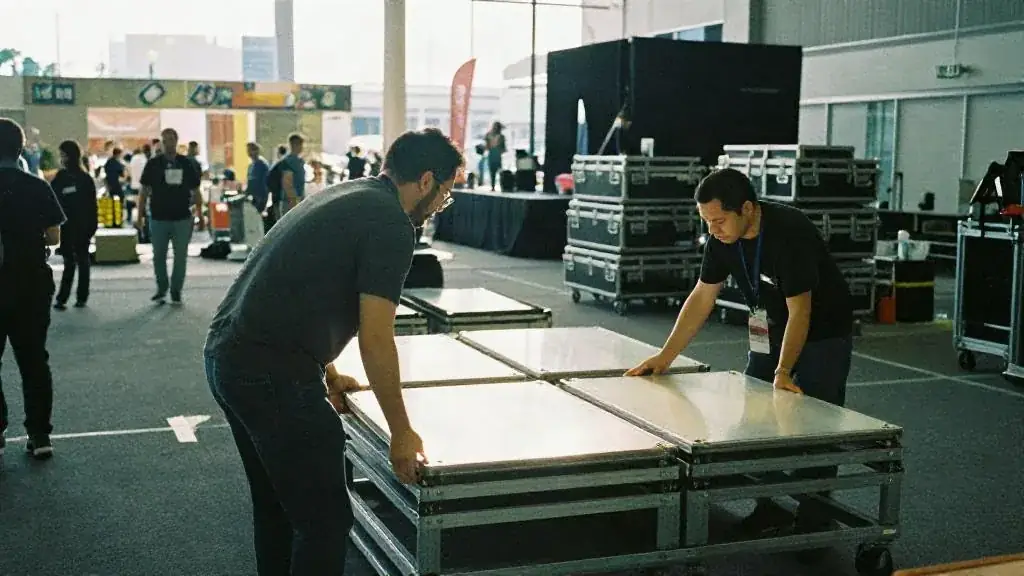
An LED wall is assembled on site from cabinets, commonly 500 by 500 mm or 500 by 1,000 mm, that lock together and connect to a video processor.
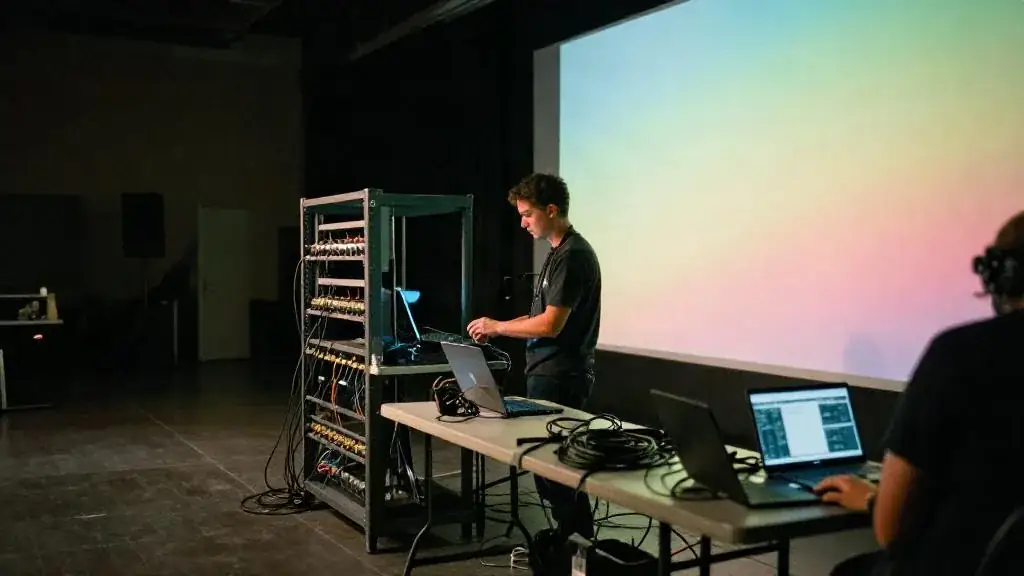
The processor takes a laptop or switcher feed and maps it onto the panels.
Worked numbers.
Ask the designer to build slides and video at the wall's native resolution.
A standard 16:9 deck will be stretched or letterboxed on most wall shapes.
How to handle it.
Fix the wall size early: it sets the stage width, the riser layout and the content template.
Confirm power and weight with the supplier and the venue. Walls need dedicated circuits, and floors and points must take the load.
More detail, examples and common mistakes are on this page, below the video.
How it works in practice
An LED wall is assembled on site from cabinets, commonly 500 × 500 mm or 500 × 1,000 mm, that lock together and connect to a video processor. The processor takes a laptop or switcher feed and maps it onto the panels. Walls are either ground-stacked on a base frame or flown from rigging or truss.
Pixel pitch is the distance between LEDs, in millimetres. Smaller pitch looks sharper close up and costs more. A rough rule many suppliers use is that the nearest viewer should be at least about 1 m away for every millimetre of pitch, so a 3.9 mm wall looks clean from about 4 m back. Treat it as a guide, not a specification.
Worked numbers
| Wall size | 500 × 500 mm panels | Pixels at 3.9 mm pitch | Pixels at 2.6 mm pitch |
|---|---|---|---|
| 4 × 2.5 m | 8 × 5 = 40 | about 1,024 × 640 | about 1,536 × 960 |
| 6 × 3.5 m | 12 × 7 = 84 | about 1,536 × 896 | about 2,304 × 1,344 |
Ask the designer to build slides and video at the wall’s native resolution. A standard 16:9 deck will be stretched or letterboxed on most wall shapes.
How to handle it
- Fix the wall size early: it sets the stage width, the riser layout and the content template.
- Confirm power and weight with the supplier and the venue. Walls need dedicated circuits, and floors and points must take the load.
- Add build and test time to load-in; a wall is not instant.
- Send the content template to presenters and sponsors with a deadline before the show.
- Ask the photographer and videographer to test for flicker and moiré at the rehearsal.
Questions to ask
- Is pricing per panel, per square metre or per day, and does it include the processor and technician?
- What brightness setting suits our room? Full output in a dark ballroom is glaring.
- Who switches content during the show, and from where?
Related tools
Track the wall, processor and operator as separate lines in the event budget sheet. A sponsor loop on the wall is a natural item for the sponsorship deck template.
Why it matters
Works in bright rooms and doubles as a stage backdrop; priced per panel.
Example
A 4 × 2.5 m LED wall behind a product launch stage.
Common mistakes
- Content in the wrong aspect ratio
- Not budgeting the processor and technician
Related guides, venues and vendors

Dance floor sizing
Venue & Layout
Rule of thumb: about 0.4 m² (4 sq ft) for each guest dancing at the same time, and usually only a third…
Read more
Stilts
Entertainment
Performers on stilts in costume, typically 2.5–3 m tall, used for arrivals and roaming.
Read more
Sightlines
Venue & Layout
The lines of view from seats to the stage, screen or ceremony point.
Read more