The process of bringing equipment and materials into a venue, through a dock or elevator, at scheduled times.
Read the transcript
Load-in.
The process of bringing equipment and materials into a venue, through a dock or elevator, at scheduled times.
How it works in practice.
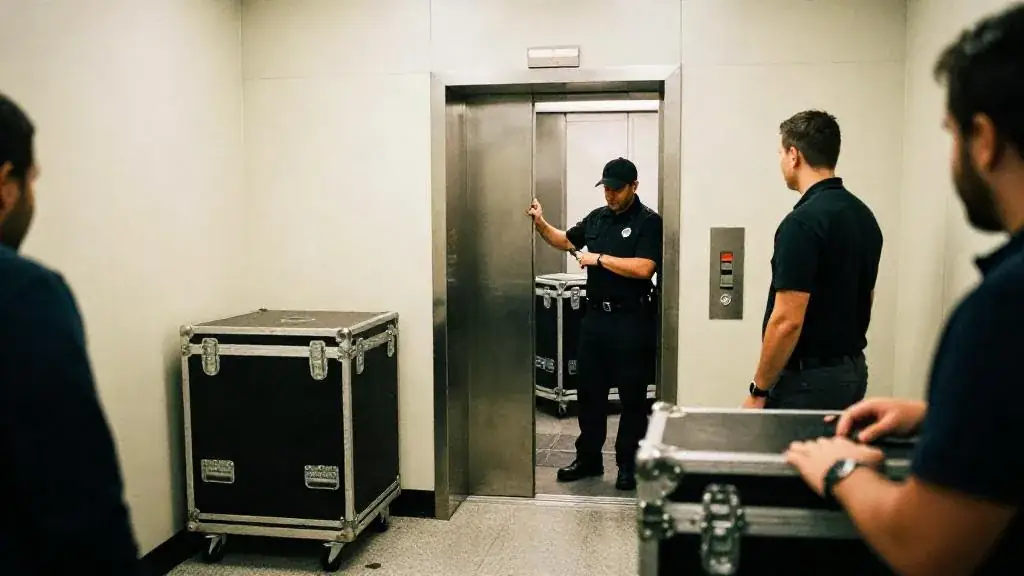
Every venue has a route from the street to the room, and the narrowest point on that route sets the rules.
In downtown hotels it is usually the loading dock and the freight elevator.
In Ontario and the GTA.
Downtown Toronto hotels and convention spaces commonly book docks in fixed slots, and some require a certificate of insurance (COI) from each vendor before they are allowed in.
Street loading on a weekday can mean ticketing or towing, so ask the venue where vans park after unloading.
How to handle it.
Ask the venue for the dock location, window, elevator size and weight limit, and any union rules.
Send those details to every vendor with their assigned slot.
More detail, examples and common mistakes are on this page, below the video.
How it works in practice
Every venue has a route from the street to the room, and the narrowest point on that route sets the rules. In downtown hotels it is usually the loading dock and the freight elevator. In lofts and heritage buildings it can be a single passenger elevator, a flight of stairs or a laneway with no parking. The venue assigns dock windows, and AV, florals, rentals, the band and the caterer may all be sharing the same two hours.
Load-in drives start times. If the dock opens at 08:00 and the truss and LED wall take five hours to build, nothing else goes into the room until early afternoon. Some venues use union crews for any handling inside the building, which adds labour minimums and fixed call times.
In Ontario and the GTA
Downtown Toronto hotels and convention spaces commonly book docks in fixed slots, and some require a certificate of insurance (COI) from each vendor before they are allowed in. Street loading on a weekday can mean ticketing or towing, so ask the venue where vans park after unloading. In our experience, lofts in the Distillery District and on King West often have the tightest access, and vendors price that in.

How to handle it
- Ask the venue for the dock location, window, elevator size and weight limit, and any union rules.
- Send those details to every vendor with their assigned slot.
- Collect each vendor’s vehicle size, crew count and longest item. A 4.9 m piece of truss does not fit in every elevator.
- Stagger arrivals in the production schedule, heaviest and overhead work first.
- Put a person at the dock with the schedule for the first two hours.
Questions to ask
- Is the freight elevator shared with another function that day?
- Does the venue require a COI before load-in, and naming whom?
- Is there an early access fee if set-up starts before the contracted time?
- Where do empty cases go during the event?
Related tools
The venue tour checklist covers dock and elevator questions, and the performer tech rider template asks acts for load-in needs up front.
Why it matters
Dock windows, elevator sizes and union rules decide what time your event can start.
Example
A 2-hour dock window at a downtown hotel shared by AV, florals and the band.
Common mistakes
- Not booking the dock
- Union venues: unplanned drayage charges
Related guides, venues and vendors

Backdrop
Production & AV
A decorative or branded wall behind a stage, ceremony or photo moment.
Read more
Strike
Production & AV
The dismantling and removal of everything after an event, by the venue curfew.
Read more
Hora
Weddings & Cultural
The circle dance at Jewish weddings in which the couple is lifted on chairs.
Read more