Aluminium lattice sections that carry lighting, sound or scenery, ground-supported or flown.
Read the transcript
Truss.
Aluminium lattice sections that carry lighting, sound or scenery, ground-supported or flown.
How it works in practice.
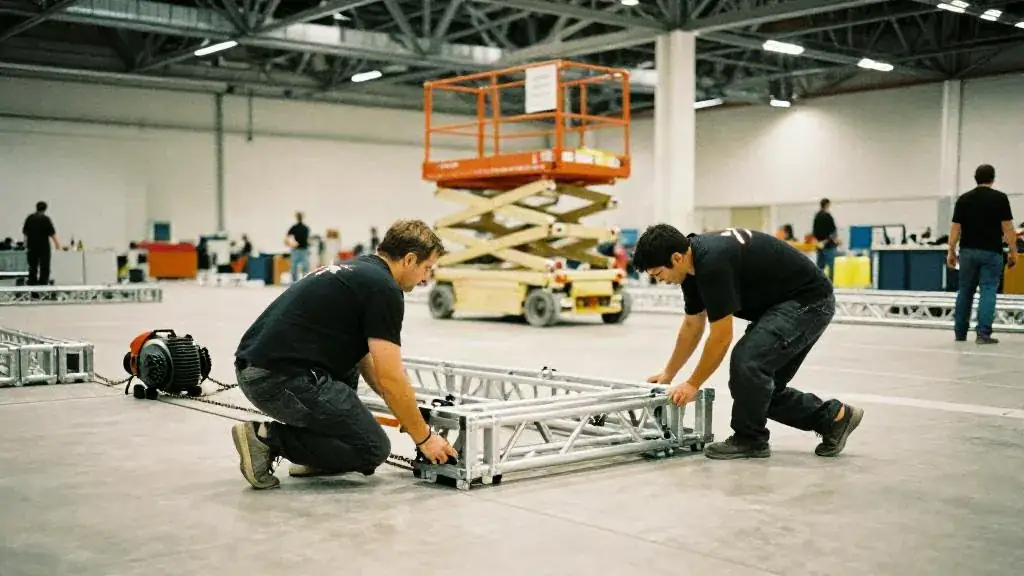
Truss comes in straight sections, corners and junction blocks that bolt or pin together.
Common profiles are square box truss in roughly 30 cm and 40 cm sizes, and flatter ladder truss for light loads.
How to handle it.
Decide what the truss has to carry: lights, speakers, an LED wall, a backdrop, or a performer.
Ask the production company to confirm in writing that the structure is rated for that load and span.
In Ontario and the GTA.
Outdoors, wind is the main concern.
Ground-supported truss with banners or screens acts like a sail, so the supplier should give you a wind limit and a plan for what happens when it is reached.
More detail, examples and common mistakes are on this page, below the video.
How it works in practice
Truss comes in straight sections, corners and junction blocks that bolt or pin together. Common profiles are square box truss in roughly 30 cm and 40 cm sizes, and flatter ladder truss for light loads. Each manufacturer publishes a load table that says how much the truss can carry over a given span. The production company works from that table, not from guesswork.
There are two ways to support it. Ground-supported truss stands on its own: towers with base plates, outriggers and ballast hold up a horizontal span, the classic goalpost over a stage. Flown truss hangs from rigging points on chain motors and can be raised after equipment is attached. Ground support is what you use in rooms, tents and outdoor sites without ceiling points.
How to handle it
- Decide what the truss has to carry: lights, speakers, an LED wall, a backdrop, or a performer.
- Ask the production company to confirm in writing that the structure is rated for that load and span.
- Never hang an aerial performer from ground-supported truss unless the system is specifically designed and engineered for the dynamic load of an act. See rigging.
- Check the ceiling height and doorways. Truss and towers arrive in sections, but they still need a route in.
- Allow build time in load-in, and the same for strike at the end of the night.
- Keep towers, ballast and outriggers out of aisles and egress routes.
In Ontario and the GTA
Outdoors, wind is the main concern. Ground-supported truss with banners or screens acts like a sail, so the supplier should give you a wind limit and a plan for what happens when it is reached. If the truss sits inside a tent, the tent itself is a separate matter: in Ontario, tents over 60 m² aggregate need a building permit, and tents of 225 m² or more need an engineer’s review of the structure and anchoring.
Questions to ask
- What is the maximum load on this span, and what are we putting on it?
- Who inspects the build before guests are allowed in the room?
- What is the wind limit outdoors, and who makes the call to lower or clear it?
- How long are build and strike, and how many crew?
Related tools
Put build, inspection and strike times in the production schedule, and record wind and structure risks in the risk register template.
Why it matters
Ground-supported truss creates a stage look and rigging options in rooms without ceiling points.
Example
A 6 m goalpost truss with moving lights over a corporate stage.
Common mistakes
- Under-rating the truss for the load
- Blocking egress with truss bases
Related guides, venues and vendors

Mehndi
Weddings & Cultural
A pre-wedding gathering where henna is applied to the bride and guests, typically with music and food.
Read more
Dance floor sizing
Venue & Layout
Rule of thumb: about 0.4 m² (4 sq ft) for each guest dancing at the same time, and usually only a third…
Read more
Force majeure
Business & Legal
A clause that excuses performance when extraordinary events outside either party's control (storms, strikes, public-health orders) make the event impossible.
Read more