The minimum food and beverage spend a venue requires, often in place of a rental fee.
Read the transcript
food and beverage minimum.
The minimum food and beverage spend a venue requires, often in place of a rental fee.
How it works in practice.
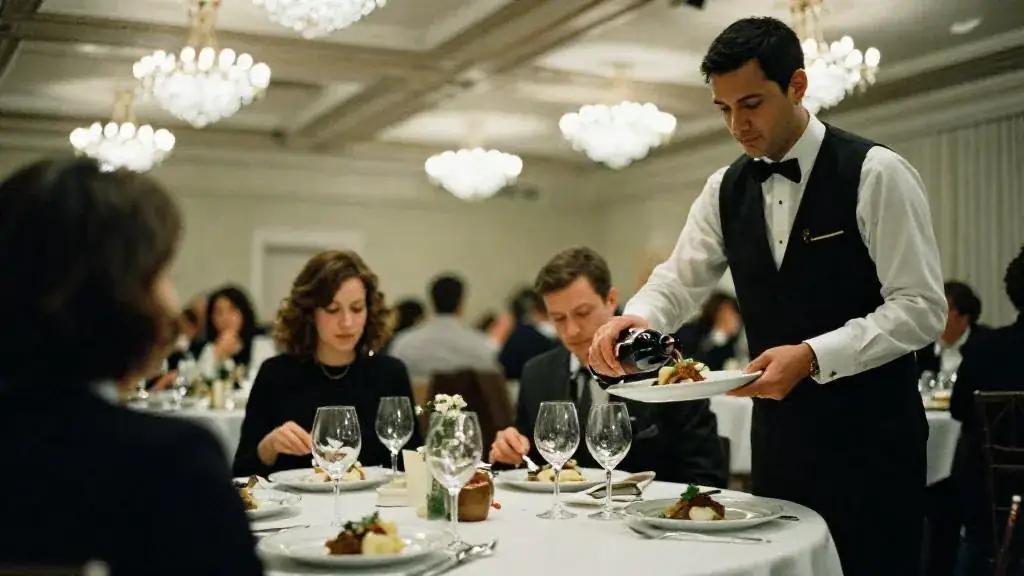
A food and beverage minimum is the least you must spend on catering and bar for the venue to give you the room.
If you spend less, you pay the difference anyway, usually listed as a "room charge" or "shortfall".
Worked numbers.
A hotel quotes an 18,000 dollars food and beverage minimum for a Thursday gala.
So the realistic cost of that room is about 24,000 dollars before AV, décor and entertainment, roughly a third more than the headline number.
How to handle it.
Divide the minimum by your realistic guest count. If the result is far above the venue's per-plate pricing, the room is too big or the night too popular for your group.
Ask which charges count toward the minimum, and get it in writing.
More detail, examples and common mistakes are on this page, below the video.
How it works in practice
A food and beverage minimum is the least you must spend on catering and bar for the venue to give you the room. If you spend less, you pay the difference anyway, usually listed as a “room charge” or “shortfall”. Restaurants, private dining rooms and hotels in Toronto use minimums far more often than flat rental fees, especially for Friday and Saturday nights in high season.
The trap is what counts toward the minimum. Food and drink usually do. Service charge, HST, AV, room rental, coat check, security and corkage usually do not. That means the minimum is the floor of your bill, not the bill.
Worked numbers
A hotel quotes an $18,000 F&B minimum for a Thursday gala.
| Line | Amount |
|---|---|
| F&B minimum | $18,000 |
| 18% service charge | $3,240 |
| Subtotal | $21,240 |
| 13% HST on subtotal | $2,761 |
| All-in | about $24,000 |
So the realistic cost of that room is about $24,000 before AV, décor and entertainment, roughly a third more than the headline number.
How to handle it
- Divide the minimum by your realistic guest count. If the result is far above the venue’s per-plate pricing, the room is too big or the night too popular for your group.
- Ask which charges count toward the minimum, and get it in writing.
- If you are under, upgrade what guests notice (a better wine, a late snack, an extra pass-around) rather than paying a shortfall for nothing.
- Negotiate: a lower minimum on a Thursday or Sunday, or the minimum spread across a reception and a dinner.
- Recheck the maths when you set the guarantee. A drop in numbers can push you below the minimum.
In Ontario and the GTA
Typical GTA ranges in 2026 run $65–$120 per plate at banquet halls and $95–$180 per plate at downtown hotels, before tax and service. A minimum that implies more than that per head is a signal to negotiate or look elsewhere.

Related tools
Run the all-in figure through the event budget calculator, and use the venue matchmaker to find rooms whose minimums suit your headcount.
Why it matters
It is the real price of the room. Check whether it includes HST and gratuity.
Example
A King West restaurant waives the $3,000 room fee against a $12,000 F&B minimum, before tax and 18% gratuity.
Common mistakes
- Comparing a minimum that excludes tax against one that includes it
- Forgetting that the minimum must be met even if guests drop
Related guides, venues and vendors
COI (Certificate of Insurance)
Business & Legal
A document from an insurer confirming a vendor holds liability coverage at stated limits for a date.
Read more
Ketubah
Weddings & Cultural
The Jewish marriage contract, signed before the ceremony.
Read more
Standing capacity
Venue & Layout
The number of guests a room holds for a reception without seating, about 0.6 m² per person.
Read more