The circle dance at Jewish weddings in which the couple is lifted on chairs.
Read the transcript
Hora.
The circle dance at Jewish weddings in which the couple is lifted on chairs.
How it works in practice.
The hora is a high-energy circle dance, and at most Jewish weddings it is the first big dance set, often right after the couple enters the reception.
Guests form concentric circles, the music builds, and the couple (and often parents) are lifted on chairs.
How to handle it.
Agree with the couple when the hora happens and how long it should last.
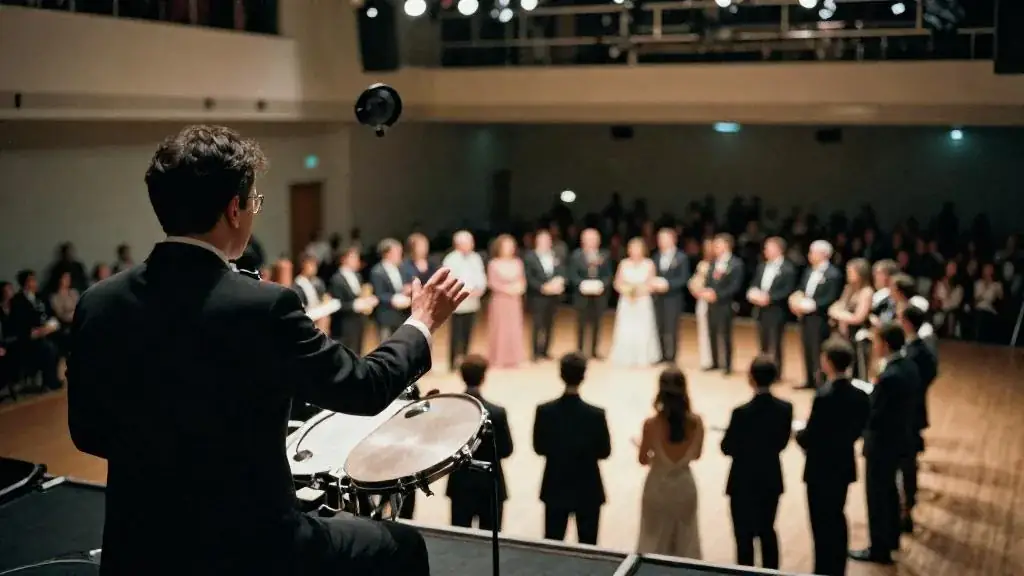
Brief the band or DJ on the cue and the songs, and the signal for ending.
In Ontario and the GTA.
Many Toronto and Thornhill venues see horas often and know the drill, but a first-time venue may not.
Mention it at the walk-through.
More detail, examples and common mistakes are on this page, below the video.
How it works in practice
The hora is a high-energy circle dance, and at most Jewish weddings it is the first big dance set, often right after the couple enters the reception. Guests form concentric circles, the music builds, and the couple (and often parents) are lifted on chairs. It can run anywhere from a few minutes to well over ten, depending on the crowd and the band.
Planning for it is about three things: the music cue, the floor and the lifting. The band or DJ needs to know exactly when it starts and roughly how long to play. The floor must be clear of tables, décor and cables. And the chair lift must be done safely.
How to handle it
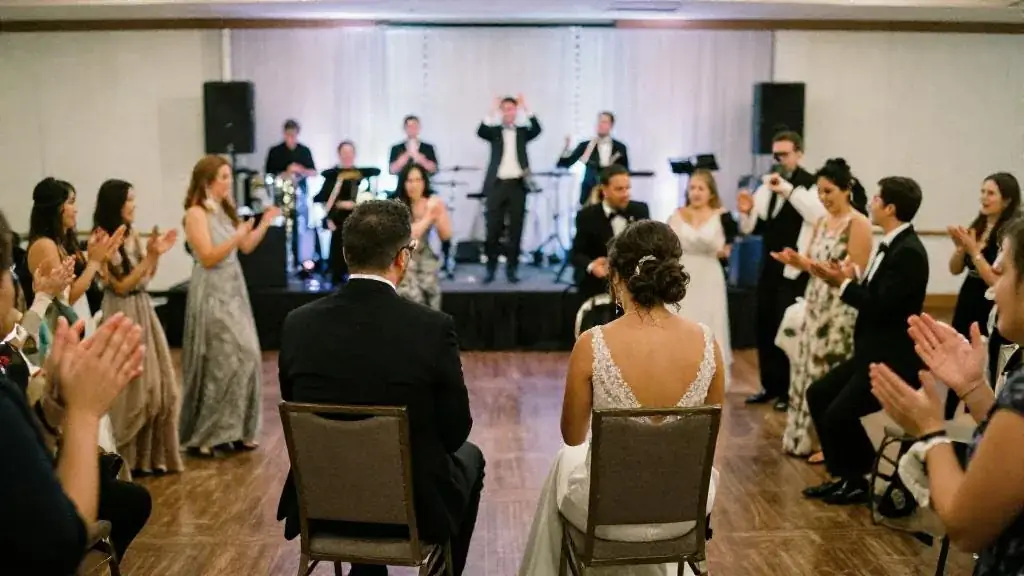
- Agree with the couple when the hora happens and how long it should last.
- Brief the band or DJ on the cue and the songs, and the signal for ending.
- Choose sturdy chairs with arms, or the venue chairs that hold weight best. Lightweight folding or chiavari chairs are a poor choice for lifting.
- Ask four to six strong, sober guests in advance to be lifters for each chair, and brief them.
- Keep the floor clear and dry; have staff hold drinks service away from the edge.
- Position the photographer and videographer, ideally with one on a step or riser for an overhead angle.
- Plan the transition out of the hora, usually into dinner service or the next dance set.
In Ontario and the GTA
Many Toronto and Thornhill venues see horas often and know the drill, but a first-time venue may not. Mention it at the walk-through. Size the dance floor for it: the rule of thumb of about 0.4 m² per guest assumes a third to half are dancing at once, and a hora often pulls more than half the room onto the floor. If the floor is tight, open the circle into the space around it, keeping exits and service paths clear.
Questions to ask
- Which family members expect to be lifted?
- Does the band play the set live, or will the DJ run it?
- Is the dance floor big enough for two circles?
- Are there any guests who should be kept clear of the floor during the dance for mobility reasons?
See also dance floor sizing and chuppah.
Why it matters
Needs a strong band or DJ cue, a cleared floor and sturdy chairs; it usually happens right after the entrance.
Example
A 12-minute hora set immediately after the couple's grand entrance.
Common mistakes
- Flimsy chairs
- A dance floor too small for a circle
Related guides, venues and vendors
Indemnity
Business & Legal
A promise by one party to cover the other's losses in defined situations.
Read more
Attrition
Business & Legal
A contract clause charging you if you use fewer hotel rooms or catering covers than you committed to.
Read more
Money dance
Weddings & Cultural
A tradition in Filipino, Polish, Greek and other weddings where guests pin or give money while dancing with the couple.
Read more