Social, wedding, cultural, corporate and public events share one process but differ in who decides, who pays and what success means. Knowing the type tells you where the risk sits.
Read the transcript
Types of events and who plans them.
Social, wedding, cultural, corporate and public events share one process but differ in who decides, who pays and what success means.
Knowing the type tells you where the risk sits.
Five families, five different jobs.
Every event you will ever plan belongs to one of five families, and the family tells you who decides, who pays, and what "it worked" means.
Get that wrong and you will build the right event for the wrong person.
Why the family decides the risk.
Risk sits in different places in each family.
In a wedding the risk is interpersonal: two families, one seating chart.
How to classify an event in two minutes.
You do not need a long meeting to place an event in its family.
Ask three questions in order and the answers do the sorting for you.
Questions to ask the client at the first meeting.
Who signs the contract, and who signs the cheque? Are they the same person?
Is there anyone not yet in the room who will have an opinion on the venue or the food?
GTA practice notes by family.
Weddings and cultural events.
In Toronto and Peel a large share of weddings involve two or three days of events: a mehndi or sangeet, a religious ceremony, a reception.
That is the lesson. The worksheet and the quiz are just below this video.
What you will be able to do
- Classify any event into one of five families
- Identify the decision-maker and the payer for each family
- Name the success measure each family uses
Five families, five different jobs
Every event you will ever plan belongs to one of five families, and the family tells you who decides, who pays, and what “it worked” means. Get that wrong and you will build the right event for the wrong person.
| Family | Who decides | Who pays | Success measure |
|---|---|---|---|
| Social and family (birthdays, showers, reunions) | The host, often with one strong-willed relative | The host | Did the guest of honour feel celebrated; did nobody complain about the food |
| Weddings | The couple, two families, sometimes a cultural authority | Couple and families, usually split | Ceremony went as planned; photos; guests stayed to the end |
| Cultural and religious | Family elders and the officiant or community | Family | Rituals performed correctly and on time; the community fed |
| Corporate | A marketing, HR or executive sponsor; procurement sets the rules | The company, from a budget line someone must defend | Attendance, survey scores, leads, retention, and whether the sponsor looked good |
| Public and community | A committee, a board or a municipality | Tickets, sponsors, grants and the public purse | Ticket revenue or attendance, safety, media coverage, net proceeds |
Why the family decides the risk
Risk sits in different places in each family. In a wedding the risk is interpersonal: two families, one seating chart. In a corporate event it is reputational and financial: a sponsor who looks foolish in front of the executive team does not book you twice. In a public event the risk is physical: crowd density, weather, alcohol in a park. Social events carry the smallest financial risk and the largest emotional one.
So when a client says “it is just a party”, ask which family it belongs to. A 50th birthday for the founder of a company, attended by clients, is a corporate event wearing a social costume.
How to classify an event in two minutes
You do not need a long meeting to place an event in its family. Ask three questions in order and the answers do the sorting for you.

- Whose money is it? Personal savings point to social or wedding. A company budget line points to corporate even if the occasion is a birthday. Ticket sales, grants or a charity’s revenue point to public and community.
- Who can veto a decision? If one person can say no and nobody can overrule them, you have a host. If a committee or a board must vote, you have a public event with a longer approval cycle, and your timeline needs to allow for their meeting schedule.
- What would the client call a failure? “My mother was upset” is social. “The CFO asked why we spent that much” is corporate. “Somebody got hurt” or “we lost money” is public.
Write the family at the top of the brief. When the client later asks for something that belongs to another family, the mismatch is the warning sign.
Questions to ask the client at the first meeting
- Who signs the contract, and who signs the cheque? Are they the same person?
- Is there anyone not yet in the room who will have an opinion on the venue or the food?
- What happened at the last one of these, and who was unhappy afterward?
- Are there cultural or religious requirements, and who is the authority on them?
- Will anyone outside the organization attend: clients, donors, press, the public?
- Is alcohol expected, and is the venue licensed, or will we need a Special Occasion Permit?
GTA practice notes by family
Weddings and cultural events. In Toronto and Peel a large share of weddings involve two or three days of events: a mehndi or sangeet, a religious ceremony, a reception. Each day may have its own venue, caterer and dress code. Ask for the full sequence in the first meeting, not just “the wedding”.

Corporate. Expect procurement paperwork: vendor registration, a certificate of insurance request, sometimes a purchase order before any deposit. Remember the CRA rule for staff social events: non-taxable only if open to all employees and no more than $150 per person including taxes; over that, the whole amount is taxable. Flag it early.
Public and community. Alcohol at a public event needs an AGCO Special Occasion Permit applied for at least 30 days ahead, plus a municipal significance resolution; private events need at least 10 days. Toronto park permits for summer weekends fill months ahead. Raffles need a lottery licence (municipal under $50,000 in prizes, AGCO over), and only charitable or religious organizations qualify.
Worked example: the Harbour Gala
Our running example is a 200-guest fundraising dinner for a hospital foundation, in a downtown Toronto hotel ballroom, with a $25,000 production budget. Which family? It is public and community (a registered charity, tickets sold, a cause) but it behaves like a corporate gala (a committee, sponsors, a program with speeches). The success measure is net proceeds and whether donors stayed for the ask. That single decision tells us where the money should go: the program, not the centrepieces.
Run it through the three questions. Whose money: the foundation’s, so every dollar spent is a dollar not given to the hospital. Who can veto: a committee that meets monthly and reports to a board, so a decision missed in October waits until November. What is failure: a night that netted less than last year. Those answers explain why we later protect the mentalist set and let the tall florals go.
Numbers to remember
- In our experience, weddings are the largest planning market in the GTA by spend; corporate events are the largest by number of bookings for entertainers and venues.
- Public events with 5,000 or more people a day trigger longer permit notice periods in Ontario (60 days instead of 30 for a liquor permit).
- Corporate staff events: CRA non-taxable limit $150 per person all-in, six events a year.
Common mistakes
- Treating a corporate client’s executive assistant as the decision-maker when the sponsor is a vice-president you have never met. Fix: ask “who else needs to say yes” at the first meeting and get fifteen minutes with that person before you write the proposal.
- Measuring a fundraiser by how beautiful the room was instead of what it netted. Fix: write the net target on the first page of the brief and test every spend against it.
- Planning a cultural wedding from a generic wedding timeline, missing the second and third days of events. Fix: ask for every event in the sequence, with its own venue, headcount and dress code, before you quote.
- Letting a public committee treat you as the decision-maker. Fix: put their meeting dates on the master timeline and present decisions as options.
Checklist
- Family named at the top of the brief.
- Decision-maker and payer identified by name.
- Success measure written as something you can count.
- Permits or tax rules the family triggers listed for the planning phase.
Worksheet
Download the worksheet, complete it for your own event (or the running gala example), and keep it in your course binder. It takes about 10 minutes.

Check your understanding
Related guides, venues and vendors

Tools of the trade
Module 1: Foundations · 15 min
A planner needs a budget spreadsheet, a timeline, a run of show, a vendor contact sheet, a floor plan tool and a…
Read more
The discovery meeting
Module 2: Discovery & Concept · 15 min
Forty-five minutes with a client decides the next six months. Learn the question order that surfaces the real goal, the real budget…
Read more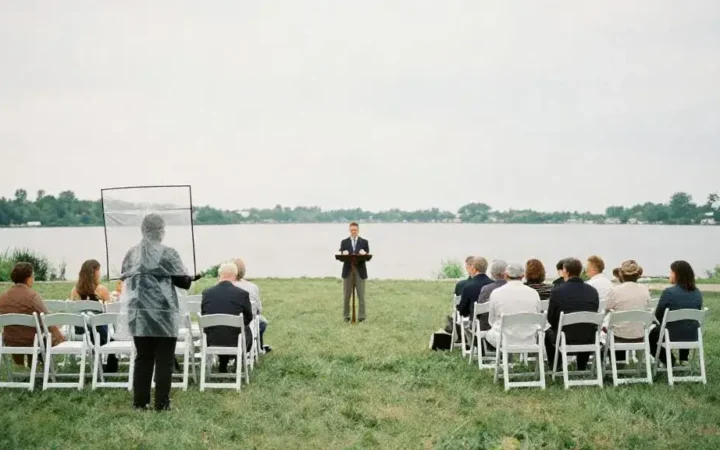
Ceremony logistics and the marriage licence
Specialist · Weddings · 15 min
Ontario licence rules, officiants, ceremony order, processional and recessional, rain plans.
Read more