For décor and rental companies, the truck, the crew and the late-night strike can quietly eat the profit on every order. Learn to set delivery zones and order minimums from real costs, publish them clearly, and send quotes that are complete, honest and quick to say yes to.
Read the transcript
Delivery zones, minimums and quoting.
A 400 dollars order delivered to a downtown hotel at 7 a.m. and collected at 1 a.m. can cost more to fulfil than it earns.
Many décor and rental companies discover this only at tax time.
What delivery really costs.
Start with an hourly cost for a delivery run: the truck and the crew it needs.
Use your own numbers.
Setting zones from drive time.
Draw zones by drive time from your warehouse, not by distance or city boundary.
Twenty kilometres across the city at rush hour can take longer than fifty on an open highway.
Minimums that protect your margin.
Every order carries handling costs that do not change much with size: quoting, pulling stock, checking it out, cleaning it and checking it back in.
Put a number on it and set a minimum.
The surcharges people forget.
Write down every circumstance that adds real cost and decide how you will price it: early delivery before 7 a.m., strike after 11 p.m., stairs or no elevator, long carries from the truck, timed load-in windows that leave the crew waiting, and same-day turnarounds at hotels.
Decide which are optional add-ons the client chooses and which depend on the venue.
Explaining fees without apologizing.
Clients rarely object to a fee they understand.
They object to one that appears without explanation.
That is the lesson. The worksheet and the quiz are just below this video.
What you will be able to do
- Calculate delivery zone fees and an order minimum from your real truck, crew and handling costs
- Publish delivery terms that meet Canada's all-in pricing rules and set clear expectations
- Build a quote template that answers the client's questions before they ask
A $400 order delivered to a downtown hotel at 7 a.m. and collected at 1 a.m. can cost more to fulfil than it earns. Many décor and rental companies discover this only at tax time. Delivery zones, minimums and a disciplined quote are not paperwork. They are marketing decisions that decide which clients you attract and whether each booking makes money.
What delivery really costs
Start with an hourly cost for a delivery run: the truck and the crew it needs. Use your own numbers. An illustrative example for a small company with one cube truck and a two-person crew:

- Truck lease, insurance, maintenance and fuel, spread across working hours: about $45 an hour.
- Two crew members at $28 an hour, plus about 15 percent for payroll costs: about $64 an hour.
- Total: about $110 for every hour the truck and crew are out.
Every order needs two trips, one to deliver and one to collect, and each trip includes driving both ways plus loading and unloading time. With that, you can cost any delivery.
Setting zones from drive time
Draw zones by drive time from your warehouse, not by distance or city boundary. Twenty kilometres across the city at rush hour can take longer than fifty on an open highway. A worked example for Thistle & Trestle, the illustrative Burlington company, using $110 an hour and 30 minutes of handling at each end of each trip:
| Zone | One-way drive | Hours per trip | Hours for delivery and pickup | Cost at $110 an hour | Published fee |
|---|---|---|---|---|---|
| 1 | Up to 30 minutes | 2.0 | 4.0 | $440 | $450 |
| 2 | 30 to 60 minutes | 3.0 | 6.0 | $660 | $675 |
| 3 | 60 to 90 minutes | 4.0 | 8.0 | $880 | $895 |
| Beyond | Over 90 minutes | Varies | Varies | Quoted individually | On request |
Hours per trip are the round-trip drive plus one hour of handling. In Zone 1, that is one hour of driving and one of handling, so two hours a trip and four for the pair.
These fees look high because the costs are real. You can bring them down honestly by planning routes so that one run serves several orders, by offering warehouse pickup, and by setting up and collecting several orders at the same venue on the same day. If you routinely combine two Zone 1 drops per run, your actual cost per order nearly halves, and you can publish a lower fee with confidence.
Minimums that protect your margin
Every order carries handling costs that do not change much with size: quoting, pulling stock, checking it out, cleaning it and checking it back in. Put a number on it and set a minimum.
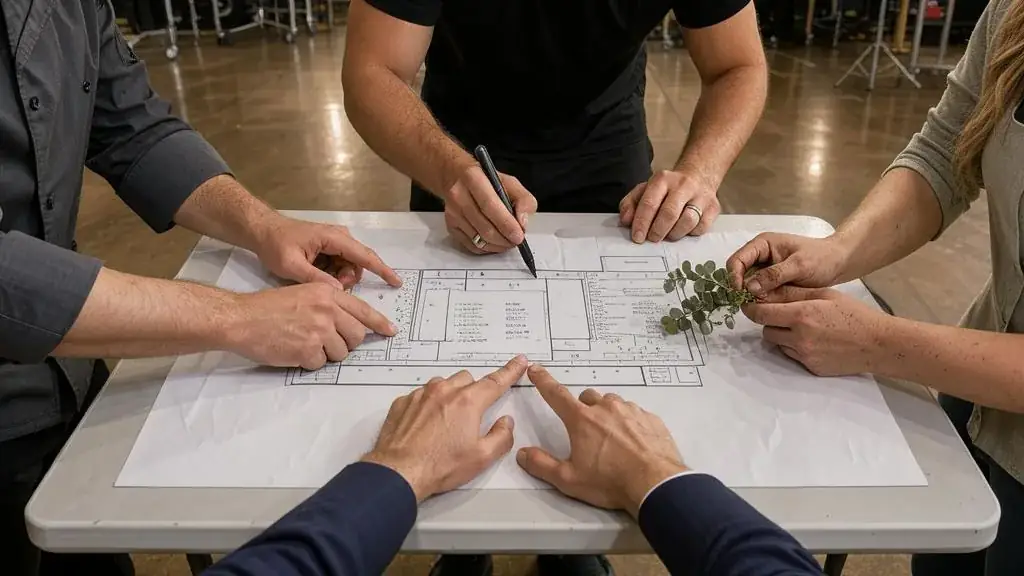
An illustrative calculation: processing an order takes about 2.5 hours of warehouse time at $32 an hour, or $80, plus $40 of cleaning and laundry, for $120. If your rentals carry a 60 percent gross margin and you want each order to contribute at least $180 after handling, the order must produce $300 of margin. Divide by 0.6 and the minimum order is $500 before delivery and tax.
Use different minimums for different services:
- Warehouse pickup: a lower minimum, because there is no truck.
- Delivery: the full minimum, plus the zone fee.
- Peak dates: a higher minimum on Saturdays from June to October and in December, when your truck is your scarcest asset.
Publish minimums on the website and in the catalogue. A clear minimum is a kindness: it tells a client with a $150 budget to look elsewhere before either of you spends time on a quote.
The surcharges people forget
Write down every circumstance that adds real cost and decide how you will price it: early delivery before 7 a.m., strike after 11 p.m., stairs or no elevator, long carries from the truck, timed load-in windows that leave the crew waiting, and same-day turnarounds at hotels. Decide which are optional add-ons the client chooses and which depend on the venue. Either way, name them in your published terms, so the client knows they exist before they see a quote.
Explaining fees without apologizing
Clients rarely object to a fee they understand. They object to one that appears without explanation. When a client asks why delivery costs $675, answer with the work, not with an apology. A script you can adapt:
“Good question. Your venue is in our second zone, about 45 minutes each way. The fee covers a truck and two trained crew for the delivery and again for the late-night pickup, including loading, unloading and checking every piece back in. If it helps your budget, you are welcome to collect from our warehouse in Burlington, and the fee disappears.”
Three things make that script work. It gives the reason in one breath, it offers a genuine alternative, and it never hints that the fee is negotiable when it is not. If you do want to discount, discount the items, not the truck. A client who learns that delivery fees can be talked down will ask every time, and so will everyone they refer.
A quote template that sells
A quote is often the first document a client shows to their partner, their manager or their planner. Make it complete enough that nobody has to write back with questions. A template you can copy:
- Header: client name, event date, venue address and room, guest count, your business name, mailing address, contact details and HST number.
- Items: each item with a small photo, quantity, unit price and line total, grouped by event zone.
- Services: delivery zone fee, set-up and strike labour if chosen, and any venue-specific surcharge, each with a one-line explanation.
- Total: subtotal, HST at 13 percent, and the total the client will pay.
- Timing: delivery window, pickup window and what the client or venue must have ready.
- Terms: how long the quote is valid, that items are reserved only once the deposit is paid, the deposit and balance dates, the damage and loss policy, and the cancellation terms.
- Next step: one sentence that tells the client exactly how to book.
Send quotes quickly. In a busy season, a complete quote sent within one business day wins more often than a cheaper one sent next week. Follow up once after three days and again before the quote expires.
In Canada and the GTA
Published delivery terms and drip pricing. Since June 23, 2022, the Competition Act has treated drip pricing as a false or misleading representation. Advertising a price that cannot be attained because of fixed obligatory charges or fees is drip pricing, unless the extra charges are only amounts imposed by law, such as HST. For a rental company, a mandatory fee that every order must pay, such as a booking, handling, cleaning or damage waiver fee, belongs inside the item prices you advertise. Delivery is different when clients can choose warehouse pickup, because it is then optional. If you deliver only, say so prominently beside your prices and show the zone fees on the same page. The Competition Bureau says consumers should see the true total cost upfront, without scrolling or reading fine print, and that variable charges can also raise concerns, so a published zone table is far safer than “delivery fees apply”. Read the Bureau’s guidance on drip pricing.

Estimates for labour. Set-up and strike labour is often quoted as an estimate because venues change load-in times. Ontario’s guidance under the Consumer Protection Act, 2002, which applies until the 2023 Act is proclaimed, says you cannot bill a consumer more than 10 percent above an estimated price unless the consumer agrees in writing to the extra charges. If a venue delays your crew for two hours, get the client’s written agreement to the overtime before you invoice it. Corporate clients are not consumers under that Act, but they will expect the same discipline in a purchase order.
Future performance and clear terms. Rental bookings paid now and delivered later are generally future performance agreements. If delivery is more than 30 calendar days after the agreed date, the consumer may cancel and get a refund. Any uncertainty in a consumer agreement is interpreted in the consumer’s favour, so write delivery and pickup windows, damage terms and what happens to a deposit in plain words. Ontario’s business guide to consumer protection explains the key concepts. This is general information, not legal advice.
HST on the quote. Ontario’s HST rate is 13%. Show either the HST amount separately or a statement that the total includes HST, using the total rate rather than federal and provincial parts. For invoices of $500 or more, include your registration number, the client’s name, a brief description and the payment terms.
Your service area on Google. If clients do not visit your warehouse, Google Business Profile treats you as a service-area business: hide the address and set a service area, which should not extend farther than about two hours of driving time from your base. Matching your Google service area to your published delivery zones keeps your marketing consistent.
Delivering in the GTA
GTA logistics change your costs more than distance does. Highway 401 and the Gardiner Expressway can double a drive time at rush hour, and Highway 407 is a toll road, so either price tolls into Zone 2 and 3 fees or plan routes around them. Downtown Toronto hotels and convention venues usually have dock schedules and may require a booked time slot, and some work with unionized labour that limits what your crew can do inside. Condo party rooms often require a booked service elevator and a certificate of insurance. Strike at many venues must finish by a set time after midnight, so a 1 a.m. pickup is normal and should be priced. Winter adds snow, salt and slower loading from November to March. Ask every venue for its load-in rules when you quote, not the week before, and put them on the quote so the client understands what they are paying for.
Worksheet
Download the worksheet and complete it for your own business, using Lantern & Lane as the model where it helps. Keep it with your marketing plan. It takes about 10 minutes.

Check your understanding
Related guides, venues and vendors

F&B minimum
Business & Legal
The minimum food and beverage spend a venue requires, often in place of a rental fee.
Read more
Venue contracts and minimums
Module 4: Venues · 15 min
Minimum spend, attrition, cancellation schedules, exclusivity, insurance, overtime and force majeure. Clause by clause, with the red flags.
Read more
Wedding planners: shows, listing platforms and the inquiry season
Specialist Track: Marketing for Event Planners · 20 min
Wedding planning inquiries arrive in a predictable wave after the winter engagement season, and the planners who are ready for it book…
Read more