Minimum spend, attrition, cancellation schedules, exclusivity, insurance, overtime and force majeure. Clause by clause, with the red flags.
Read the transcript
Venue contracts and minimums.
Minimum spend, attrition, cancellation schedules, exclusivity, insurance, overtime and force majeure.
Clause by clause, with the red flags.
Read the contract before you love the room.
A venue contract is where a 25,000 dollars event becomes a 31,000 dollars event.
The room may be perfect; the paper decides what you pay when numbers drop, when the program runs long and when someone cancels.
Clause by clause.
The five red flags.
A minimum that quietly includes room rental. If the room rental counts toward the food and beverage minimum, say so in writing.
Attrition with no allowance. "Guest count guaranteed at signing" means you pay for 200 plates in November based on a guess in June.
Negotiating the cancellation schedule.
Venues negotiate cancellation terms more readily than price, because they expect never to use them.
Propose a schedule and show the logic.
Worked example: the Harbour Gala.
The hotel's draft contract set a 18,000 dollars food and beverage minimum, which is the figure every planner should expand before the client sees it: 18,000 dollars by 1.18 service charge = 21,240 dollars; times 1.13 HST = 24,001. dollars
Call it 24,000 dollars all-in.
That is the lesson. The worksheet and the quiz are just below this video.
What you will be able to do
- Read a venue contract clause by clause
- Spot the five red flags
- Negotiate the cancellation schedule
Read the contract before you love the room
A venue contract is where a $25,000 event becomes a $31,000 event. The room may be perfect; the paper decides what you pay when numbers drop, when the program runs long and when someone cancels. Read every clause with a pen and a calculator, and do it before the client signs, not after the deposit clears.

Venue contracts in the GTA follow a pattern. Hotels use long, standardized agreements; banquet halls and lofts use short ones that leave more unsaid. Short is not better. What is unsaid is decided by the venue.
Clause by clause
| Clause | What it does | What to ask for |
|---|---|---|
| Minimum spend (F&B minimum) | You pay at least this on food and beverage whether or not you consume it. Quoted before service charge and HST | Confirm whether the minimum is before or after service charge; ask that room rental be waived or reduced once the minimum is met |
| Attrition | The guaranteed guest count and the allowance below it. Fall further and you pay for empty plates | A guarantee due 72 hours out, an allowance of around 10 percent (typical), and the right to reduce the guarantee once more before the deadline |
| Cancellation schedule | A sliding scale of what you owe if you cancel, by date | Steps that track the venue’s real loss: small until the date is unlikely to resell, rising late. Ask for the right to rebook within twelve months with the deposit credited |
| Deposits and payments | When money moves. Often 25 percent at signing, 50 percent at 90 days, balance at 14 days | Align the schedule with the client’s cash flow and sponsor payment dates |
| Exclusivity | In-house catering, bar, AV, décor, security. Outside suppliers pay a fee or are barred | Written list of what is exclusive and what the fees are for outside suppliers; the right to bring your own entertainment and photographer without fee |
| Insurance and indemnity | You carry liability insurance naming the venue; you indemnify the venue for your guests and vendors | Limits you can actually buy (a one-day $2–5M liability policy runs $150–$400, typical GTA range, 2026); mutual indemnity rather than one-way |
| Overtime and access | Hours included; hourly rate after; load-in and strike windows | Strike included in the hours; overtime quoted per half hour; a written load-in time |
| Force majeure | Who bears the loss when the event cannot happen for reasons outside both parties’ control | A list that includes public health orders, severe weather and labour disruption; refund or credit of deposits rather than forfeit |
| Damage and cleaning | Deposits and charges for damage and excess cleaning | A walk-through at load-in and strike with photographs, signed by both |
The five red flags

- A minimum that quietly includes room rental. If the room rental counts toward the F&B minimum, say so in writing. If it does not, the real minimum is higher than the number on page one.
- Attrition with no allowance. “Guest count guaranteed at signing” means you pay for 200 plates in November based on a guess in June.
- A cancellation schedule with one step. “100 percent of estimated revenue if cancelled within 180 days” is not a schedule; it is a penalty. Ask for four or five steps.
- Force majeure that covers only the venue. Some contracts excuse the venue from performing but still hold you to the minimum. Make it mutual.
- “Prevailing rates” for anything. Overtime, labour, patch fees and parking at “prevailing rates” means whatever the venue charges on the day. Ask for numbers, or at least a current price sheet attached as a schedule.
Negotiating the cancellation schedule
Venues negotiate cancellation terms more readily than price, because they expect never to use them. Propose a schedule and show the logic. For a November gala signed in May, something like: 10 percent of the minimum if cancelled more than 150 days out, 25 percent between 150 and 90 days, 50 percent between 90 and 30, 75 percent inside 30 days, full minimum inside 7 days. Then ask for a rebook clause: if the client rebooks within twelve months, the cancellation fee is credited to the new date. Many hotels will accept this because it keeps the business.
Whatever you agree, ask for the same schedule in reverse: if the venue cancels, it refunds deposits and covers the reasonable extra cost of a comparable room. You will not always get it. Ask anyway.
Worked example: the Harbour Gala
The hotel’s draft contract set a $18,000 food and beverage minimum, which is the figure every planner should expand before the client sees it: $18,000 × 1.18 service charge = $21,240; × 1.13 HST = $24,001. Call it $24,000 all-in. The room rental of $2,500 was waived on meeting the minimum, which we confirmed in writing.
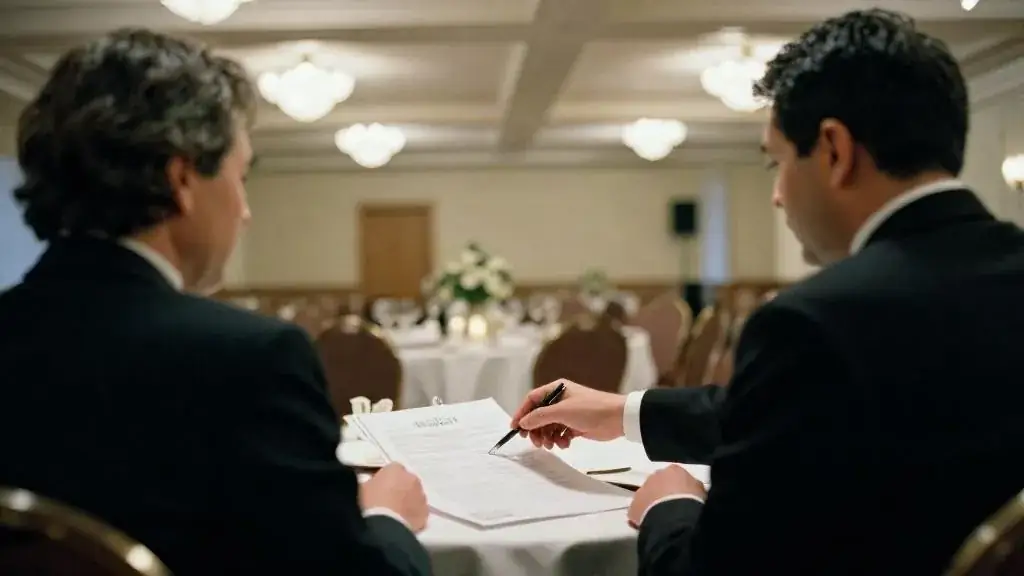
Attrition: the draft guaranteed 200 with no allowance. We negotiated a guarantee due the Monday before the event with a 10 percent allowance, so the foundation can fall to 180 plates without penalty. Sponsors buy tables in the last three weeks, and a hard 200 would have forced the foundation to guess high.
Cancellation: the draft had two steps, 50 percent inside 120 days and 100 percent inside 60. We got five steps on the schedule above plus a twelve-month rebook credit. Exclusivity: in-house catering, bar and AV with a patch fee for outside AV; entertainment and photography free of fees, which we had in writing. Overtime: strike included to 11:30 p.m., then charged per half hour at a stated rate rather than “prevailing”. Force majeure became mutual with deposits credited. Total negotiation time: two emails and one call. Total protected: roughly $4,000 of attrition exposure and most of the deposit in a worst case.
Numbers to remember
- Minimum × 1.18 × 1.13 is the all-in figure for a hotel that adds an 18 percent service charge; the service charge is taxable.
- HST in Ontario is 13 percent, and vendors habitually quote before it.
- Attrition allowance: around 10 percent is typical; ask for the guarantee date as late as the venue will allow.
- One-day liability insurance of $2–5M: $150–$400, typical GTA range, 2026.
Put the contract questions and the final numbers into the event budget sheet the day the contract is signed, so the all-in figure is the one everyone works from.
Worksheet
Download the worksheet, complete it for your own event (or the running gala example), and keep it in your course binder. It takes about 15 minutes.

Check your understanding
Related guides, venues and vendors

Pricing your fee: percentage, flat, hourly
Module 2: Discovery & Concept · 15 min
Ontario planners charge 10–20% of budget, flat packages, or hourly for consulting. Each model changes the client's incentives and yours. Choose deliberately.
Read more
Site planning and crowd management
Specialist · Festivals & Public Events · 15 min
Site maps, egress, density, barriers, security ratios, medical and weather.
Read more
Types of events and who plans them
Module 1: Foundations · 15 min
Social, wedding, cultural, corporate and public events share one process but differ in who decides, who pays and what success means. Knowing…
Read more