Wedding shows, trade shows and networking events put you in front of buyers and partners face to face, but only a planned follow-up turns a conversation into a booking. Learn how to choose the right rooms, run the numbers on a booth, work a conversation and follow up within the rules.
Read the transcript
Networking, trade shows and wedding shows.
A wedding show is a strange marketplace.
Thousands of people walk past you in a day, most of them carrying tote bags full of postcards they will never read.
Choose the right rooms.
Every in-person event costs you a day or an evening, and some cost thousands of dollars.
Pick them by who will be in the room, not by how busy the room will be.
Run the numbers on a booth.
Before you sign a booth contract, estimate what one booking will cost.
Here is a worked example with illustrative numbers for Lantern and Lane at a two-day consumer wedding show.
Design the booth around one conversation.
Visitors decide in about the time it takes to walk past whether to stop.
Make that decision easy.
A conversation script.
The goal of the first minute is to find out whether this person is your client, not to pitch.
Open with a question about them: “When is the big day?” or, at a trade show, “What kind of events does your team run?”
Follow up within 48 hours.
Every vendor at the show collects the same couples' details.
The first thoughtful, personal follow-up usually wins the consultation.
That is the lesson. The worksheet and the quiz are just below this video.
What you will be able to do
- Choose shows and networking events by audience fit and calculate the cost per booking of a booth
- Staff a booth or work a room with a short opening, qualifying questions and a lead capture method
- Run a 48-hour follow-up sequence that respects CASL consent and contest disclosure rules
A wedding show is a strange marketplace. Thousands of people walk past you in a day, most of them carrying tote bags full of postcards they will never read. The vendors who leave with bookings are rarely the ones with the biggest booth. They are the ones who knew who they wanted to meet, had a real conversation with them, and followed up before anyone else did.
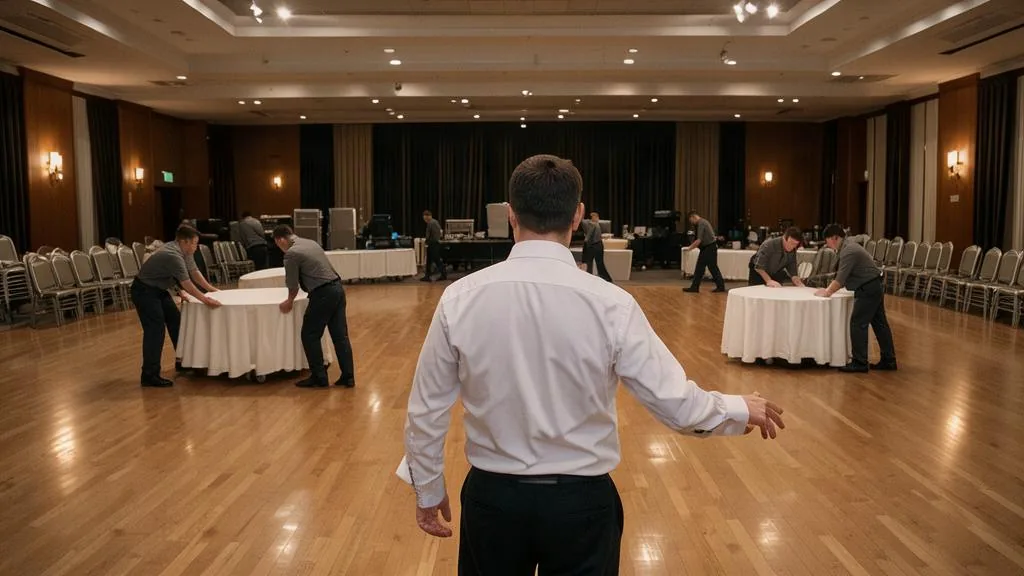
Choose the right rooms
Every in-person event costs you a day or an evening, and some cost thousands of dollars. Pick them by who will be in the room, not by how busy the room will be.
| Room | Who you meet | Typical cost | Best for |
|---|---|---|---|
| Consumer wedding show | Engaged couples and their families, many early in planning | High: booth fee, display, staff, print | Venues, planners, photographers, caterers, DJs, décor, entertainers |
| Industry trade show | Corporate buyers, association planners, other suppliers | High to very high | Corporate planners, AV, production, entertainers, venues |
| Venue open house or vendor night | Couples who already chose the venue, plus coordinators | Low to moderate, sometimes free for preferred vendors | Anyone booked after the venue |
| Chamber of commerce or board of trade mixer | Local business owners, office managers, HR staff | Low: membership and ticket | Corporate event vendors, caterers, entertainers |
| Industry association meeting or styled shoot | Other vendors and planners | Low | Building the referral network from earlier in this module |
A useful rule: a booth at a show is a sales channel, so judge it on bookings. A mixer or association meeting is a network channel, so judge it on the relationships it starts.
Run the numbers on a booth
Before you sign a booth contract, estimate what one booking will cost. Here is a worked example with illustrative numbers for Lantern & Lane at a two-day consumer wedding show.
- Booth fee: $2,400
- Display, printing and a sample tablescape: $700
- Parking, food and incidentals for two days: $150
- Total cash cost: $3,250
Priya and Marco expect to have about 90 real conversations and to capture 60 leads. Last year, 10 percent of show leads booked a consultation and half of those booked, so about 5 percent of leads became clients.
- Expected bookings: 60 leads multiplied by 5 percent equals 3 bookings.
- Cost per booking: $3,250 divided by 3 equals about $1,083.
- Average planning booking: $5,800. Gross margin after direct costs, say 55 percent: $3,190 per booking.
- Gross margin from the show: 3 multiplied by $3,190 equals $9,570, against $3,250 spent.
That looks worthwhile, but there is a hidden cost: two people, two full days, plus a day of set-up and a day of follow-up. At four days of two people’s time, the show has to beat whatever else that time could produce. Run the same sum for your business with your real close rate. If you have never done a show, use a cautious guess, and track the outcome so next year’s estimate is real.
Design the booth around one conversation
Visitors decide in about the time it takes to walk past whether to stop. Make that decision easy.
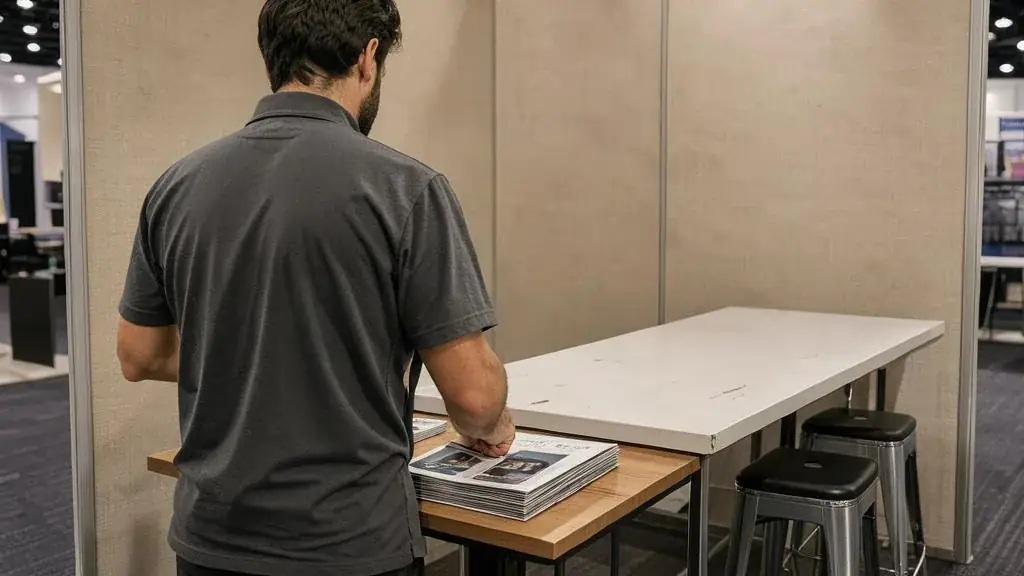
- One clear line. A large, readable statement of who you serve: “Two families, two traditions, one weekend.” Not your logo alone.
- Show the work. A real tablescape, a live demonstration, a photo wall, a tasting. Caterers and entertainers have a natural advantage here.
- Open front. Put the table at the side or back, not as a wall between you and the aisle. Stand, do not sit, and keep phones away.
- A reason to give contact details. A useful planning checklist, a date-availability check, or a consultation booked on the spot.
- Two roles. One person greets and qualifies, the other has the longer conversation. Swap every hour.
A conversation script
The goal of the first minute is to find out whether this person is your client, not to pitch. Copy and adapt.
- Open with a question about them: “When is the big day?” or, at a trade show, “What kind of events does your team run?”
- Qualify gently: “Where are you thinking of celebrating?” and “Roughly how many guests?” These two answers tell you most of what you need.
- Listen for the worry: “What part feels hardest right now?”
- Offer one relevant proof: a photo of a similar event, or a sentence about a client in the same situation.
- Ask for the next step: “Would it help if I checked our availability for your date and sent you a note on Tuesday?”
- Capture and tag: name, email, date, venue, guest count and a one-word temperature: hot, warm or cool.
If the person is clearly not your client, say so kindly and, where you can, point them to a partner who fits. That generosity is noticed by the vendors in neighbouring booths, who become referral partners of their own.
Follow up within 48 hours
Every vendor at the show collects the same couples’ details. The first thoughtful, personal follow-up usually wins the consultation. Here is a sequence to copy.
| When | Hot leads | Warm and cool leads |
|---|---|---|
| Within 48 hours | Personal email or call mentioning your conversation, with the availability you promised | Short personal email recalling the conversation and the checklist you offered |
| Day 7 | Call if no reply, then propose two consultation times | One useful follow-up, such as a sample timeline for their guest count |
| Day 21 | Final friendly note | Invitation to your newsletter, if they have agreed to receive it |
Enter the leads into your CRM the evening of the show, while the conversations are fresh. A stack of cards left in a bag for a week is money left on the floor.
Networking without a booth
At mixers and association events, the same principles apply on a smaller scale. Prepare a two-sentence introduction that says who you help and what makes you different. Ask more questions than you answer. Aim for three good conversations, not thirty handshakes. Then follow up each one within two days with something useful: an introduction, an article, a vendor name. You are building the network you mapped earlier in this module, one coffee at a time.
In Canada and the GTA
The show calendar. In the GTA, consumer wedding shows cluster in two seasons. The largest run in January and February, after the December engagement season, when newly engaged couples are starting to plan. A second, smaller wave runs in the fall, roughly September to October. Many shows also target specific communities, including South Asian, Chinese, Caribbean and other cultural wedding markets, and some focus on luxury or on a single region such as Durham, York or Hamilton and Niagara. Corporate and association trade shows follow business cycles instead: spring and fall are busiest, and summer and December are quiet. Book booths early, since good locations near entrances and food areas often go first, and ask the organizer for last year’s attendance and the vendor mix in your category before you pay.
Venue open houses are often held on quiet weekday evenings in late winter or early fall, and they reach couples who have already chosen a venue, which makes them more targeted than a large show for vendors booked after the venue.
The rules that apply
CASL and business cards. An email address someone gives you, for example by handing you a business card or writing it on your sign-up sheet, can be a basis for implied consent under Canada’s Anti-Spam Legislation, provided they did not say they do not want to be contacted. The CRTC suggests recording this with a follow-up email that mentions the conversation and the date. That follow-up may itself be a commercial electronic message, so it must identify your business, give a mailing address and a phone number, email address or website, and include an unsubscribe mechanism. See the CRTC’s guidance on implied consent.
The safer course at a show is to collect express consent for your newsletter separately. On your sign-up form or tablet, add an unticked box: “Yes, send me Lantern & Lane’s monthly planning tips. I can unsubscribe at any time.” Express consent has no time limit unless the person withdraws it. Implied consent from an inquiry lasts 6 months, so a couple who only asked about your availability cannot be kept on your newsletter for a year without agreeing. Process any unsubscribe within 10 business days.
Contests and draws at your booth. A prize draw is a popular way to collect leads, and the Competition Act has specific rules for it. Under section 74.06, running a contest or game of chance or skill to promote a business is reviewable conduct if you do not make “adequate and fair disclosure” of the number and approximate value of the prizes, the area they relate to and any fact that materially affects the chances of winning, if prize distribution is unduly delayed, or if winners are not selected by skill or at random. So print short rules at the booth and online: the prize and its value, how many there are, how and when the winner is chosen, and the closing date. Canadian contests also have to be structured with the Criminal Code’s lottery provisions in mind, which is why so many include a skill-testing question. Keep the draw simple and have the rules reviewed if the prize is significant. The text is in the Competition Act.
Do not make entry conditional on a review or a social post that praises you. Google prohibits incentives for reviews, and a post made to enter a contest is a material connection that the entrant would need to disclose under Ad Standards’ influencer guidelines.
Privacy. Lead forms collect personal information under PIPEDA. Say what you will use it for, collect only what you need (name, email, date, venue, guest count), keep tablets and paper forms secure, and do not share the list with other exhibitors without consent.
Accessibility. Under Ontario’s accessible customer service rules, organizations with one or more employees must welcome service animals and support persons and allow assistive devices. At a booth, that means a clear, step-free front, materials available in accessible formats on request, and staff who know to offer them.
This is general information, not legal advice. Check the source or a lawyer for your situation.
Worksheet
Download the worksheet and complete it for your own business, using Lantern & Lane as the model where it helps. Keep it with your marketing plan. It takes about 10 minutes.
Check your understanding
Related guides, venues and vendors
Trade show venue guide
Trade Shows & Booth Activations
What the Toronto and GTA exhibition venues mean for an exhibitor: load-in, docks, ceiling heights, labour rules, parking, hotels and the questions…
Read more
Corporate and trade show bookings
Specialist Track: Marketing for Performers and Entertainers · 20 min
Corporate clients book entertainment to achieve a business goal, from thanking staff to pulling prospects into a trade show booth. Learn how…
Read more
Trade show planning timeline
Trade Shows & Booth Activations
Twelve months out to thirty days after: when to book space, order show services, brief the booth team and follow up leads.
Read more