A styled shoot lets a décor, floral or rental company show the work it wants to sell before a client has paid for it. Learn to plan a shoot with a clear business goal, share costs and images fairly with collaborators, and label and disclose everything honestly under Canadian rules.
Read the transcript
Styled shoots and honest disclosure.
Clients book the décor they have already seen.
If every photo in your portfolio shows blush and gold because that is what last year's clients ordered, you will keep getting blush and gold.
What a styled shoot is for.
A styled shoot is a staged set-up, photographed as if it were a real event, created by vendors to show their work.
Nobody is paying for the event.
Building the team and the budget.
Most styled shoots are collaborations.
A décor company brings the furniture and design, a florist the arrangements, a photographer the images, a venue the room, plus perhaps a stationer, a baker, models and a hair and makeup artist.
Agree everything in writing first.
Arguments after a styled shoot are almost always about images, credits and money.
Settle them before anyone unloads a van.
Labelling: the honest part.
A styled shoot shown as if it were a client's real wedding gives a false impression.
Prospective clients reasonably assume a portfolio shows work clients chose and paid for, delivered under real conditions, with real guests, real timelines and real budgets.
Getting the most from the images.
A shoot that produces 300 images and is posted once is wasted.
Plan the use before the day:
That is the lesson. The worksheet and the quiz are just below this video.
What you will be able to do
- Plan a styled shoot around a specific booking goal, budget and image list
- Write a collaboration agreement that settles costs, credits and image licences before the shoot
- Label styled, gifted and AI-altered content correctly on your website and social posts
Clients book the décor they have already seen. If every photo in your portfolio shows blush and gold because that is what last year’s clients ordered, you will keep getting blush and gold. A styled shoot is how you show the work you want to be hired for next. Done honestly, it is one of the best investments a décor company can make. Done carelessly, it misleads clients and damages the trust your real work has earned.
What a styled shoot is for
A styled shoot is a staged set-up, photographed as if it were a real event, created by vendors to show their work. Nobody is paying for the event. The vendors are the clients, and the photographs are the product.
Start with the booking you want, not the mood board. A good shoot answers one of these goals:
- A new style. You want to move from rustic to modern minimal, or add a bold colour palette to a portfolio full of neutrals.
- A new market. You want corporate gala work, or a cultural wedding style you have the inventory for but no photos of.
- A new product. You have bought a ceiling installation system, a neon sign collection or a set of lounge furniture, and need to show it in use.
- A new venue. You want to be on a venue’s recommended list, and the venue needs to see its room at its best.
Write the goal in one sentence at the top of the plan: “Show corporate planners that we can dress a 300-guest ballroom in a modern, branded style.” Every decision after that, from the venue to the shot list, has to serve it.
Building the team and the budget
Most styled shoots are collaborations. A décor company brings the furniture and design, a florist the arrangements, a photographer the images, a venue the room, plus perhaps a stationer, a baker, models and a hair and makeup artist. Collaboration lowers your cost but adds people whose goals differ from yours.
Choose collaborators whose clients you want. A photographer whose portfolio is full of the corporate galas you want to win is worth more to you than a friend who shoots everything.
Then cost the shoot honestly, including the value of what everyone contributes.
| Item | Cash cost | Value contributed |
|---|---|---|
| Venue (four hours, weekday) | $0 | $1,200, contributed by the venue |
| Photographer | $0 | $1,500, in exchange for images and credit |
| Fresh flowers and greenery | $650 | Florist’s labour contributed |
| Décor and rentals (own stock) | $0 | $2,800 at rental rates |
| Delivery, set-up and strike (two crew, six hours) | $480 | Own crew |
| Models, hair and makeup, stationery, cake | $350 | Partly contributed |
| Total | $1,480 | About $6,000 of contributed value |
A worked example of whether it pays: Thistle & Trestle, the illustrative Burlington company, spent $1,480 in cash and about 20 hours of the owners’ time on a modern gala shoot. If its average corporate order is $3,200 at a 45 percent margin, each booking contributes $1,440. The cash cost is covered by roughly one booking; two bookings cover the owners’ time as well. In the following season, three corporate bookings named the shoot images as the reason they called. That is the test to apply before you agree to any shoot: how many bookings must it produce, and is that realistic?
Agree everything in writing first
Arguments after a styled shoot are almost always about images, credits and money. Settle them before anyone unloads a van. A short collaboration agreement, even an email that everyone replies to with “agreed”, should cover:
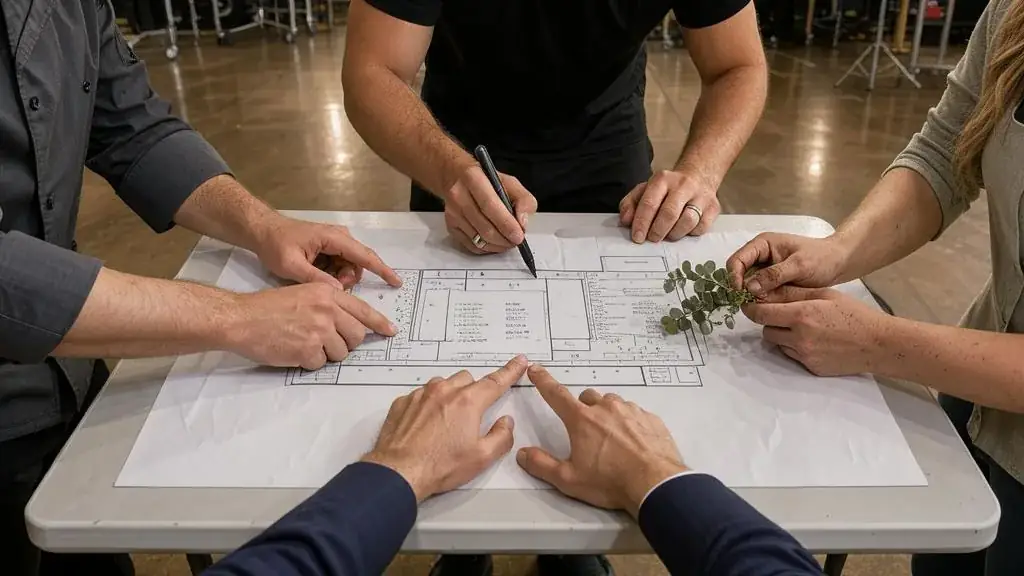
- The goal, the date, the venue and the timeline for load-in, shooting and strike
- Who pays which cash costs, and who owns any items bought for the shoot
- Who owns copyright in the photos and video, and the licence each collaborator receives: where they may post, for how long, and whether they may submit to publications or use images in paid ads
- The credit line and social handle for every collaborator
- When images will be delivered, and whether anyone has first right to submit to a publication or blog
- Model consent and releases, including for any children
- Who is responsible for damage to venue property or rented items
- How the shoot will be labelled when the images are published
Labelling: the honest part
A styled shoot shown as if it were a client’s real wedding gives a false impression. Prospective clients reasonably assume a portfolio shows work clients chose and paid for, delivered under real conditions, with real guests, real timelines and real budgets. Label styled work clearly everywhere it appears.
| Where | How to label it |
|---|---|
| Portfolio or gallery page | A heading or line that says “Styled shoot” or “Editorial”, not just a title like “Winter Romance” |
| Social post | “Styled shoot” in the first line of the caption, plus credits for every collaborator |
| Post promoting a collaborator who gave you something | A disclosure such as #Gifted or #ad in the main caption, before any links |
| Images heavily edited or generated with AI | A clear label such as #MadeWithAI, or leave them out of your portfolio |
| Sales conversations | Say it was a styled shoot when you show it, and tell clients what the same look would cost for their guest count |
Labelling does not weaken the photos. Planners and experienced couples know what styled shoots are, and they respect a company that is open about them. What damages you is a client who books the look, discovers it was never delivered for a real event, and feels misled.
Getting the most from the images
A shoot that produces 300 images and is posted once is wasted. Plan the use before the day:
- Write a shot list tied to your goal: wide room shots for planners, table details for couples, product close-ups for the catalogue.
- Shoot a short video walk-through for social media and a vertical clip for each collaborator.
- Publish a portfolio page for the shoot, with the look’s estimated price for a real event.
- Send the venue a curated set of its room, with a licence to use them.
- Pitch the shoot to a publication or wedding blog only if the agreement allows it.
- Add the hero pieces to your catalogue’s collections, with the shoot images as the in-context photos.
In Canada and the GTA
The general impression test. The Competition Act makes it reviewable conduct to make a representation to the public that is false or misleading in a material respect to promote a business. Knowingly or recklessly making one is a criminal offence. The Canadian Code of Advertising Standards, administered by Ad Standards, judges truthfulness by the general impression an ad conveys, not by intent, and says disclaimers must not contradict more prominent parts of the message. Clause 2 adds that no advertisement may be presented in a format that conceals the fact that it is an advertisement. Presenting a styled shoot as a real client event can create exactly that kind of false impression, which is why the label belongs in the heading and the first line, not in a footnote. This is general information, not legal advice.
Material connections. Ad Standards’ Influencer Marketing Disclosure Guidelines, updated in fall 2025, treat free products, gifts, discounts and personal relationships as material connections. A styled shoot is full of them: the venue gave its room, the photographer gave their time, the florist received free exposure. When you post praising a collaborator who gave you something, disclose it with a recognized label such as #ad or #Gifted in the main caption, before any links, and not buried among other hashtags. A disclosure only in the comments is not enough, and #Collab, #PR or a brand tag on its own is not acceptable. For video, the guidelines expect disclosure in the first 30 seconds, in both audio and on-screen text. Read the Ad Standards guidelines.
AI and heavy editing. The same guidelines say AI-generated or heavily altered images that show a product’s benefits should be disclosed, for example with #MadeWithAI, and that a disclaimer cannot correct a misleading impression. If AI added a chandelier you do not own or doubled the size of an installation, do not use the image to sell. If you use AI to clean up a stray cable, that is ordinary retouching.
Who owns the photos. Under the Copyright Act, the author of a work is the first owner of copyright, and for photos taken since November 7, 2012 that is the photographer, even on a shoot you organized and paid for. An assignment of copyright is valid only in writing, signed by the owner. In practice, collaborators receive a licence, not ownership, so write its terms into the agreement, including whether you may use the images in paid ads.
Models and privacy. Photos of identifiable people are treated as their personal information under PIPEDA principles. Get written consent from every model that covers where and how images will be used, and get a parent or guardian’s consent for any child. If a model is a friend or a staff member who later posts about the shoot, the personal or employment relationship is itself a material connection to disclose.
Green claims. If you describe a shoot as sustainable, foam-free or zero-waste, those are environmental claims. Since June 20, 2024, the Competition Act requires claims about a product’s environmental benefits to be based on an adequate and proper test, and claims about a business’s environmental benefits to be based on adequate and proper substantiation. Keep records of what you did, such as which mechanics replaced floral foam, and describe it precisely.
Shoot timing in Ontario
Most styled shoots in the GTA happen between late January and April, when venues have free weekdays and vendors have time, so the images are ready for the summer posting season and next year’s January shows. Weekday venue time is far easier to get than a weekend in June. Winter shoots need a plan for snow, salt and short daylight, and any outdoor location, such as a park or conservation area, may need a permit from the municipality or authority that runs it, so ask before you schedule.
Worksheet
Download the worksheet and complete it for your own business, using Lantern & Lane as the model where it helps. Keep it with your marketing plan. It takes about 10 minutes.
Check your understanding
Related guides, venues and vendors

Influencers, creators and the disclosure rules
Module 9: Social Media · 20 min
How to decide whether a creator partnership makes sense for an event business, how to find, vet and brief the right creator,…
Read more
Quotes and proposals that sell
Module 5: Pricing, Packages and Proposals · 20 min
A proposal has to sell on its own, in a room you are not in. Learn when to send a quote and…
Read more
Filling off-peak dates
Specialist Track: Marketing for Venues · 15 min
Every empty weekday and winter date is revenue a venue never recovers, but careless discounts teach clients to wait for a deal.…
Read more