Owning your images only helps your marketing if clients and vendors know exactly what they may do with them. Learn to write a plain usage licence for each type of user, price commercial use, and ask for a credit line that brings you work.
Read the transcript
Copyright, usage licences and credit lines.
Every image you deliver will travel.
The couple posts it, the venue puts it on its website, the florist enters it in an awards submission and the sponsor wants it for a print ad.
Copyright and licence are different things.
Copyright is ownership: the exclusive right to copy, publish and adapt the work.
In Canada, photographers own copyright in their images by default, including commissioned ones, unless they assign it in writing.
The four users and what each needs.
Think about who will ask for your images and design a licence for each.
Most requests fall into four groups.
A usage licence you can copy.
Put this in your contract, on your gallery landing page and in the email that delivers vendor images.
Adapt it with a lawyer for your own business.
Pricing a commercial licence.
When a sponsor, venue or corporate client asks to use an image in paid advertising, you are selling a new product.
A simple way to price it is to start from a base fee per image and adjust by how widely, how long and how prominently it will be used.
Credit lines that bring in work.
A credit is free advertising, but only when it is consistent and clickable.
Ask for the same credit everywhere: your studio name and handle on social media, your studio name and website on web pages, and your studio name in print.
That is the lesson. The worksheet and the quiz are just below this video.
What you will be able to do
- Draft a plain-language usage licence covering clients, vendors and commercial users
- Price a commercial licence for a corporate or vendor request using a simple formula
- Write a standard credit line and a polite script for handling uncredited or unlicensed use
Every image you deliver will travel. The couple posts it, the venue puts it on its website, the florist enters it in an awards submission and the sponsor wants it for a print ad. A clear usage licence decides whether each of those journeys sends business back to you or quietly gives your work away.
Copyright and licence are different things
Copyright is ownership: the exclusive right to copy, publish and adapt the work. In Canada, photographers own copyright in their images by default, including commissioned ones, unless they assign it in writing. A licence is permission you grant someone else to use the work in defined ways, while you keep ownership. You can grant many licences on the same image to different people, each with its own scope.

Most event creatives should almost never assign copyright. Assigning it means you could lose the right to show the work in your own portfolio. Licensing lets you meet every reasonable client need and still keep the asset.
The four users and what each needs
Think about who will ask for your images and design a licence for each. Most requests fall into four groups.
| User | Typical use | Licence to grant | Fee |
|---|---|---|---|
| Private client (couple, family) | Prints, albums, personal social posts | Personal, non-commercial, unlimited duration | Included in collection price |
| Corporate client | Internal channels, company social media, press release, annual report | Commercial, editorial and internal, named uses, set term or perpetual | Included for agreed uses; extra for paid advertising |
| Vendors in the image | Their own website and social media, portfolio, award entries | Limited promotional, credit required, no paid ads, no resale | Free, in exchange for credit |
| Third parties (sponsors, publications, brands) | Paid ads, packaging, editorial features | Commercial, specific media, territory and term | Quoted per use |
Write each of these in plain words. A licence that a busy florist cannot understand in thirty seconds will be ignored, and an ignored licence protects nobody.
A usage licence you can copy
Put this in your contract, on your gallery landing page and in the email that delivers vendor images. Adapt it with a lawyer for your own business.

- Ownership. “All images remain the copyright of [Studio name]. Nothing in this agreement transfers copyright.”
- Client licence. “You may print, share and post these images for personal, non-commercial use. You may not sell them, use them in advertising, or enter them in contests without our written permission.”
- Vendor licence. “Vendors who appear in or contributed to the event may use up to 15 images on their own website, social media and portfolio, with the credit line below. Paid advertising, print advertising and resale need a separate licence.”
- Editing. “Please do not apply filters, crop out our watermark or alter the images beyond resizing.”
- Credit line. “Photo: [Studio name], [website or handle].”
- Commercial requests. “For advertising, publication or any use not listed here, contact us for a licence quote.”
Pricing a commercial licence
When a sponsor, venue or corporate client asks to use an image in paid advertising, you are selling a new product. A simple way to price it is to start from a base fee per image and adjust by how widely, how long and how prominently it will be used.
Here is an illustrative formula. Base fee per image for paid use: $150. Multiply by a media factor (1.0 for social ads only, 1.5 for web and social, 2.0 for print and outdoor), a term factor (1.0 for one year, 1.5 for three years, 2.5 for perpetual) and an exclusivity factor (1.0 non-exclusive, 2.0 exclusive).
Worked example. Northlight Studio, an illustrative Hamilton studio, shot a gala. The event’s lead sponsor wants three images for a one-year print and web campaign, non-exclusive. The fee is 3 images x $150 x 2.0 (print) x 1.0 (one year) x 1.0 = $900, plus 13% HST of $117, for a total of $1,017. If the sponsor wanted the same three images exclusively and in perpetuity, the fee would be 3 x $150 x 2.0 x 2.5 x 2.0 = $4,500 before tax. Show the client both numbers. Many choose the smaller, cleaner licence once they see the cost of forever.
The point is not the exact figures, which you should set for your own market. The point is to have a formula ready so a request becomes a quote in ten minutes instead of a vague “sure, go ahead”.
Credit lines that bring in work
A credit is free advertising, but only when it is consistent and clickable. Ask for the same credit everywhere: your studio name and handle on social media, your studio name and website on web pages, and your studio name in print. On Instagram, a tag on the image plus a mention in the caption gives both a visible credit and a link.
When someone forgets, assume good faith first. Here is a script.
- “Hi [name], thank you for sharing our photos from the [event]. They look great on your page. Could you add the credit ‘Photo: [Studio name] [handle]’ to the caption? It helps couples find both of us. Thanks so much.”
If a third party uses your work commercially without a licence, send a short, factual note with the image, where it appears, and an invoice for a retroactive licence at your standard rate. Many disputes end there. Keep screenshots with dates, and speak to a lawyer if it escalates.
Keep a licence log
A licence you cannot find is a licence you cannot enforce. Keep a simple spreadsheet with one row per licence: the date, the licensee, the event, the image file names, the permitted media, the term, the fee and the invoice number. When a sponsor’s agency asks two years later whether the campaign images can run again, the answer takes a minute. The log also shows which images earn licence fees repeatedly, which tells you what to shoot more of and which frames to feature in your corporate collection.
Video, booths and design work
The same logic applies to wedding films, conference recaps, photo booth strips and event branding. Videographers face one extra layer: music. Owning your footage does not give you rights to the song underneath it, which is why many filmmakers deliver a licensed-music version for the client and a separately cleared version for their own marketing.
In Canada and the GTA
The rules behind the licence. Under the Copyright Act, the author of a work is its first owner. The former section 13(2), which gave the commissioning client ownership of a photograph or portrait, was repealed, and that repeal took effect on November 7, 2012. So for images taken since then, the photographer owns copyright by default, even when the client paid. An assignment of copyright, or a grant of an interest in it, is valid only in writing signed by the owner or the owner’s agent. If an employee made the work in the course of employment, the employer is the first owner unless they agreed otherwise. Read the source in the Copyright Act.
The client’s personal-use right. The Act lets an individual use, for private or non-commercial purposes, a photograph or portrait they commissioned for personal purposes and paid for, unless you agreed otherwise. That is why a couple can print and share their wedding photos even without a written licence. It does not extend to commercial use. A business using event photos in advertising is outside that exception and needs your permission.
Moral rights. You have a right to the integrity of your work and a right to be associated with it by name or pseudonym, or to stay anonymous. Moral rights cannot be assigned, but they can be waived in whole or in part. This is the legal basis for your credit line and your no-filter request. Some corporate contracts include a moral rights waiver buried in the terms. Read for it, and decide whether you are willing to sign it.
How long it lasts, and registration. Copyright generally runs for the author’s life, plus the rest of that calendar year, plus 70 years. Registration with CIPO is voluntary, because a work is protected once it is created and fixed. Some photographers register a handful of signature images they expect to license often. The CIPO guide to copyright explains the process.
Music in your videos. SOCAN represents songwriters and publishers, and Re:Sound represents performers and record labels. Their public-performance licences, often held by venues, cover music played in a room. As general guidance, putting a song into your own video is a different right, usually called synchronization, licensed separately by the rights holders, and a venue’s performance licence does not cover it. On TikTok, businesses should use the Commercial Music Library, a pre-cleared library that TikTok makes free for businesses; the general music library may not be used for commercial purposes. See TikTok’s Commercial Music Library help page.
Local practice
In the GTA, vendors expect to receive images from photographers and many will post within days. Planners and venues often ask for images for awards submissions and wedding show displays, which are promotional but not paid advertising, so decide in advance which bucket those fall into. Corporate clients in Toronto commonly send a master services agreement with an intellectual property clause that claims ownership of everything produced. Do not sign it as written. Offer a broad, perpetual licence for the company’s own use instead, and keep copyright. Listing platforms and awards submissions often ask the vendor who uploads an image to confirm they have the right to use it. Remind the vendors you work with that your vendor licence covers their own marketing, and that they should ask you before submitting your work anywhere that claims broader rights. Add 13% HST to licence fees if you are registered for HST, and show the HST amount or rate on the invoice. This is general information, not legal advice; check the source or a lawyer for your situation.
Worksheet
Download the worksheet and complete it for your own business, using Lantern & Lane as the model where it helps. Keep it with your marketing plan. It takes about 10 minutes.

Check your understanding
Related guides, venues and vendors
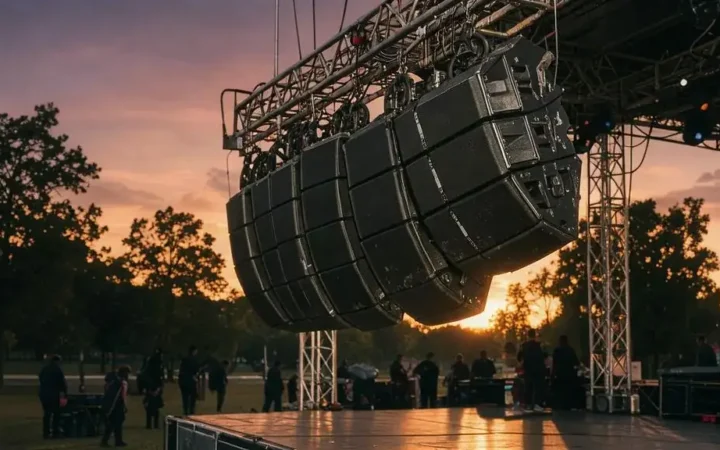
Line array
Production & AV
A column of speaker elements that projects sound evenly over long distances.
Read more
Module 3 workshop: the gala budget, line by line
Module 3: Budgeting · 15 min
Build the full line-item budget for the 200-guest Harbour Gala with HST, gratuity, contingency and a payment calendar at a $40,000 envelope,…
Read more
The venue website and inquiry flow
Specialist Track: Marketing for Venues · 15 min
A venue website has one job: turn the right visitors into tours. Learn which pages and facts planners and couples look for…
Read more