A column of speaker elements that projects sound evenly over long distances.
Read the transcript
Line array.
A column of speaker elements that projects sound evenly over long distances.
How it works in practice.
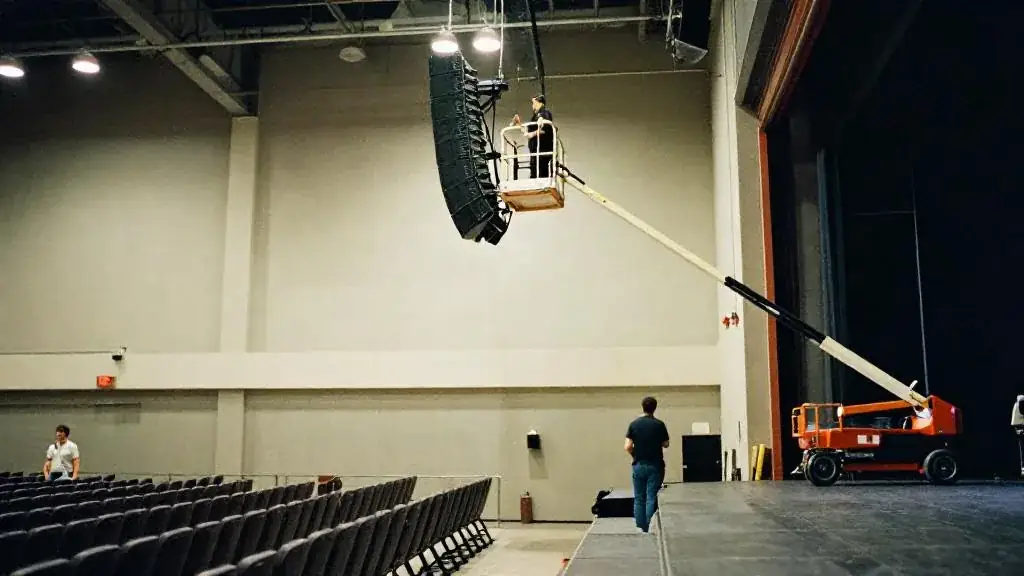
A line array is several identical speaker boxes hung or stacked in a vertical column and angled slightly against each other in a gentle curve.
Together they behave like one tall source that throws sound forward with less drop-off over distance than a single box.
Worked numbers.
These are typical starting points; the AV company should design for the actual room.
How to handle it.
Ask whether the arrays will be flown or ground-stacked. Flying needs rigging points or truss; stacking costs floor space beside the stage.
Check sightlines: arrays hung too low block screens and the stage from side tables.
More detail, examples and common mistakes are on this page, below the video.
How it works in practice
A line array is several identical speaker boxes hung or stacked in a vertical column and angled slightly against each other in a gentle curve. Together they behave like one tall source that throws sound forward with less drop-off over distance than a single box. The top boxes aim at the back of the room, the bottom ones at the front, so the front tables are not deafened to make the back row hear.
The alternative is point source: a single speaker on a stand or a pair either side of the stage. Point source is cheaper, faster to set and perfectly good for small and mid-sized rooms. Long or large rooms often add delay speakers part-way back instead of moving up to a line array, and front-fill speakers along the stage lip for the first rows.
Worked numbers
| Audience | Typical system |
|---|---|
| Up to about 150 | Two point-source speakers on stands, one or two subwoofers |
| About 150–400 | Larger point source, front fills, possibly delays in a long room |
| About 400 and up, or a very long room | Flown or ground-stacked line array each side, front fills, delays |
These are typical starting points; the AV company should design for the actual room.
How to handle it
- Ask whether the arrays will be flown or ground-stacked. Flying needs rigging points or truss; stacking costs floor space beside the stage.
- Check sightlines: arrays hung too low block screens and the stage from side tables.
- Add rigging and flying time to the production schedule.
- Place front of house where the engineer hears the arrays as the audience does.
In Ontario and the GTA
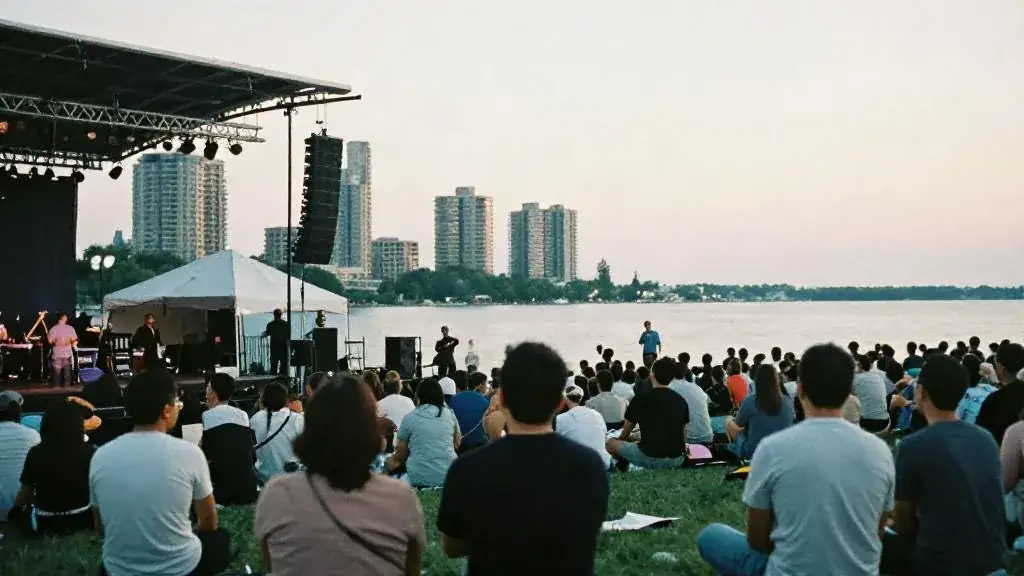
Outdoors, a line array carries a long way. Toronto’s Noise Bylaw (Chapter 591) applies stricter limits on amplified sound from 11 p.m. to 7 a.m., and a noise exemption permit for outdoor amplified sound takes about 4 weeks to process. Apply early, and aim the system away from homes where you can.
Related tools
Record sound levels and neighbour complaints as a risk in the risk register template, and put speaker flying times on the run of show.
Why it matters
Needed for rooms over about 400 people or long rooms; point-source speakers work for smaller events.
Example
A conference for 800 uses a flown line array each side of the stage.
Common mistakes
- Over-specifying a line array for a 100-person room
Related guides, venues and vendors

Cash bar vs open bar
Food & Beverage
Open bar: the host pays for drinks, usually per person per hour. Cash bar: guests pay. Toonie bar: guests pay a token…
Read more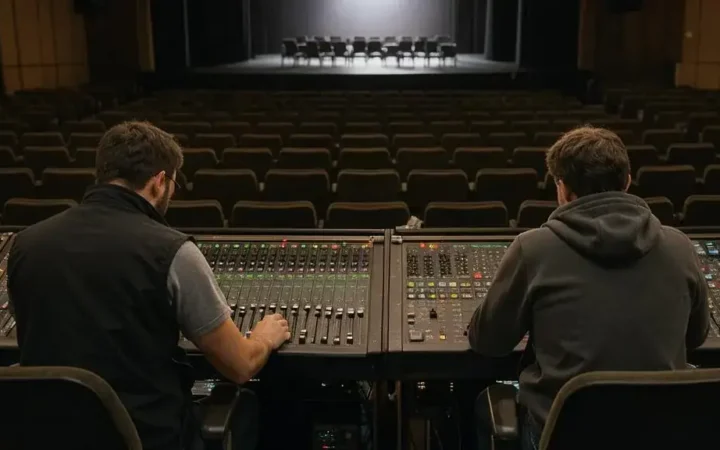
Front of house
Production & AV
The area and the technical position facing the stage where sound and lighting are controlled; also the guest-facing side of an operation.
Read more
IEM (in-ear monitor)
Production & AV
Earpieces that let performers hear a mix of their own audio and cues without stage monitors.
Read more