Build the full line-item budget for the 200-guest Harbour Gala with HST, gratuity, contingency and a payment calendar at a $40,000 envelope, then cut it toward $34,000 without losing the program.
Read the transcript
Module 3 workshop: the gala budget, line by line.
Build the full line-item budget for the 200-guest Harbour Gala with HST, gratuity, contingency and a payment calendar at a 40,000 dollars envelope, then cut it toward 34,000 dollars without losing the program.
The exercise.
Build the Harbour Gala budget in full at the 40,000 dollars envelope, then cut it to 34,000 dollars without losing the program.
Use the budget sheet.
Before you start: the rules of the build.
Every line is all-in: pre-tax quote, service charge or gratuity where it applies (food and bar only), HST at 13 percent on everything including the service charge.
Contingency is 10 percent, its own line, held by the planner under the clause in the proposal.
The 40,000 dollars version (summary).
It is over by 6,655. dollars
That is normal for a first pass.
Where each line came from.
The hotel line is the per-plate figure from the HST lesson (95 dollars by 1.18 by 1.13 = 126.67 dollars) times 200 covers; it is above the 24,000 dollars grossed-up minimum because the minimum is a floor, not a price.
The bar is a consumption bar capped at a pre-tax figure, grossed up by the same 1.3334.
The payment calendar for this budget.
That is the lesson. The worksheet and the quiz are just below this video.
What you will be able to do
- Build a complete gala budget
- Make cuts that protect the goal
- Present the budget to a committee
The exercise
Build the Harbour Gala budget in full at the $40,000 envelope, then cut it to $34,000 without losing the program. Use the budget sheet.

Before you start: the rules of the build
- Every line is all-in: pre-tax quote, service charge or gratuity where it applies (food and bar only), HST at 13 percent on everything including the service charge.
- Contingency is 10 percent, its own line, held by the planner under the clause in the proposal.
- The planner fee is flat at $4,500 plus HST, its own line.
- Non-negotiables from the creative brief: the program under 90 minutes, the ask before 9 p.m., an accessible stage. The mentalist set and the two strolling magicians are the program and are protected.
- Nice-to-haves from the brief, which go first: tall florals, the photo wall, the gobo.
- Every cut must name what it changes for the guest or the goal. A cut with no consequence was never a real line.
The $40,000 version (summary)
| Line | All-in (HST and gratuity included) |
|---|---|
| Hotel F&B: 200 plated covers at $126.67 all-in | $25,334 |
| Bar: consumption bar capped, all-in | $3,400 |
| Entertainment: two strolling magicians, a 25-minute mentalism set before the ask | $3,100 |
| AV beyond the inclusions: lighting wash, screen, technician | $1,900 |
| Décor: low florals, pin spots, a gobo | $1,700 |
| Photography | $1,600 |
| Print, signage, stewardship cards | $900 |
| Planner fee | $5,085 |
| Contingency (10 percent) | $3,636 |
| Total | $46,655 |
It is over by $6,655. That is normal for a first pass.
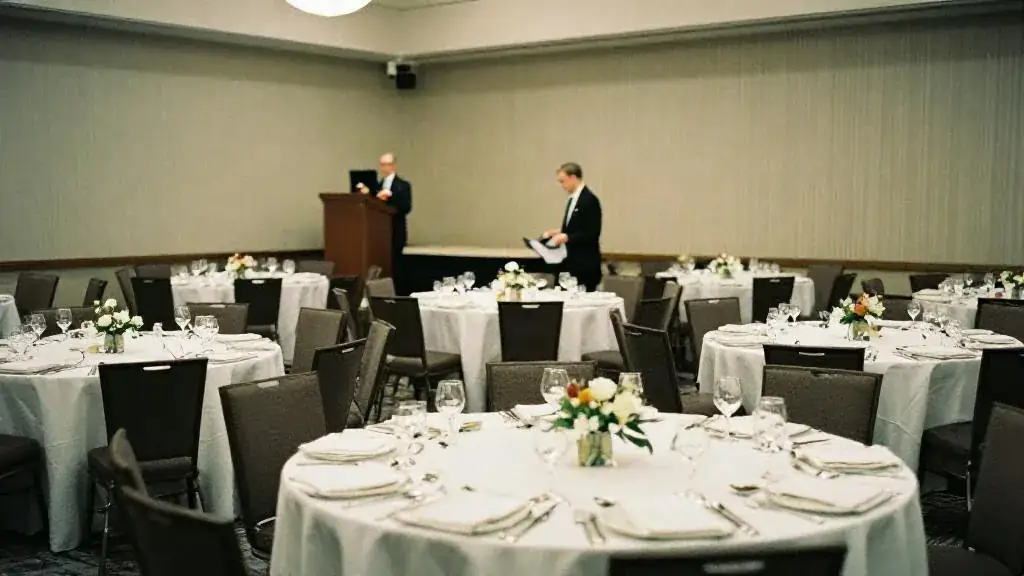
Where each line came from
The hotel line is the per-plate figure from the HST lesson ($95 × 1.18 × 1.13 = $126.67) times 200 covers; it is above the $24,000 grossed-up minimum because the minimum is a floor, not a price. The bar is a consumption bar capped at a pre-tax figure, grossed up by the same 1.3334. Entertainment is two close-up magicians for the cocktail hour and the gap before the first plate, plus a mentalist for 25 minutes, at mid-range typical GTA prices plus HST. AV is the lighting wash, a screen for the paddle-raise totals and a technician beyond what the hotel included in the negotiation lesson. Décor is low florals in brass holders, pin spots on the tables and a gobo of the foundation’s logo. Photography is one photographer for six hours. Print covers the program, the paddle-raise signage and the stewardship cards the CEO hands out at the door. The planner fee is $4,500 plus HST. Contingency is 10 percent of the spend.
The payment calendar for this budget

| When | Payment | Approver |
|---|---|---|
| Month two | Hotel deposit; planner retainer | Board (deposit over threshold); committee chair |
| Month three | Mentalist, magicians and photographer deposits, each with COI received | Committee chair |
| Month four | Florist and AV deposits; lottery licence fee for the 50/50 draw | Development officer |
| Month five | Hotel second instalment (90 days) | Board |
| Month six | Planner milestone | Committee chair |
| Final two weeks | Hotel balance with the 72-hour guarantee; entertainment balances; planner balance | Committee chair; development officer |
| Week after | AV overtime if any; hotel final with bar consumption; florist balance; contingency reconciled and returned | Development officer |
Cutting to $34,000
- Move from 200 to 180 covers by removing comped seats for staff who can sit at a side table with a lighter menu: saves $2,533.
- Change the bar to a two-hour hosted bar with a cash bar after: saves $1,600.
- Drop the gobo and reduce florals to candles and linens: saves $900.
- Replace the lighting wash with the hotel’s included uplights: saves $1,100.
- Keep the program (the mentalist and the magicians) intact, because it drives the ask.
Those cuts save $6,133 and get the budget to $40,522. Reaching $34,000 requires either a Thursday-to-Wednesday move (the hotel drops the minimum by $4,000) or 160 covers. Present both to the committee; do not choose for them.
What each cut costs the guest or the goal
Every cut has a consequence, and the committee should hear it before voting. Fewer covers means twenty staff and volunteers eat a lighter plate at a side table; the guest experience for donors is unchanged. The hosted-then-cash bar means a donor ordering a drink at 9:30 is asked to pay; the ask is already over by then, so the effect on proceeds is small, but the stewardship cards should say thank you in a way that makes up for it. Candles instead of florals means the room reads warmer and plainer; enclosed candles only, under the hotel’s open-flame rule. The hotel’s uplights instead of a wash means the room is slightly less photographed; the paddle raise, which must photograph well, still has the pin spots and the screen. The Wednesday move changes who can attend; the development officer thinks a few donors would decline, which is why the choice goes to the committee with the 160-cover option beside it.

Presenting to a committee
One page: the envelope, the shape as a chart, the three largest lines, the cuts you made and the two decisions you need from them. Committees decide quickly when the decisions are framed as trade-offs rather than as a request for more money.
The one page for this committee, in order. The $40,000 envelope and the $46,655 first pass, with the gap in bold. The shape chart with the hotel line at more than half. The three largest lines: hotel, planner fee and contingency, each with one sentence on why it is the size it is. The four cuts, each with its saving and its consequence in one line. The two decisions: Wednesday or 160 covers, with the development officer’s view on each. Then the question: “Which would you rather explain to a donor?” The committee chose 160 covers and asked the sponsors to fill the room with their own guests rather than with comped seats, which is how the event ended up with 180 covers on the night and $1,100 of contingency released for the extra 20. The night netted above target, and the mentalist set is the thing the donors mentioned in the survey.
Checklist for the worksheet
- Every line grossed up correctly: food and bar × 1.18 × 1.13; everything else × 1.13.
- Contingency and the planner fee as their own lines.
- Nice-to-haves cut before anything that touches the program or the ask.
- Each cut has a saving and a consequence written beside it.
- A payment calendar with approvers, built from the contract dates and the board calendar.
- Two decisions for the committee, framed as trade-offs, with your recommendation.
Worksheet
Download the worksheet, complete it for your own event (or the running gala example), and keep it in your course binder. It takes about 18 minutes.
Check your understanding
Related guides, venues and vendors

Module 11 workshop: debrief and report
Module 11: After the Event · 15 min
Produce the gala's survey, ROI report, project write-up and portfolio entry.
Read more
Technical riders
Module 5: Vendors & Entertainment · 15 min
Every performer and band sends a rider: stage size, power, sound, lighting, dressing room, timing. Forward it to the venue the day…
Read more
Contracts and liability basics
Module 8: Legal, Safety & Risk (Ontario) · 15 min
What a contract must contain, who is liable for what, and why your own client agreement needs a liability cap. Not legal…
Read more