Every performer and band sends a rider: stage size, power, sound, lighting, dressing room, timing. Forward it to the venue the day you receive it.
Read the transcript
Technical riders.
Every performer and band sends a rider: stage size, power, sound, lighting, dressing room, timing.
Forward it to the venue the day you receive it.
What a rider is.
A technical rider is the list of what a performer needs from you and the venue to do the job: stage size, power, sound, lighting, dressing room, arrival and sound-check time, meals, parking, and sometimes who may and may not be in the room during set-up.
Every professional act and band sends one with the contract.
Reading a rider.
Riders for bands are longer and include an input list and a stage plot, a diagram of who stands where and what is plugged into which channel.
Send the stage plot to the AV company unchanged.
Reconciling riders with the venue.
Forward the rider to the venue contact and the AV supplier the day it arrives, with the event date and room in the subject line.
Ask for a written reply: can do, can do at a cost, cannot do. Put the cost items into the budget sheet.
Building a combined rider for the venue.
Venues do not want five riders; they want one document that says what the room must provide, by time.
The combined rider is a single sheet: a floor plan with stage, AV and performer positions; a power list; a complete microphone and input list; a lighting note; dressing room assignments; a load-in and sound-check schedule; and the hospitality count.
Worked example: the Harbour Gala.
Three riders arrived over the summer.
The mentalist's, received in June: stage minimum 4 by 3 m with stairs on the audience side; one lavalier and one wireless handheld as backup; a general warm wash with house lights at no less than half during the set, because he works with the audience; no photographs during two specific pieces; a lockable room; arrival 4:30, sound check 5:00, set 8:25 to 8:55; one meal.
That is the lesson. The worksheet and the quiz are just below this video.
What you will be able to do
- Read and forward a tech rider
- Reconcile riders with venue capabilities
- Build a combined rider for the venue
What a rider is
A technical rider is the list of what a performer needs from you and the venue to do the job: stage size, power, sound, lighting, dressing room, arrival and sound-check time, meals, parking, and sometimes who may and may not be in the room during set-up. Every professional act and band sends one with the contract. It is not a wish list and it is not a negotiation opener; it is the act telling you what the show was built on.
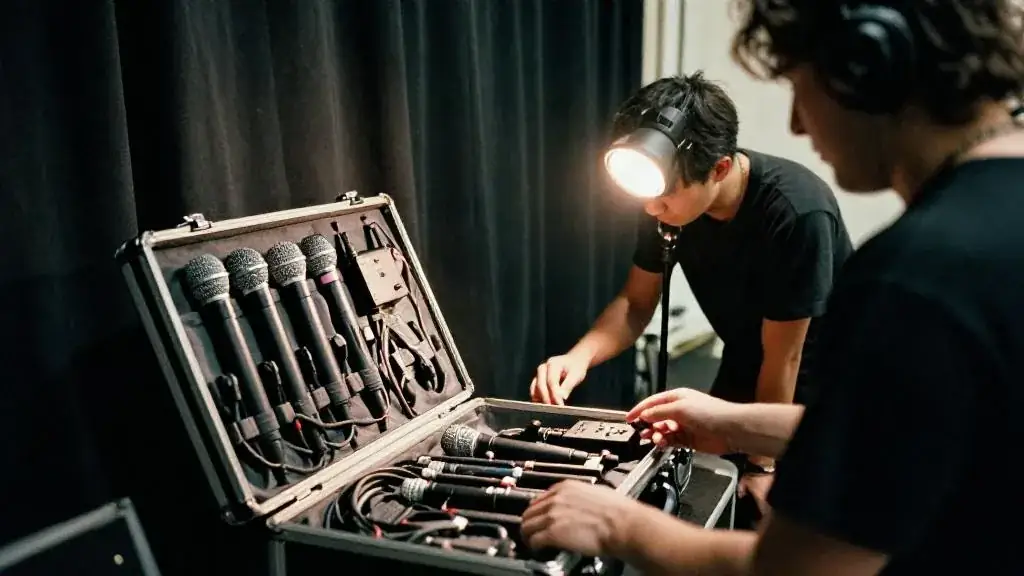
The rule that saves planners the most grief: forward the rider to the venue the day you receive it. Not the week the program is finalized. The day. The venue will tell you within a day or two what it can and cannot do, and you will still have time to solve it.
Reading a rider
| Section | What it usually says | What it means for you |
|---|---|---|
| Stage | Minimum dimensions, height, stairs, a clear path to the audience | Compare with house staging and the room plan. A 6 × 4 m stage in a room with a 5 m stage wall is a problem now, not on the day |
| Power | Number of circuits, where, sometimes three-phase for bands | Send to the venue’s electrician or the AV company |
| Sound | Microphones by type (handheld, lavalier, headset), monitors, a mixer input list for bands, a sound-check time | Becomes the AV brief in lesson 6; sound check goes on the production schedule |
| Lighting | A general wash; for illusions, specific requests such as no backlighting or no audience blackout | Tell the AV company; some requests are about the method and are not optional |
| Dressing room | A lockable room with a mirror, water, within reach of the stage | Hotels have them; lofts do not. Book one or build one |
| Timing | Arrival, set-up, sound check, performance window, strike | Goes straight into the run of show |
| Hospitality | Meals, parking, water on stage | Costs a plate and a parking pass each; budget it |
| Restrictions | No photography of certain pieces, no one backstage, no announcements of the act’s method | Brief the MC, the photographer and the venue |
Riders for bands are longer and include an input list and a stage plot, a diagram of who stands where and what is plugged into which channel. Send the stage plot to the AV company unchanged.
Reconciling riders with the venue
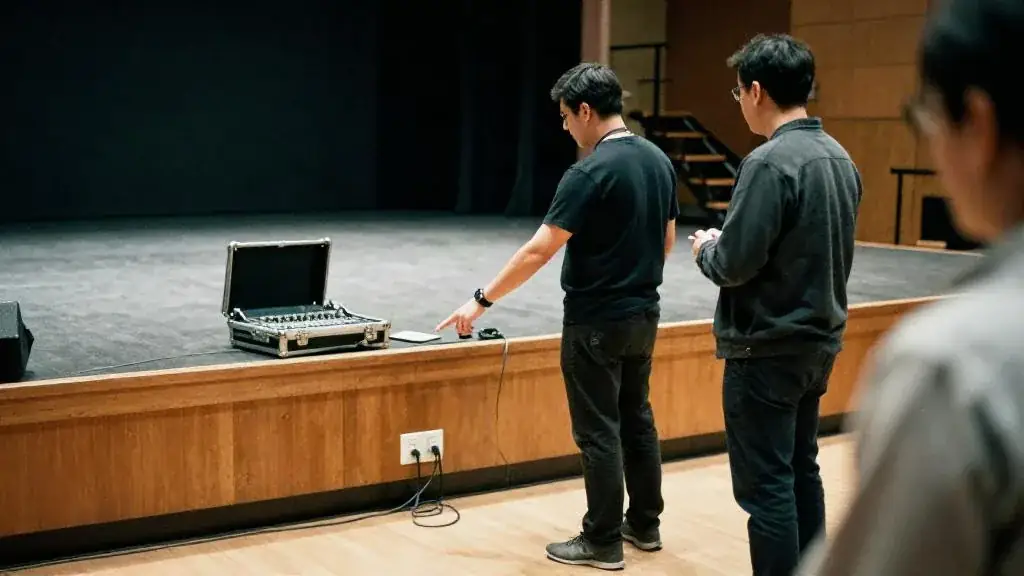
- Forward the rider to the venue contact and the AV supplier the day it arrives, with the event date and room in the subject line.
- Ask for a written reply: can do, can do at a cost, cannot do. Put the cost items into the budget sheet.
- For each “cannot do”, go back to the act. Most riders have flexibility the act will tell you about if asked directly; a mentalist who asks for a 6 m stage may be fine with 4 m and a clear aisle.
- Record the agreed changes in an email to both sides. The rider plus that email is now the technical agreement.
- Put every timing item (arrival, sound check, performance, strike) into the production schedule.
Building a combined rider for the venue
Venues do not want five riders; they want one document that says what the room must provide, by time. The combined rider is a single sheet: a floor plan with stage, AV and performer positions; a power list; a complete microphone and input list; a lighting note; dressing room assignments; a load-in and sound-check schedule; and the hospitality count. The performer tech rider template has the structure; fill it from each act’s rider and send it to the venue and the AV supplier four weeks out, then again with any changes at one week.
Worked example: the Harbour Gala
Three riders arrived over the summer. The mentalist’s, received in June: stage minimum 4 × 3 m with stairs on the audience side; one lavalier and one wireless handheld as backup; a general warm wash with house lights at no less than half during the set, because he works with the audience; no photographs during two specific pieces; a lockable room; arrival 4:30, sound check 5:00, set 8:25 to 8:55; one meal. Forwarded to the hotel and in-house AV the same afternoon. The reply: house stage 6 × 2.4 m decks configurable to 4.8 × 3.6 m, fine; AV fine; dressing room assigned; the house-lights request noted for the technician.
The strolling magicians’ rider, received in September, was a paragraph: a green room to share with the mentalist, two meals, a parking pass each, and the request that dinner lighting not drop below the level where cards can be seen. Forwarded the same day; the lighting note went to the AV technician as a cue, “no dim until the magicians clear at 7:25”.
The pianist asked for the house grand tuned and moved to stage left, and a music stand light. The hotel tunes the piano on request at a stated fee, which went into the budget.
The combined rider went to the hotel on October 10: floor plan with the stage on the east wall, piano stage left, AV position on the west; microphone list of one podium, two handhelds, one lavalier; lighting notes with the two cues; dressing room A for the mentalist, green room B shared; schedule from AV load-in at 3:00 through mentalist sound check at 5:00 to strike at 11:30; four performer meals and three parking passes. One page and a floor plan. The hotel’s banquet captain had it clipped to the run of show on the night.
Common mistakes
- Sitting on a rider until the month of the event and discovering the stage does not fit.
- Treating a method-related lighting or photography request as negotiable.
- Forgetting that performer meals and parking are real costs.
- Sending the venue five separate riders and expecting it to reconcile them.
- Not scheduling sound check, so the act sound-checks over cocktail hour.
Worksheet
Download the worksheet, complete it for your own event (or the running gala example), and keep it in your course binder. It takes about 10 minutes.
Check your understanding
Related guides, venues and vendors

Websites, SEO and getting found
Module 12: The Business of Event Planning · 15 min
Positioning, a site that converts, local SEO for "event planner Toronto", reviews and directories.
Read more
Building the vendor team
Module 5: Vendors & Entertainment · 15 min
Order of booking, how to find good vendors in the GTA, references, and the directory filters that save hours.
Read more
Crowd management and emergency plans
Module 8: Legal, Safety & Risk (Ontario) · 15 min
Occupant loads, egress, crowd density, weather, medical, security ratios, and the one-page emergency plan every event needs.
Read more