Plated, family, buffet, stations, cocktail. Tasting etiquette, dietary codes on the seating chart, and the quantity calculator.
Read the transcript
Catering: styles, tastings and dietary planning.
Plated, family, buffet, stations, cocktail.
Tasting etiquette, dietary codes on the seating chart, and the quantity calculator.
Five service styles and what each one costs you.
Catering is the largest line after the venue, and the service style decides staffing, timing, room size and how the program flows.
Choose the style before the menu.
The tasting.
Caterers offer tastings after a deposit or a signed letter of intent, usually for two to four people.
Go with the decision-maker and one honest eater.
Dietary planning.
Collect on the RSVP, with specific tick-boxes (vegetarian, vegan, halal, kosher-style, gluten-free, nut allergy, shellfish allergy, other) and a free-text line. "Any dietary needs?" gets vague answers.
Code the seating chart. Each guest's code goes beside the name; the caterer gets the chart by table 72 hours out.
Quantities.
Run the food quantity calculator for a starting point, then adjust: a young crowd at a late party eats more; an older crowd at a lunch eats less; stations need the 1.3 multiplier; a late-night snack (pizza, poutine, sliders) at midnight needs about half a portion per guest because a third have left.
Questions for the caterer.
Is the quote per person all-in, or plus 18 percent service and 13 percent HST?
What is the guarantee deadline, and can the number go up after it?
That is the lesson. The worksheet and the quiz are just below this video.
What you will be able to do
- Choose a service style for the room and timing
- Run a tasting
- Plan dietary needs with codes
Five service styles and what each one costs you
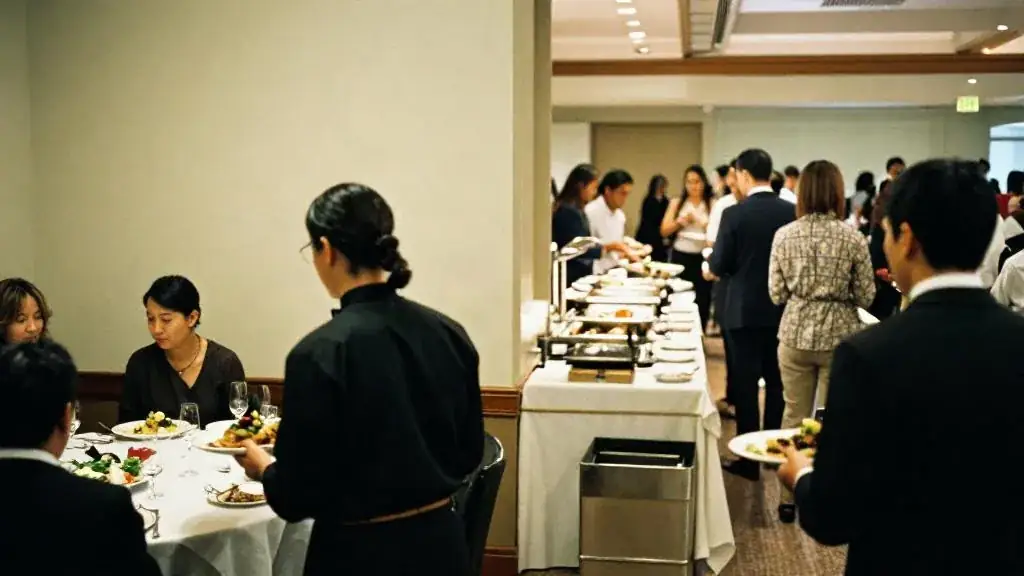
Catering is the largest line after the venue, and the service style decides staffing, timing, room size and how the program flows. Choose the style before the menu.
| Style | Best for | Timing for 200 | Space and staffing | Watch out |
|---|---|---|---|---|
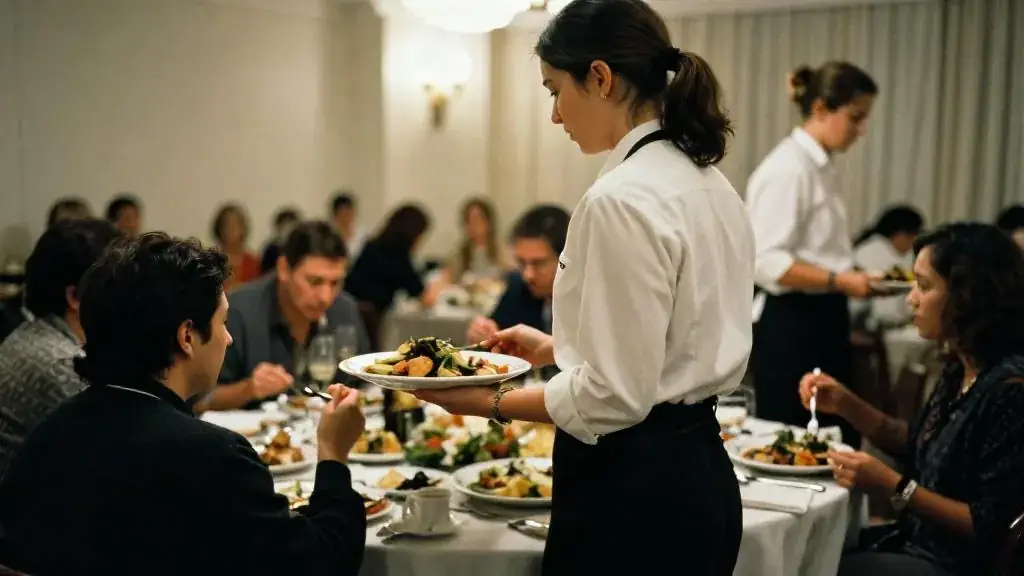
| Plated | Galas, weddings, anything with a program | Each course about 20–25 minutes to serve and clear | Roughly 1 server per 2 tables of 10; room at 0.95–1.1 m² per seat | Entrée choices must be collected in advance and coded on the seating chart |
| Family style | Warm, social dinners under 150 | Platters land in 10 minutes | Needs 72-inch rounds or larger; wide tables | Platters crowd centrepieces; plan the tablescape around them |
| Buffet | Large numbers, mixed dietary needs | A double-sided line for 300 clears in about 35 minutes; single-sided takes twice as long | About 20 percent more floor space than plated for the line and the flow | Release tables in order or you get a queue of 80 people |
| Stations | Holiday parties, receptions where people mingle | Continuous; open four or more stations at once | A chef per station; stations against walls, not in the traffic path | Guests eat more than you think: budget 1.3× a plated portion |
| Cocktail / pass-around | Receptions under two hours; launches | Continuous; 8–12 pieces per person for a two-hour reception that replaces dinner | One server per 25–30 guests carrying trays | Nobody can hold a plate, a glass and a handshake; keep pieces one-bite |
The tasting
Caterers offer tastings after a deposit or a signed letter of intent, usually for two to four people. Go with the decision-maker and one honest eater. Taste the dishes at the temperature they will reach the table (ask for a plated service, not a chef’s counter), ask what changes at volume (“this is for four; what does it look like for 200?”), and taste the vegetarian and the allergen-free plates, because guests notice when those are an afterthought. Confirm portion sizes in writing. A tasting is also the moment to see how the caterer handles a request; if they bristle at “could this be nut-free?”, imagine the night.
Dietary planning

- Collect on the RSVP, with specific tick-boxes (vegetarian, vegan, halal, kosher-style, gluten-free, nut allergy, shellfish allergy, other) and a free-text line. “Any dietary needs?” gets vague answers.
- Code the seating chart. Each guest’s code goes beside the name; the caterer gets the chart by table 72 hours out. Servers then deliver the right plate to the right seat without asking the table.
- Design the base menu to be inclusive so that fewer special plates are needed: a main that is naturally gluten-free, a nut-free kitchen if the audience includes children.
- Allergy is not preference. A severe allergy means asking the caterer about cross-contact, separate prep and labelled plates, not just a different dish.
- Cultural needs (halal, kosher, Jain vegetarian, no beef, no pork) are common in the GTA. Ask the client who is coming; label stations and buffet dishes clearly.
Quantities
Run the food quantity calculator for a starting point, then adjust: a young crowd at a late party eats more; an older crowd at a lunch eats less; stations need the 1.3 multiplier; a late-night snack (pizza, poutine, sliders) at midnight needs about half a portion per guest because a third have left.
Questions for the caterer

- Is the quote per person all-in, or plus 18 percent service and 13 percent HST?
- What is the guarantee deadline, and can the number go up after it?
- How many staff, for how many hours, and what is the overtime rate?
- Do you bring the kitchen, or does the venue have one? Who pays for the kitchen rental?
- Rentals (china, glassware, linens): included or extra?
- Who handles the cake cutting and is there a cake-cutting fee?
- What happens to leftovers? (Many caterers cannot release them for liability reasons; ask before the client assumes.)
Worked example
The Harbour Gala uses the hotel’s kitchen, so service style is plated, three courses, at $95 per person before the 18 percent service charge and HST. The RSVP collected 23 vegetarian, 9 halal, 4 gluten-free and 2 nut-allergy guests; the development officer coded the seating chart and sent it 72 hours out. The vegetarian plate was tasted and upgraded from a pasta to a roasted squash dish because the committee chair would be eating it.
Common mistakes
- Choosing the menu before the service style.
- Collecting dietary needs without a seating chart to deliver them.
- A single-sided buffet for 300 and no table-release order.
- Forgetting the vendor meals: 12 vendors eating is a line on the budget.
- Treating an allergy as a preference.
Ontario rules that apply
Food served to guests in Ontario comes from a kitchen that is regulated, inspected and accountable, and a planner’s job is to make sure that is true of every caterer on the file. The province’s food premises regulation sets the standards, and local public health units carry out inspections; in Toronto, the City publishes inspection results through its DineSafe program, which is worth a look before you shortlist a caterer you have not worked with. Ask any caterer whether their kitchen leads hold food handler certification and where the food is prepared. A home kitchen is not a commercial one, however good the cooking.
Allergens have a national reference point. Health Canada lists the priority food allergens: peanuts, tree nuts, sesame, milk, eggs, fish, crustaceans and molluscs, soy, wheat and triticale, and mustard, along with sulphites. Build your RSVP tick-boxes from that list and you will catch most of what matters. Then ask the caterer how they label buffet and station dishes against it.
Accessibility is part of food service too. Under the AODA, venues and organizations serving the public must meet accessibility standards, and the practical version for a planner is simple: a buffet height that someone using a wheelchair can reach, a server assigned to help guests who cannot carry a plate, and large-print or clearly signed labels on every station. If guests with service animals attend, water and a quiet spot near the table help more than any policy.
Leftovers are a common question. Ontario’s Donation of Food Act, 1994 offers protection to people who donate food in good faith, but caterers set their own rules about what leaves their control. Raise it before the event, not at midnight.
Numbers to know
These are planning figures, not promises. Confirm each one with your caterer and venue.
- Service charge and tax. In GTA hotels and banquet halls, a service charge in the range of 15 to 20 percent is typical, and HST at 13 percent applies on top, including on a mandatory service charge. A $95 plated dinner commonly lands somewhere around $120 to $130 per guest once both are added.
- The guarantee. Most venues and caterers ask for a final number somewhere between 72 hours and a week before the event. You pay for the guarantee even if fewer guests arrive.
- Dietary share. In a mixed GTA crowd, expect a meaningful share of guests to flag a dietary need. Do not budget for exceptions as if they were rare.
- Vendor meals. Performers, photographers, AV crew and planners working through dinner need a hot meal. Ask for a vendor meal rate, usually lower than the guest plate.
- Kitchen time. An off-site caterer in a venue without a full kitchen needs set-up time and power for warming equipment. Ask how many hours before doors and how many circuits.
GTA practice notes
The GTA is one of the most culturally varied dining markets in the country, and that changes the questions you ask. Halal is not a preference to be met with a vegetarian plate; it requires halal-sourced meat and, for many guests, confidence about preparation. Ask the caterer where the meat comes from and whether they can show certification. Kosher is more involved still: kosher-style menus avoid certain combinations, while a truly kosher meal requires a supervised kitchen or sealed, certified meals brought in. Know which one your client means before you promise either.
Many hotels and banquet halls in the GTA have exclusive catering, meaning no outside food apart from a wedding cake or certified kosher meals, and sometimes only with a fee. Lofts, galleries and event spaces often have an approved caterer list instead. Read the venue contract for outside food rules before you fall in love with a caterer.
Off-site catering in a raw space adds rentals that clients forget: china, glassware, cutlery, linens, serving tables, a back-of-house tent if the space has no prep area, and garbage and recycling removal. Ask the caterer to quote rentals on a separate page so you can compare like with like.
How this connects to the next lesson
Food and drink are planned together. The service style you choose here sets the rhythm the bar must follow: plated dinners pour wine at the table, stations pull guests toward a bar between plates, and a pass-around reception needs bar service that keeps up with mingling. Bring your guest count, service style and timeline into the next lesson on bar packages, permits and Smart Serve. Before then, run your numbers through the food and drink calculator and make sure every guest on the seating chart has a code from the dietary codes list.
Worksheet
Download the worksheet, complete it for your own event (or the running gala example), and keep it in your course binder. It takes about 12 minutes.

Check your understanding
Related guides, venues and vendors

Venue contracts and minimums
Module 4: Venues · 15 min
Minimum spend, attrition, cancellation schedules, exclusivity, insurance, overtime and force majeure. Clause by clause, with the red flags.
Read more
Technical riders
Module 5: Vendors & Entertainment · 15 min
Every performer and band sends a rider: stage size, power, sound, lighting, dressing room, timing. Forward it to the venue the day…
Read more
Systems, tools and scaling
Module 12: The Business of Event Planning · 15 min
CRM, proposals, contracts, payments, project boards, and when to hire your first coordinator.
Read more