What you will be able to do
- Build a message house with a headline, three pillars and three proof points under each
- Map the message house onto your website, profiles, phone pitch and content calendar
- Check each proof point against Canadian rules on testimonials, reviews and regular-price claims
Small event businesses rarely suffer from having nothing to say. They suffer from saying something different every time. The website leads with creativity, the Instagram bio with luxury, the wedding show banner with value and the phone pitch with whatever comes to mind. A message house fixes that. It is a one-page structure that holds your main message, the three ideas that support it and the proof under each, so every piece of copy pulls in the same direction.
Read the transcript
The message house: headline, pillars and proof.
Small event businesses rarely suffer from having nothing to say.
They suffer from saying something different every time.
How a message house is built.
Picture a simple house with three parts.
The roof is your headline message: the one sentence you most want a client to remember. It comes straight from the short version of your positioning statement.
Choosing the roof and the pillars.
The roof should state the client's outcome in eight to twelve plain words.
It is not a slogan to be admired; it is the idea you will repeat until clients repeat it back.
Worked example: Lantern and Lane's message house.
Roof: Two families, two traditions, one weekend that feels like everyone's.
Notice that each pillar stands on proof the studio already gathered in Module 3.
Using the house everywhere.
Once the house exists, writing gets faster because you are choosing from it rather than starting from nothing.
Each channel uses a different amount of it.
Message houses for other vendors.
The structure works for every vendor type.
Some illustrative roofs and pillars:
That is the lesson. The worksheet and the quiz are just below this video.
How a message house is built
Picture a simple house with three parts.

- The roof is your headline message: the one sentence you most want a client to remember. It comes straight from the short version of your positioning statement.
- The pillars are the three supporting messages a client needs to believe before they book. Three is enough to be persuasive and few enough to remember.
- The foundation is the proof under each pillar: specific, current facts a client could check.
Some teams add a floor beneath the foundation for voice and values, but for a small business the voice chart from the previous lesson does that job. Keep the house on one page. If it needs two, it is a brochure, not a house.
Choosing the roof and the pillars
The roof should state the client’s outcome in eight to twelve plain words. It is not a slogan to be admired; it is the idea you will repeat until clients repeat it back.
To find the pillars, ask what a hesitant client must believe to say yes. For most event services the answers fall into three groups:
- You understand people like me. Fit with the client’s culture, industry, event type or situation.
- You can actually deliver. Capability, process, experience, backup plans.
- It is a fair deal. Clear pricing, reasonable terms, a guarantee, value for the money.
Write each pillar as a short message in the client’s language, not as a category name. “Fair terms” is a label. “You will know the full price before you sign” is a message.
Avoid three common mistakes. Do not use your services as pillars: “planning, design and coordination” describes what you sell, not why a client should believe in you. Do not repeat the roof in different words three times. And do not choose a pillar you cannot prove yet, however much you would like it to be true. A pillar with no proof weakens the two beside it.
Worked example: Lantern & Lane’s message house
Roof: Two families, two traditions, one weekend that feels like everyone’s.

| Pillar | Message | Proof |
|---|---|---|
| 1. Both families feel at home | Each side is heard, briefed and respected from the first meeting | A family timeline workshop with both sets of parents; briefings in English, Portuguese or Gujarati; reviews from parents on both sides |
| 2. Two ceremonies, one calm schedule | We have done this many times and have a process built for it | Eleven two-ceremony weddings in two years; a shared timeline template refined at each one; two coordinators on site for both days |
| 3. You know the full price before you sign | One clear price, fair terms and a promise we stand behind | $9,800 plus 13% HST with travel and parking included; the Family Timeline Guarantee; a written commitment to refund everything if we ever cancel |
Notice that each pillar stands on proof the studio already gathered in Module 3. A message house does not create new claims. It organizes the ones you can prove.
Using the house everywhere
Once the house exists, writing gets faster because you are choosing from it rather than starting from nothing. Each channel uses a different amount of it.
| Channel | What to use from the house |
|---|---|
| Website home page | Roof as the headline; three pillars as sections; one proof point under each |
| Google Business Profile description | Roof in plain words, the pillars as one sentence each, your service area |
| Instagram or TikTok bio | A short form of the roof and one proof point |
| 20-second phone pitch | Roof, one proof point from pillar 2, then a question to the client |
| Proposal cover page | Roof, then the three pillars tailored to this client |
| Wedding show banner | Roof only, large enough to read from the aisle |
| Content calendar | Each pillar becomes a content theme |
The content calendar is where the house saves the most time. If you post 12 times a month, plan 4 posts per pillar. Lantern & Lane’s April plan had four posts showing families together (pillar 1), four showing the timeline and set-up process (pillar 2) and four explaining pricing and terms in plain words (pillar 3). Over a year that is 48 posts reinforcing each pillar, and the roof message appears in captions throughout. Clients who follow the account for three months see the same three ideas from many angles, which is exactly how a position is built.
Message houses for other vendors
The structure works for every vendor type. Some illustrative roofs and pillars:
- A corporate magician. Roof: “The reception your guests will still be talking about on Monday.” Pillars: built for mixed corporate crowds; zero fuss for the organizer; repeat bookings from the same firms.
- A venue. Roof: “A heritage room where every guest comes through the front door.” Pillars: fully accessible; all-in packages; an on-site coordinator from tour to teardown.
- A food truck. Roof: “Two hundred guests fed in an hour, without the lineup.” Pillars: speed; a menu that suits mixed dietary needs; self-contained, so any venue can host it.
Stress-test the house
Before you use it, check every part:
- Could a competitor put their name on the roof truthfully? If so, sharpen it.
- Does each pillar answer a real client hesitation you have heard in calls?
- Does every pillar have at least two proof points you could produce within a day?
- Is every proof point current, and would the people quoted still stand behind it?
- Can you say the roof and the three pillars from memory in 30 seconds?
Review the house once a year, or when your offer changes. Proof gets stale: “eleven weddings in two years” should become a bigger, newer number as your record grows.
In Canada: the rules under your foundation
The foundation of the house is where legal risk lives, because proof points are factual claims. Under the Competition Act, a representation to the public that is false or misleading in a material respect is reviewable conduct, and claims about performance must be based on an adequate and proper test. Ad Standards judges truthfulness by the general impression an advertisement conveys. Run every proof point through four checks. This is general information, not legal advice.
Reviews and testimonials. Clause 7 of the Canadian Code of Advertising Standards says testimonials must reflect the genuine, reasonably current opinion of the person giving them, based on adequate experience of the service. A glowing quote from a client in 2019 may no longer be reasonably current for a pillar about how you work today. The Competition Bureau warned in 2024 that anyone who writes or permits reviews that give a false or misleading impression could be liable, and that employees must disclose their connection when reviewing their employer, even if their opinion is honest. If a connection cannot be shown, as with a star rating alone, they should not post it. Reviews from friends, relatives or business partners carry the same problem: an undisclosed material connection matters even when the review is honest. The Bureau’s notice on online reviews explains what it expects, including training staff and monitoring for misconduct.
Value and price claims. A “fair deal” pillar tempts businesses into savings claims such as “regularly $11,000, now $9,800”. The Competition Act says a supplier stating its own ordinary price must have sold a substantial volume at that price or higher within a reasonable period, or offered it in good faith at that price for a substantial period. The Bureau’s tests are more than 50% of sales at that price or higher, or a good-faith offer at that price for a substantial period, usually within a year before or after the promotion. Ad Standards’ Clause 3 uses a similar test and gives six months as an example of a reasonable period. If you have never sold at the higher price, do not call it your regular price. The Bureau’s page on ordinary selling price sets out the tests; keep records of your prices and promotion dates.
Numbers and awards. “Eleven two-ceremony weddings” must be eleven, and the time period must be stated and current. An award or “best of” badge must name who gave it and when, and should come down when it is out of date.
Environmental claims. If one pillar is sustainability, remember that since June 20, 2024 the Act has required claims about a product’s environmental benefits to be based on an adequate and proper test, and claims about a business’s environmental or climate benefits to be based on adequate and proper substantiation. “Low-waste weddings” needs evidence, such as your diversion records.
GTA practice notes
Many GTA event businesses serve two quite different buyers, such as couples and corporate event managers. Rather than one blurred house, build two that share the same voice and identity but have different roofs and pillars, and keep them on separate pages of your website. A corporate buyer in the financial district and a couple in Brampton are reassured by different proof.
If you market in more than one language, translate the house, not just individual posts. A fluent speaker can find the natural way to say each pillar, which is rarely a word-for-word translation, and the translated house then keeps every post in that language on message.
Give your house to the people who speak for you: venue sales managers, planners who refer you and anyone who writes your content. A partner who can repeat your roof and one proof point will send better-matched inquiries.
Worksheet
Download the worksheet and complete it for your own business, using Lantern & Lane as the model where it helps. Keep it with your marketing plan. It takes about 10 minutes.
Check your understanding
Related guides, venues and vendors

Price is a marketing message
Module 5: Pricing, Packages and Proposals · 20 min
Your price tells clients who you are for, how good you are and how much risk they take before they read a…
Read more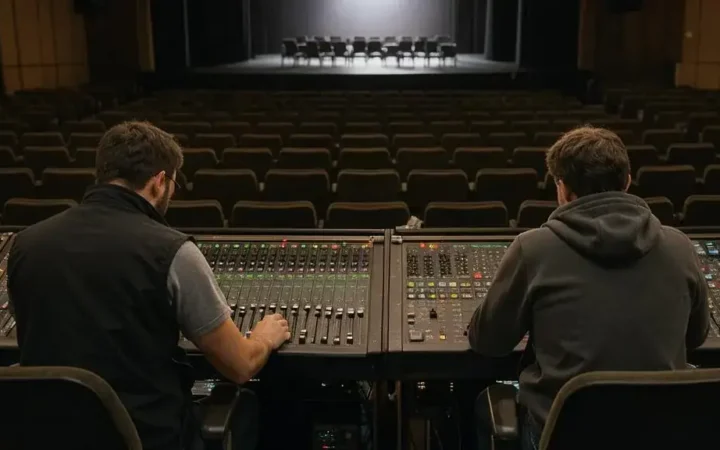
Front of house
Production & AV
The area and the technical position facing the stage where sound and lighting are controlled; also the guest-facing side of an operation.
Read more
The value proposition and the proof behind it
Module 3: Positioning, Niche and Offer · 15 min
A value proposition says what a client gets from you that they cannot easily get elsewhere, and the proof makes them believe…
Read more