Delegates rate a conference on the content and remember it by the coffee. Breaks are where the networking happens, lunch is the only slot the whole audience is in one place, and the reception is where sponsors meet buyers. Budget each of them on purpose.
Read the transcript
Conference food and drink.
Delegates rate a conference on the content and remember it by the coffee.
Breaks are where the networking happens, lunch is the only slot the whole audience is in one place, and the reception is where sponsors meet buyers.
Breaks.
Two breaks a day, 20 to 30 minutes each, roughly every 90 minutes of programme.
Coffee and tea must be hot and fast: one double-sided station per 100 delegates, placed on the route between the plenary and the breakout rooms rather than in a corner.
Lunch.
Whichever format, put the lunch room on the run of show with a start time, a last-service time and a reset time, and tell the first afternoon speaker the real time the room will be seated.
The reception.
Two hours, passed canapés at roughly eight to twelve pieces per guest if it follows a full lunch day and does not replace dinner, and a hosted bar with a cap.
A consumption bar with a stated limit is easier to control than a per-person package when attendance is uncertain.
Dietary planning.
Collect dietary needs on the registration form with a free-text field for allergies, then code them (V, VG, GF, H, K, NUT, DF) and give the caterer the counts in writing with the final guarantee.
For a buffet, label every dish with ingredients; for plated, give the banquet captain a table-by-table list.
The service charge and HST.
Hotels and banquet venues commonly add an 18 percent service charge on food and beverage, and that service charge is itself taxable.
A 120 dollars per-delegate catering package therefore costs roughly 160 dollars once both are added, and venues habitually quote before either.
Alcohol rules.
At a licensed venue (hotels, convention centres, most conference centres) the venue serves under its own licence and you need no permit.
At an unlicensed venue (a campus room, a loft, a gallery) you need an AGCO Special Occasion Permit. A private event permit must be applied for at least 10 days ahead; a public event permit at least 30 days ahead and it needs municipal notification.
The full guide, with tables and checklists, continues below this video.
Breaks
Two breaks a day, 20–30 minutes each, roughly every 90 minutes of programme. Coffee and tea must be hot and fast: one double-sided station per 100 delegates, placed on the route between the plenary and the breakout rooms rather than in a corner. Morning break with pastries and fruit; afternoon break with something savoury and something sweet. Water stations in every room all day. Many hotels sell coffee by the gallon or the litre and by the hour; a continuous service all day costs more than two timed breaks but removes the queue at the start of each one.
Lunch
| Format | Time needed | Notes |
|---|---|---|
| Plated | 60–75 minutes | Most formal; needs round tables, a seating plan is optional; works for an awards lunch |
| Buffet | 45–60 minutes | Needs two lines per 150 delegates and 20% more floor space; the most common conference choice |
| Boxed or grab-and-go | 30–45 minutes | Lets delegates eat in a sponsor session; label every box with dietary codes |
| Food stations | 60 minutes | Best for mixed diets and a networking lunch; highest cost per head |
Whichever format, put the lunch room on the run of show with a start time, a last-service time and a reset time, and tell the first afternoon speaker the real time the room will be seated.

The reception
Two hours, passed canapés at roughly eight to twelve pieces per guest if it follows a full lunch day and does not replace dinner, and a hosted bar with a cap. A consumption bar with a stated limit is easier to control than a per-person package when attendance is uncertain. Roaming entertainment (ideas) keeps people in the room past the first drink.
Dietary planning
Collect dietary needs on the registration form with a free-text field for allergies, then code them (V, VG, GF, H, K, NUT, DF) and give the caterer the counts in writing with the final guarantee. For a buffet, label every dish with ingredients; for plated, give the banquet captain a table-by-table list. In our experience roughly a quarter of a professional audience in Toronto has at least one dietary requirement, and a buffet with clearly labelled vegetarian, halal and gluten-free options handles that better than special plates ordered one by one.
The service charge and HST
Hotels and banquet venues commonly add an 18% service charge on food and beverage, and that service charge is itself taxable. HST is 13%. A $120 per-delegate catering package therefore costs roughly $160 once both are added, and venues habitually quote before either. Ask whether the service charge reaches staff; it is not always a gratuity. Compare every quote on the all-in number. The food quantity calculator and the bar and alcohol calculator help size the order.
Alcohol rules
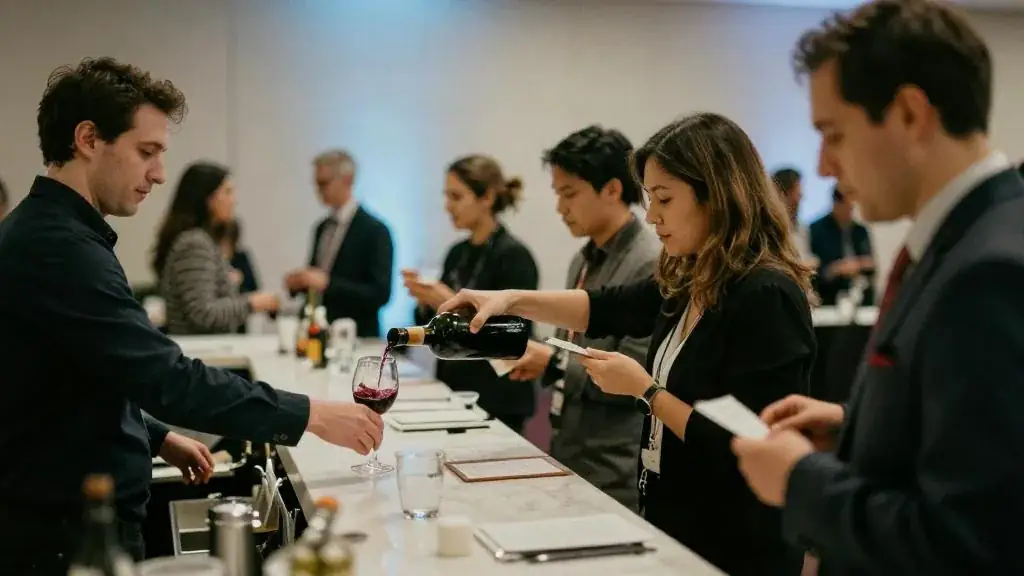
- At a licensed venue (hotels, convention centres, most conference centres) the venue serves under its own licence and you need no permit.
- At an unlicensed venue (a campus room, a loft, a gallery) you need an AGCO Special Occasion Permit. A private event permit must be applied for at least 10 days ahead; a public event permit at least 30 days ahead and it needs municipal notification. Smart Serve training is recommended for everyone serving, though the AGCO does not require it under a permit, the liquor must be bought from the LCBO, the Beer Store or a winery under the permit, receipts stay on site, and the permit is posted. Service hours are 9 a.m. to 2 a.m. (3 a.m. on New Year’s Eve) with last call at 1:45.
- No self-serve, no sponsors pouring from their own cases, and the bar closes before the room empties so the last delegates leave on their feet.
Guarantees and attrition
Venues require a final guaranteed number, often 72 business hours before, and bill the guarantee or the actual count, whichever is higher, with a set percentage of overage prepared. Give a guarantee slightly below your registered number to allow for no-shows (in our experience five to ten per cent for a paid conference, more for a free one) and let the overage cover walk-ups. If the venue contract includes an F&B minimum, confirm what counts toward it; audiovisual and room rental usually do not.
Related guides, venues and vendors
Sheraton Hotel Newfoundland
St. John's · 300+ guests
Outdoor space
A downtown hotel with 18 event rooms (about 17,400 sq ft) and an outdoor courtyard, the Court Garden.
Read more
Rodd Charlottetown
Charlottetown · 300+ guests
In-house catering
A historic downtown hotel with Georgian- and Victorian-style function rooms and full-service catering.
Read more
Toronto Botanical Garden
North York, Toronto · 150–299 guests
Near transit · Outdoor space
The Garden is a registered charity, and its event building is LEED Silver certified.
Read more