Acts that move among guests rather than performing from a stage: magicians, stilt walkers, characters, caricaturists.
Read the transcript
Roaming entertainment.
Acts that move among guests rather than performing from a stage: magicians, stilt walkers, characters, caricaturists.
How it works in practice.
Roaming acts solve a specific problem: the part of an event where guests are standing, eating, holding drinks and not yet sure who to talk to.
A stage show at that moment fights the room.
Worked numbers.
Typical GTA range, 2026, for a 200-guest event:
At the Harbour Gala, the two strolling magicians cover cocktails from 6 to 7 and the 25-minute gap before first plate.
How to handle it.
Match the act to the moment: arrivals, cocktail hour, transitions.
Use the ratio to decide how many performers, then check the budget.
More detail, examples and common mistakes are on this page, below the video.
How it works in practice
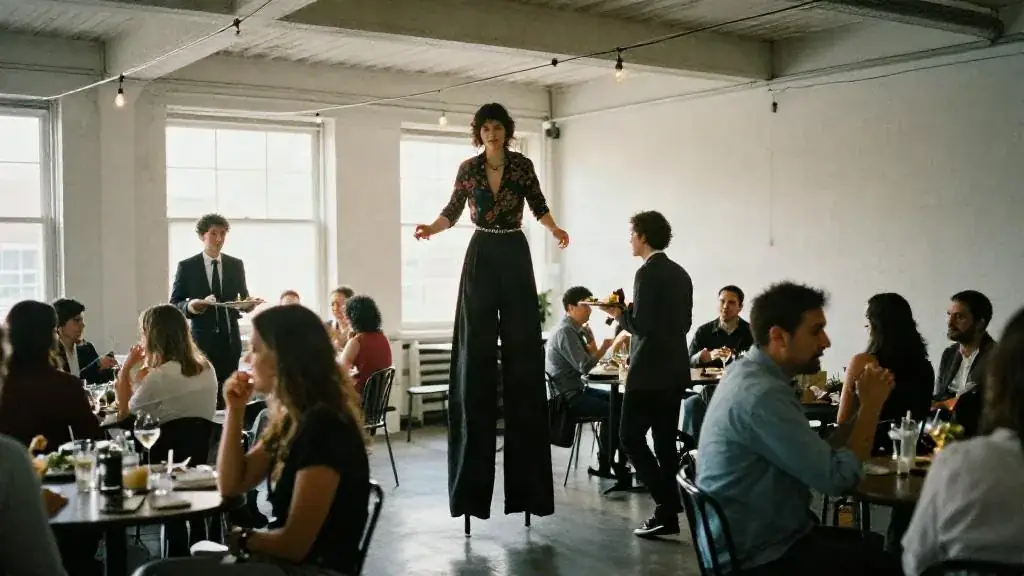
Roaming acts solve a specific problem: the part of an event where guests are standing, eating, holding drinks and not yet sure who to talk to. A stage show at that moment fights the room. A close-up magician working a group of six, a stilt walker at the door, or a caricaturist at a side table gives people a reason to gather and something to talk about afterwards.
Planning ratios vary with the act and the length of the reception. For a short cocktail hour, one performer per 40–60 guests reaches most groups. Across a long reception, one per 60–80 is usually enough. Strolling magicians and mentalists set the pace by working one group at a time; stilt walkers and costumed characters work in bursts and pose for photos.
Roaming acts need no stage and little or no AV, which is why they fit transitions and cocktail hours. They do need a briefing: who the VIPs are, which areas to avoid during speeches, and when to stop.
Worked numbers
Typical GTA range, 2026, for a 200-guest event:
| Act | When | Typical cost |
|---|---|---|
| Two close-up magicians | Cocktail hour plus 25-min gap before first plate | $1,200–$3,000 |
| Stilt walker (one) | Arrivals | Get quotes |
| Mentalist stage set | Before the paddle raise | $1,500–$5,000 |
At the Harbour Gala, the two strolling magicians cover cocktails from 6 to 7 and the 25-minute gap before first plate. They stop when the plates come out; nobody should perform over dinner service.
How to handle it
- Match the act to the moment: arrivals, cocktail hour, transitions.
- Use the ratio to decide how many performers, then check the budget.
- Brief performers on the room, VIPs and no-go zones.
- Put start and stop times in the run of show.
- Arrange a green room or secure spot for cases and breaks.
Use the entertainment hours planner to size coverage and the entertainment finder or directory to shortlist acts. Listings owned by the site founder carry a visible disclosure and get no ranking preference.
Why it matters
Fills cocktail hours and transitions with no AV; one act per 60–80 guests.
Example
Two roaming magicians and a stilt walker for a 200-guest holiday party.
Common mistakes
- Scheduling roaming acts during speeches
Related guides, venues and vendors

Dietary codes
Food & Beverage
Short labels (V, VG, GF, DF, NUT, H, K) placed on the seating chart so servers deliver the right plate.
Read more
Crowd density
Safety & Permits
The number of people per square metre in a space. Ontario's Building Code plans standing space at 0.4 m² a person (2.5…
Read more
Backdrop
Production & AV
A decorative or branded wall behind a stage, ceremony or photo moment.
Read more