Format, audience, room, program position and budget; the entertainment finder in depth.
Read the transcript
Matching acts to events.
Format, audience, room, program position and budget; the entertainment finder in depth.
Five filters, in order.
Most booking mistakes come from starting with the act ("the client loves aerialists") instead of the event.
A good match runs through five filters in a fixed order.
Program position, in practice.
Stage shows run 20 to 45 minutes, and the MC introduces every stage act.
The entertainment finder in depth.
The site's entertainment finder runs the five filters for you.
Event type and format. It removes acts that do not fit, so a seated dinner does not return roaming-only acts for the stage slot.
Worked example: matching the Harbour Gala.
Format: seated dinner with a standing cocktail hour.
Audience: 200 donors and sponsors, 40s to 70s, business and medical, black tie optional, English-speaking.
Common mistakes.
Booking the act the client saw on social media without checking the room.
One roaming performer for 300 people.
That is the lesson. The worksheet and the quiz are just below this video.
Five filters, in order
Most booking mistakes come from starting with the act (“the client loves aerialists”) instead of the event. A good match runs through five filters in a fixed order. Each one removes options, and by the end you usually have two or three acts that fit, not twenty.
- Format. Seated dinner, standing cocktail, theatre-style, trade show, outdoor festival, virtual. Format decides whether you need close-up, roaming or stage.
- Audience. Age, number, language, culture, and mood. Two hundred donors in black tie are not 200 sales staff at a kick-off.
- Room. Ceiling height, floor, sightlines, power, rigging, the venue’s rules on fire and haze, noise limits.
- Program position. What happens immediately before and after the act. The act serves the moment, not the other way around.
- Budget. Last, because budget always narrows. Starting with budget picks the cheapest act, not the right one.
Program position, in practice
| Position in the program | What it needs | Good fits | Poor fits |
|---|---|---|---|
| Arrival and cocktail hour | Mixes people, works in small groups, quiet enough to talk over | Strolling magicians, roaming mentalists, stilt walkers, roaming characters; roughly 1 performer per 40 to 60 guests | Anything that needs the room to stop and watch |
| Gap before first plate | Table-level, interruptible, 20 to 30 minutes | Strolling close-up | Stage acts; servers are about to cross the room |
| During dinner service | Nothing on stage | Background music only | Every stage act |
| Before the ask or awards | A seated audience held together, a calm high point, under 30 minutes | Mentalist, storyteller, a quiet visual act | Loud, high-energy acts that the speaker then has to calm down |
| Before the dance floor opens | Energy, spectacle, a reason to stand up | Aerial, LED, acrobatics, a band’s first set | Anything quiet |
Stage shows run 20 to 45 minutes, and the MC introduces every stage act.
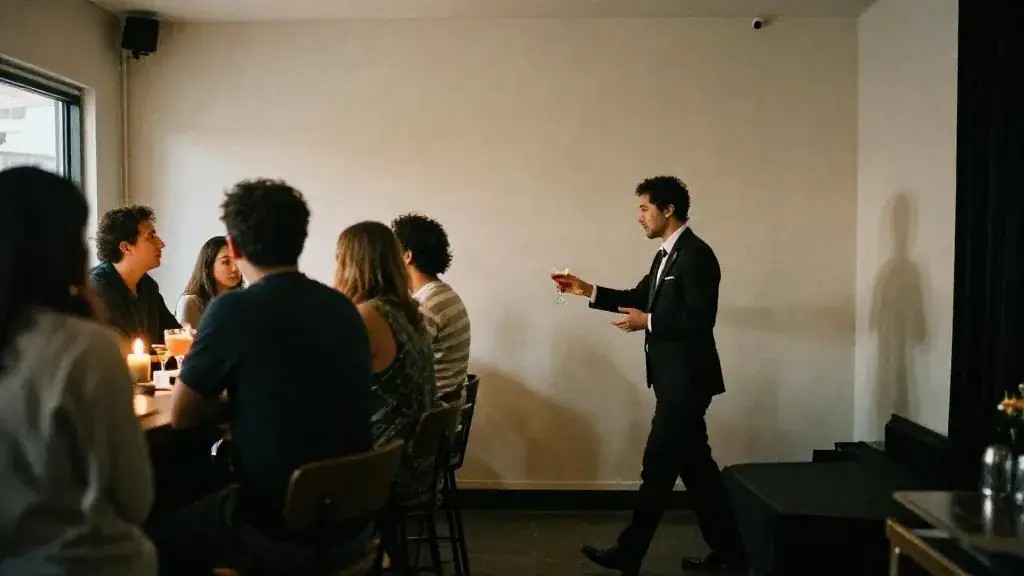
The entertainment finder in depth
The site’s entertainment finder runs the five filters for you. You enter:
- Event type and format. It removes acts that do not fit, so a seated dinner does not return roaming-only acts for the stage slot.
- Guest count. It works out how many strolling performers you need at roughly 1 per 40 to 60 guests.
- Ceiling height and rigging availability. Aerial acts disappear if the ceiling is under the typical 4.5 m minimum or there is no rated rigging point.
- Indoor or outdoor, and fire rules. Fire acts are only offered when you confirm the venue permits open flame and you can arrange approvals.
- Program position. It suggests acts that suit cocktails, the dinner gap, before the ask, or before the dance floor.
- Budget. Results show the typical GTA range for each category so you can see what fits.
The finder returns categories and then links to matching listings in the directory. It does not rank founder-owned listings higher; those carry a visible disclosure. Use the entertainment hours planner next to turn the shortlist into booked hours that match your run of show.
Worked example: matching the Harbour Gala
Format: seated dinner with a standing cocktail hour. Audience: 200 donors and sponsors, 40s to 70s, business and medical, black tie optional, English-speaking. Room: 420 m² ballroom, 4.9 m ceiling, two pillars on the north wall, no certified rigging point, hotel permits only enclosed candles.
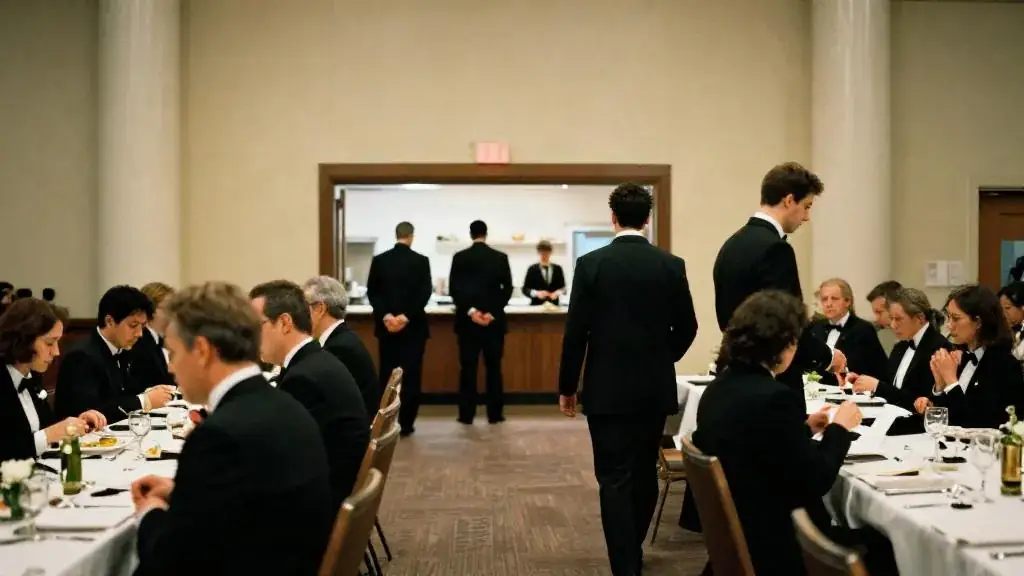
Run through the finder:
- Cocktail hour, 200 guests: 3 to 5 strollers at the 1-per-40-to-60 ratio. Budget allowed two; the planner accepted the lower end, knowing guests cluster near the bar and the silent auction.
- The 25-minute gap before first plate: the same two strollers, working the tables. Booked hours: 6:00 to 7:25, roughly 90 minutes on the floor.
- Before the ask: the finder offered mentalist, comedian and storyteller. A mentalist was chosen because the set ends on a quiet high, works for a seated room, and needs only a mic, a small table and a stool.
- Aerial was filtered out for the ceiling and rigging. Fire was filtered out for hotel rules. A band for the post-ask dance floor was considered and dropped; the foundation wanted guests home by 11.
Spend: within the typical GTA ranges of $600 to $1,500 per strolling magician for 2 hours and $1,500 to $5,000 for a stage mentalist.
Common mistakes
- Booking the act the client saw on social media without checking the room.
- One roaming performer for 300 people.
- A stage act during dinner service.
- A big high-energy act right before a speech that needs a quiet room.
- Starting with budget and ending with the cheapest act on the list.
Ontario rules that apply
Matching an act to the room includes matching it to the rules the room operates under. Several come up again and again in the GTA.
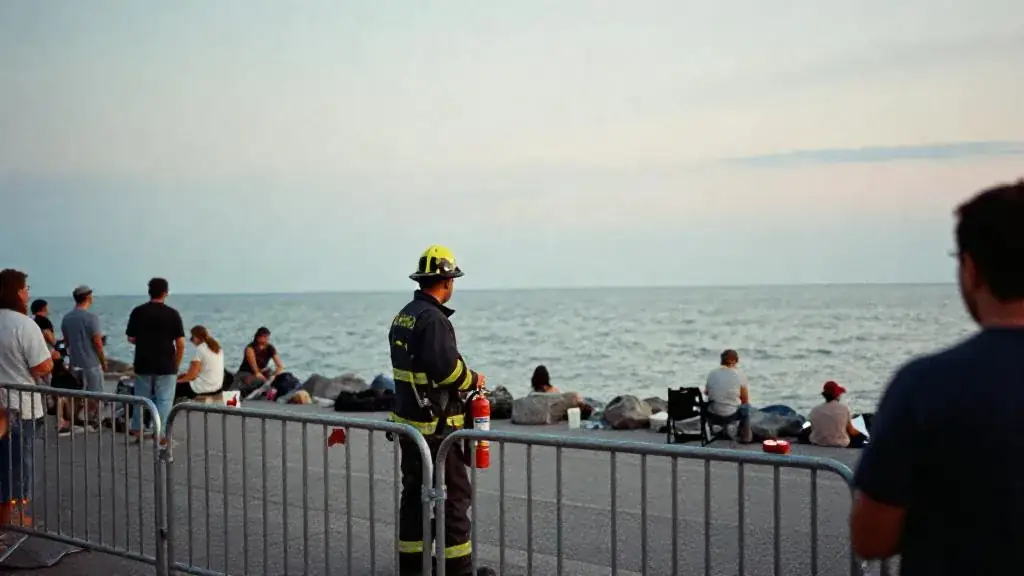
Open flame and fire performance are governed by the Ontario Fire Code and enforced by the local fire service. Many venues prohibit fire indoors outright; where it is possible, expect to need the venue’s written approval, the fire service’s approval, a safety plan, and often a dedicated fire safety person standing by. Haze and pyrotechnic effects can trigger detection systems and have their own approval process. Treat these as weeks of lead time, not a phone call the week before.
Insurance is a filter, not a formality. Most venues require a certificate of insurance from performers, especially for aerial, fire, stilt and physical acts, naming the venue and often the client as additional insured. An act that cannot provide one in time should drop off the shortlist, however good it is.
Music licensing is separate from the performer’s fee. Public performance of recorded and live music in Canada is licensed through SOCAN, and recorded music also through Re:Sound. Venues often hold licences that cover their own events, but not always for every use. Ask the venue, and do not assume the DJ or band has taken care of it.
For children’s events, ask whether a performer working closely with children has a recent police vulnerable sector check, and whether their staff do too. Many schools, camps and community organizations require one.
Outdoors, municipal noise bylaws and permit conditions set the hours and volume for amplified sound. A loud act booked at the wrong end of the evening can bring the event to an early close. Check the permit before you place the act in the program.
Accessibility shapes the match too. Under the AODA, many organizations must make their services accessible. For entertainment, this means sightlines from accessible seating, captioning or a sign language interpreter for spoken acts where needed, and a warning about strobe effects for guests who are sensitive to them.
Matching for GTA audiences
The audience filter carries extra weight in the GTA, where a single guest list can span many languages, cultures and faiths. Visual acts such as aerial, juggling, LED and illusion travel across languages; spoken comedy and wordplay often do not. If a third of the room is more comfortable in another language, a heavily verbal act will lose them.
Ask about cultural and religious considerations before you propose anything. Some audiences expect an alcohol-free program, modest costuming or gender considerations in who performs and how. Some corporate audiences will need comedy that avoids targeting groups in the room. None of this narrows the options as much as people fear; it simply moves certain acts off the list and puts others on it.
Age matters in both directions. Children’s acts need short attention spans, interaction and a performer experienced with kids. Older audiences often prefer seated, well-lit, clearly amplified acts to roaming performers who appear at their elbow.
Numbers to know
- Travel time: a performer coming from across the GTA in rush hour can need well over an hour. Build arrival and load-in times around traffic, not distance.
- Arrival: ask for performers on site well before their first set, with a green room or private space to change and warm up.
- Stage space: an act’s minimum stage size, ceiling clearance and floor surface should be in writing before you quote it to the client.
- Power: lighting and sound for an act can need dedicated circuits. Confirm with the venue’s AV team.
- Breaks: roaming performers typically need short breaks within a long shift. Plan cover so the floor is never empty at the busiest moment.
Questions to ask a performer before you shortlist
What space, ceiling height, floor and power does the act need? How long is the set, and can it be shortened without losing the ending? What insurance do you carry, and how quickly can you send a certificate? Have you performed in this venue or a similar room? What languages do you perform in? Are there audiences or settings the act does not suit? Who replaces you if you are ill, and how is that handled? The answers decide whether the act stays on the list.
How this connects to the next lesson
The five filters give you a shortlist; the act’s technical requirements decide whether it can actually happen. The next lesson, riders, rigging and ceiling heights, takes each finalist through the rider and the venue’s technical rules, so the act you matched on paper also fits the room on the night.
Worksheet
Apply this lesson to a real or practice event using the worksheet, then mark the lesson complete to track your progress toward the certificate.

Related guides, venues and vendors
Ceremony logistics and the marriage licence
Specialist · Weddings · 15 min
Ontario licence rules, officiants, ceremony order, processional and recessional, rain plans.
Read more
Writing the run of show
Module 7: Logistics & Operations · 15 min
Minute by minute, one owner per cue, printed. Build one from the template with AV, MC, catering and entertainment columns.
Read more
Galas and award nights
Specialist · Corporate · 15 min
Program shape, sponsorship, the ask, and spectacle before the ask.
Read more