Scheduling acts, changeovers, sound limits, power distribution and roaming entertainment across a site.
Read the transcript
Stage programming and production.
Scheduling acts, changeovers, sound limits, power distribution and roaming entertainment across a site.
Programming a site, not a stage.
At a festival, programming is not only about what happens on stage.
It is about where people are at each hour and why.
Scheduling acts.
Build the main stage schedule around three rules:
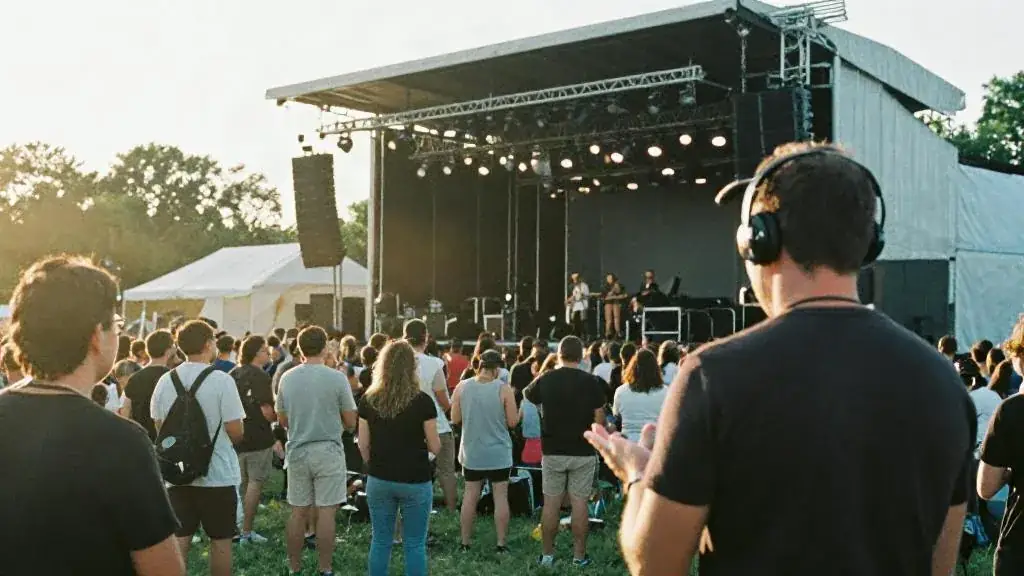
Build towards the peak. Open with acts that suit people arriving and eating, and put the strongest act at the hour you expect the peak crowd, not at the very end.
Changeovers.
Changeovers are where schedules slip.
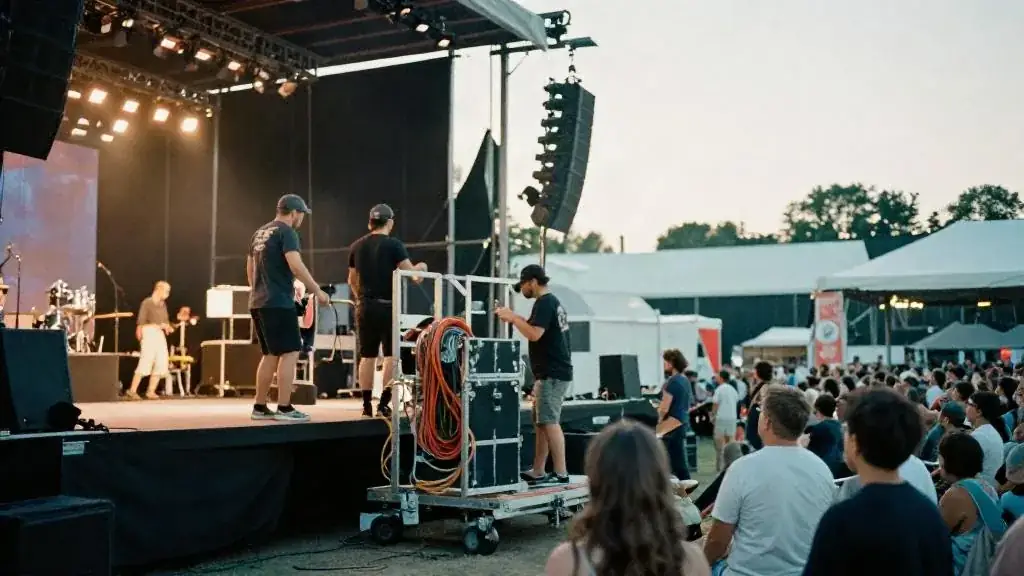
In our experience, a DJ to DJ change takes a few minutes; a band to band change on shared backline can be done in 15 to 20 minutes; a full band with its own gear, or any act with rigging or set pieces, can take 30 minutes or more.
Sound limits.
Noise is the complaint that ends festivals.
In Toronto, amplified sound limits are stricter from 11 p.m. to 7 a.m. under Chapter 591, and an exemption permit for outdoor amplified sound takes about four weeks to process.
Power distribution.
Ask every vendor and act for their power needs in writing: what equipment, how many amps, at what voltage.
Food vendors with fryers and grills draw far more than people expect.
That is the lesson. The worksheet and the quiz are just below this video.
Programming a site, not a stage
At a festival, programming is not only about what happens on stage. It is about where people are at each hour and why. The main stage pulls the crowd to one end, the food draws it to the middle, and roaming acts keep people moving and fill the gaps. A good program spreads the crowd across the site through the evening; a bad one sends everyone to the same place at the same time.
Scheduling acts
Build the main stage schedule around three rules:
- Build towards the peak. Open with acts that suit people arriving and eating, and put the strongest act at the hour you expect the peak crowd, not at the very end.
- End before the crowd does. A headliner that finishes at closing time sends everyone to the exits at once; finish the headliner earlier and close with a gentler set so departures spread out.
- Stagger stages. If there are two stages, start sets on one while the other is changing over, so the crowd moves rather than waits.
Every act gets a contract that states its set time, the length of its set, the changeover window, what the festival supplies (backline, sound, power, a tent) and what the act supplies. Send the performer tech rider template to every act and get it back before you build the stage plot.
Changeovers
Changeovers are where schedules slip. In our experience, a DJ to DJ change takes a few minutes; a band to band change on shared backline can be done in 15 to 20 minutes; a full band with its own gear, or any act with rigging or set pieces, can take 30 minutes or more. Fill the gap with the MC, a short roaming act at the stage front, or a DJ on a small table at the side of the stage. A stage manager owns the clock and has authority to cut a set that runs over.
| Time | Main stage | Acoustic stage | Roaming |
|---|---|---|---|
| 5:00–6:00 | DJ set | Closed | Two stilt walkers at entrances |
| 6:00–6:45 | Local band | Solo singer, 6:15–7:00 | Close-up magicians in the food area |
| 6:45–7:05 | Changeover; MC and DJ | — | Juggler at the main stage front |
| 7:05–8:00 | Dance group, then band | Duo, 7:15–8:00 | Close-up magicians; stilt walkers |
| 8:00–8:20 | Changeover | — | Roaming performers at the stage front |
| 8:20–9:30 | Headliner | Closed during headliner | Performers in the food area |
| 9:30–10:40 | DJ set, volume stepped down from 10:15 | Acoustic set, 9:45–10:30 | Roaming acts toward the exits |
Sound limits
Noise is the complaint that ends festivals. In Toronto, amplified sound limits are stricter from 11 p.m. to 7 a.m. under Chapter 591, and an exemption permit for outdoor amplified sound takes about four weeks to process. Other GTA municipalities have their own by-laws and exemption processes; check with the city. Whatever the permit allows, point stages away from homes, keep subwoofer levels in check, and walk the perimeter with the sound engineer during the first set. Write the end time and any volume conditions in every act’s contract and on the stage manager’s sheet.
Power distribution
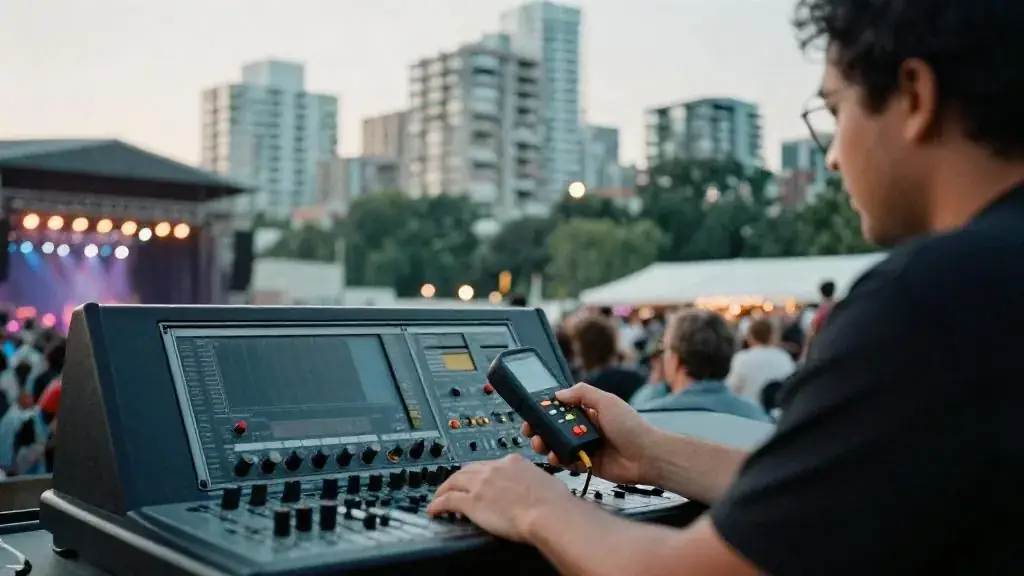
Ask every vendor and act for their power needs in writing: what equipment, how many amps, at what voltage. Food vendors with fryers and grills draw far more than people expect. Build a power plan that puts sound on its own clean circuit, separates food vendor loads from stage loads, and lists every generator or tie-in with its rating and the loads on it. Generators need fuel for the whole event plus a margin, a safe refuelling plan, and placement away from crowds and tents. Cables across walkways need rated ramps. A licensed electrician or the generator supplier should sign off on the plan; check whether the municipality or the electrical safety authority needs to inspect it.
Roaming entertainment
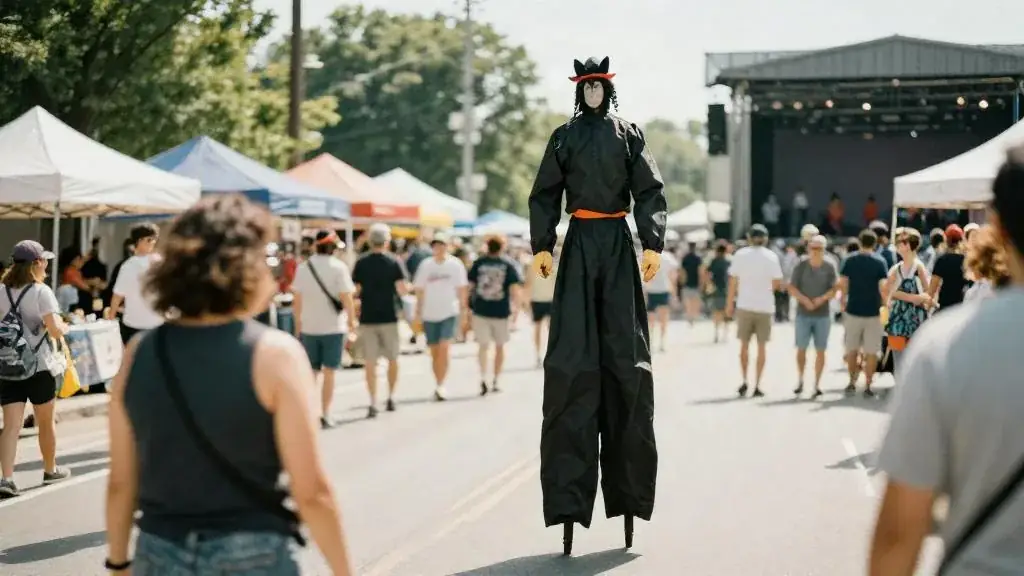
Roaming acts are the cheapest way to make a site feel alive and to steer the crowd. Use them to draw people to quieter areas, to entertain queues, to fill changeovers and, near the end, to lead people gently toward the exits. One close-up performer per 40 to 60 people works for cocktail hours; at a festival, think in zones instead and place performers where people wait. Close-up magicians, stilt walkers, jugglers and living statues all work outdoors; fire performers need venue or city approval, often fire department approval, and a fire watch with extinguishers. Plan their hours in the entertainment hours planner and find acts with outdoor experience in the entertainment finder; listings owned by the site founder carry a visible disclosure and no ranking preference.
Worked example: the Lakeshore Night Market
The Lakeshore Night Market runs two stages and a roaming program from 5 to 11 p.m., with the schedule above as its spine. The headliner finishes at 9:30, an hour and a half before close, so the 8,000 visitors leave across the last two hours rather than in one rush. The acoustic stage goes quiet during the headliner so it does not compete. Two stilt walkers greet arrivals, three close-up magicians work the food queues at the peak hours, and a juggler covers the main stage front during the changeovers. The power plan separated the 40 food vendors onto two generators and gave the main stage its own. Sound levels were checked at the nearest homes during the first set, and the DJ stepped the volume down from 10:15.
Numbers to remember
- Changeovers: plan 15 to 20 minutes on shared backline, 30 or more for a full band, in our experience.
- Toronto amplified sound limits tighten from 11 p.m.; a noise exemption takes about four weeks.
- Finish the headliner well before closing so departures spread out.
- Fire performers: approvals, a fire watch and extinguishers.
Worksheet
Apply this lesson to a real or practice event using the worksheet, then mark the lesson complete to track your progress toward the certificate.
Related guides, venues and vendors

Ask a Performer: a touring juggler on what planners get wrong
October 21, 2026 · 1 min read
An internationally touring juggler on riders, ceilings, set lengths, and the one question he wishes every planner asked.
Read more
Entertainmentverse
Circus & Aerial Acts, Entertainment, Fire, LED & Glow Acts, Magicians, Roaming Acts · Roaming acts from $650 · stage shows from $1,800
Entertainment agency combining the Magic Magic and Circus Universe rosters with new act categories: magic, circus, aerial, fire and LED, roaming characters,…
Read more
Site planning and crowd management
Specialist · Festivals & Public Events · 15 min
Site maps, egress, density, barriers, security ratios, medical and weather.
Read more