Recruiting, briefing, shifts, radios and recognition.
Read the transcript
Volunteers and staffing.
Recruiting, briefing, shifts, radios and recognition.
Volunteers are staff without a paycheque.
Most community festivals in the GTA could not run without volunteers.
They staff information tents, count crowds, direct traffic within the site, sort recycling, and greet vendors.
Recruiting.
Start two to three months out.
The best sources, in our experience: the organizing group's own members, local high schools (Ontario students need community involvement hours to graduate, so ask the school how hours are recorded), colleges with event or hospitality programs, service clubs, faith communities and businesses with volunteer days.
Shifts and roles.
Keep shifts to three or four hours.
Overlap them by 15 minutes so the outgoing person can brief the incoming one.
Briefing and radios.
Run one training session a week ahead (online is fine) and a 15-minute briefing at the start of every shift.
Every volunteer should leave the briefing knowing five things:
Recognition.
Recognition is cheap and it is what brings people back.
Give each volunteer a shirt that identifies them, a meal during their shift, and water throughout.
That is the lesson. The worksheet and the quiz are just below this video.
Volunteers are staff without a paycheque
Most community festivals in the GTA could not run without volunteers. They staff information tents, count crowds, direct traffic within the site, sort recycling, and greet vendors. Treat them as staff: give them a defined role, a shift, training, food, water and a person to report to. Volunteers who know what they are doing come back next year; volunteers who stood around confused do not.
Some roles are not for volunteers. Licensed security, first aid, anyone serving alcohol (who must be Smart Serve certified under the SOP), traffic control on open roads and anything involving cash or rigging belong to trained, paid or certified people. Know where that line is before you recruit.
Recruiting
Start two to three months out. The best sources, in our experience: the organizing group’s own members, local high schools (Ontario students need community involvement hours to graduate, so ask the school how hours are recorded), colleges with event or hospitality programs, service clubs, faith communities and businesses with volunteer days. Write a short role description for each position with the time, the place, what the person does and who they report to. Collect only what you need on the sign-up form: name, contact information, emergency contact, shift preference, accessibility needs and, for students, the school. PIPEDA principles apply: say why you collect it, protect it, and delete it when the season is over.
Shifts and roles
| Role | When | Notes |
|---|---|---|
| Set-up crew | From road closure to opening | Physical work; closed-toe shoes; supervised by the site manager |
| Information and lost persons | Opening to close, in shifts | Knows the site map and the lost-child procedure |
| Entrance greeters and counters | Opening to peak, in shifts | Clickers for attendance counts each hour |
| Vendor liaison | Load-in to close | Knows vendor spots, power and the vendor agreement |
| Waste and recycling | Through the event and tear-down | Gloves, sorting guide; rotate often |
| Tear-down crew | Close to road reopening | A fresh crew, not the people who did set-up |
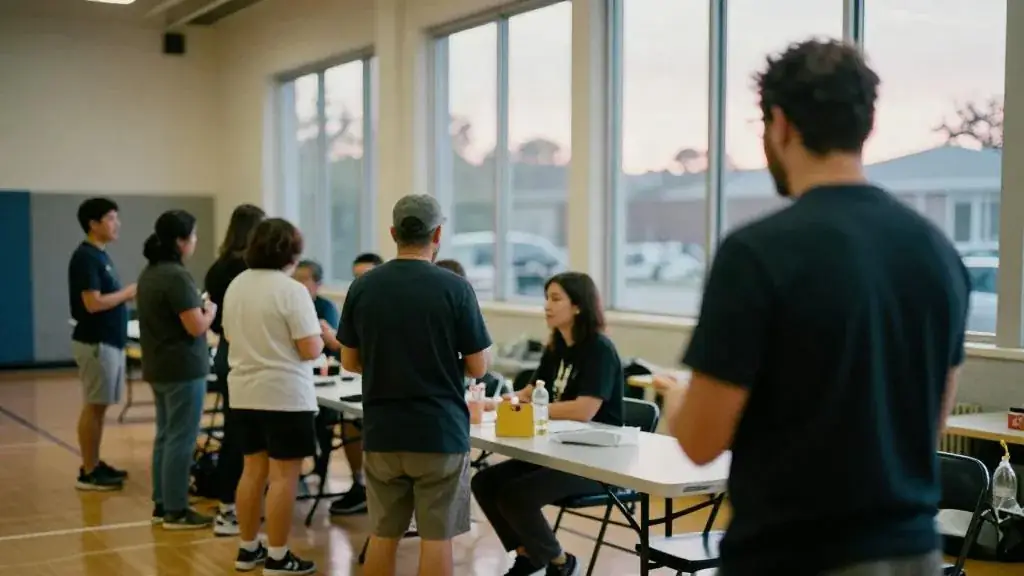
Keep shifts to three or four hours. Overlap them by 15 minutes so the outgoing person can brief the incoming one. Recruit about 20 per cent more volunteers than positions; in our experience some always cancel or do not show.
Briefing and radios
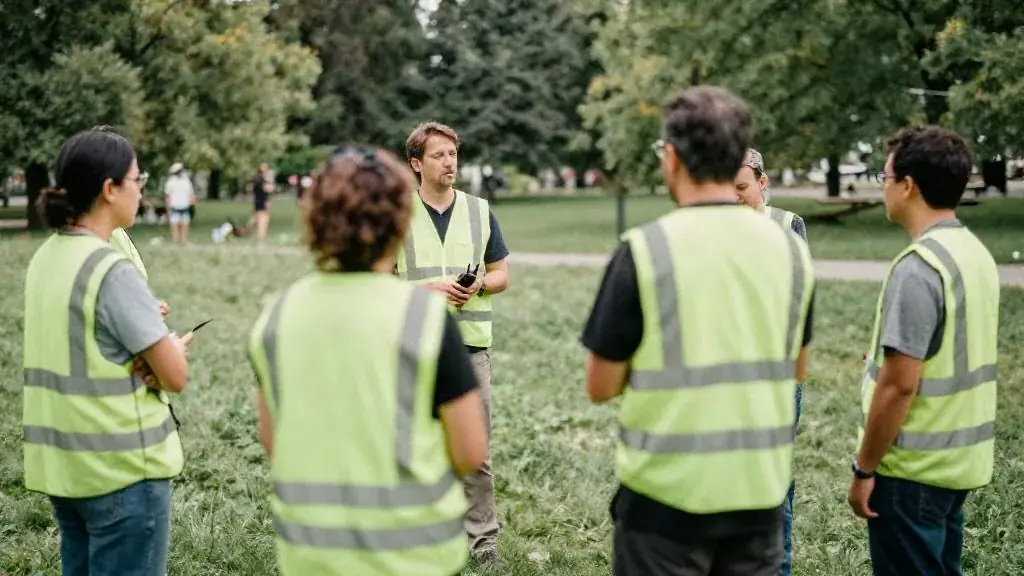
Run one training session a week ahead (online is fine) and a 15-minute briefing at the start of every shift. Every volunteer should leave the briefing knowing five things:
- Their role and their supervisor’s name.
- Where first aid, the information tent and the command post are.
- What to do in an emergency: call the supervisor, not 911, unless life is at risk, and never try to handle a fight or a medical emergency themselves.
- The lost-child procedure.
- Where to get water, food and a break.
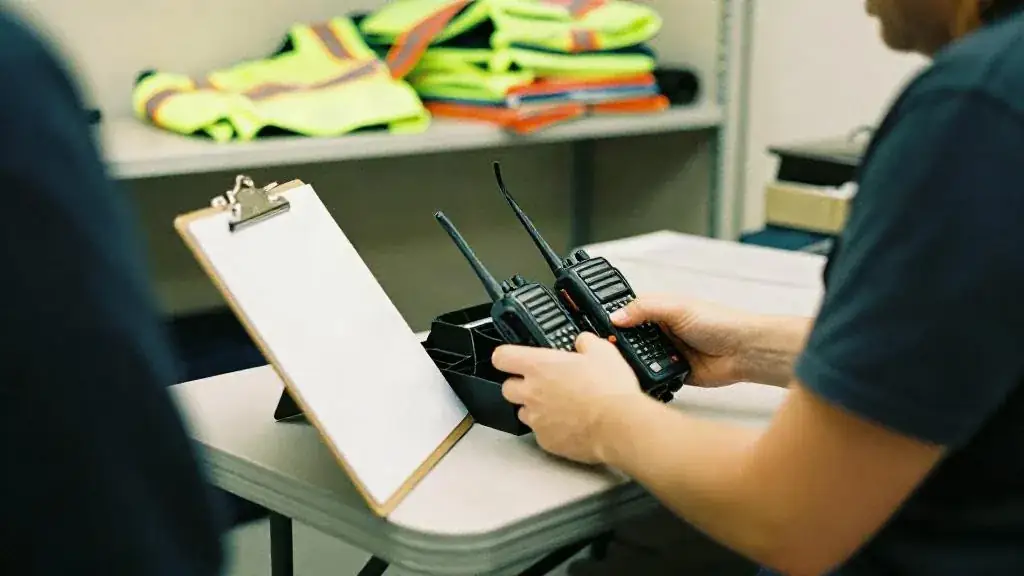
Give radios to supervisors and to roles that need them (vendor liaison, entrances). Use separate channels for safety and for operations, write the channel plan on a card, and teach basic radio discipline: say who you are calling and who you are, keep it short, and keep the safety channel clear. Test every radio and charge the spares the day before. Put each supervisor’s number on the vendor contact sheet and give volunteers a pocket map.
Recognition
Recognition is cheap and it is what brings people back. Give each volunteer a shirt that identifies them, a meal during their shift, and water throughout. Thank them in person at the end of the shift, and on stage if the program allows. Within a week, send a thank-you email with photographs, the attendance figure and what their work made possible, and sign off students’ volunteer hours promptly. Ask for feedback with the post-event survey template, and invite next year’s supervisors from this year’s best volunteers.
Worked example: the Lakeshore Night Market
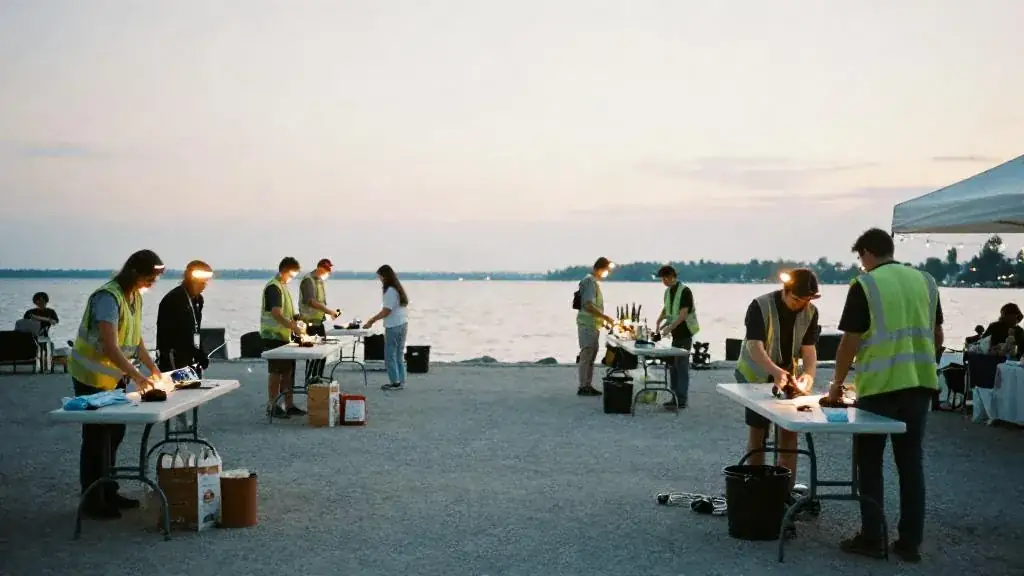
The Lakeshore Night Market needs roughly 70 volunteer positions across set-up, the evening and tear-down for its 8,000 attendees, and it recruited 85 people. Students from two local high schools filled most of the evening roles, and the schools told the organizers how to record hours. A service club took waste and recycling. Shifts were three and a half hours with 15-minute overlaps. Each of six supervisors had a radio on the operations channel and could switch to the safety channel; the command post monitored both. Licensed security, the first-aid responders and the Smart Serve certified beer garden staff were paid, not volunteers. Every volunteer got a shirt, a meal voucher for a food vendor and a pocket map. The thank-you email went out four days later with the attendance count and a photo of each crew.
Common mistakes
- Using volunteers for roles that need a licence, certification or payment.
- No supervisor, so nobody knows who to ask.
- Shifts of six hours or more with no break or food.
- The same crew doing set-up and tear-down.
- No thank-you, and then no volunteers next year.
Worksheet
Apply this lesson to a real or practice event using the worksheet, then mark the lesson complete to track your progress toward the certificate.
Related guides, venues and vendors

Ask a Performer: a touring juggler on what planners get wrong
October 21, 2026 · 1 min read
An internationally touring juggler on riders, ceilings, set lengths, and the one question he wishes every planner asked.
Read more
Permits, road closures and the city
Specialist · Festivals & Public Events · 15 min
Toronto and GTA processes for street events, parks, noise, food vendors and road closures.
Read more
Entertainmentverse
Circus & Aerial Acts, Entertainment, Fire, LED & Glow Acts, Magicians, Roaming Acts · Roaming acts from $650 · stage shows from $1,800
Entertainment agency combining the Magic Magic and Circus Universe rosters with new act categories: magic, circus, aerial, fire and LED, roaming characters,…
Read more