Uplighting, pin spots, washes, gobos, dance looks, blackout. How to plan lighting cues for a program.
Read the transcript
Lighting design for non-designers.
Uplighting, pin spots, washes, gobos, dance looks, blackout.
How to plan lighting cues for a program.
Six tools, and what each one does.
You do not need to be a lighting designer to light a ballroom well.
You need to know six tools, what each costs, and where to put them.
Specifying uplighting and pin spots.
Uplighting is sold by fixture count.
Count the wall length of the room, divide by 2.5 metres, add two fixtures per pillar and four for the backdrop.
Lighting cues follow the program.
A lighting cue is a change in the look of the room at a named moment.
Each cue needs a time, a trigger, a description and an owner.
Briefing the supplier.
Send the supplier the room dimensions and ceiling height, the floor plan with tables and stage marked, the venue's power and rigging rules, the load-in window and curfew, the fixture count you want, the colours by moment, and the cue list.
Ask for a quote that separates equipment, labour and the operator's hours.
Worked example: the Harbour Gala.
The gala's cue list has seven lines.
Doors at 6:00: uplights amber at 70 percent, house lights at 60 percent, stage wash off, cocktail area bright enough for the strolling magicians to be seen working.
That is the lesson. The worksheet and the quiz are just below this video.
What you will be able to do
- Specify uplighting and pin spots
- Plan lighting cues for the run of show
- Brief a lighting supplier
Six tools, and what each one does
You do not need to be a lighting designer to light a ballroom well. You need to know six tools, what each costs, and where to put them. A lighting supplier will do the rest, provided you give them a brief that says what you want the room to feel like at three or four moments in the evening.
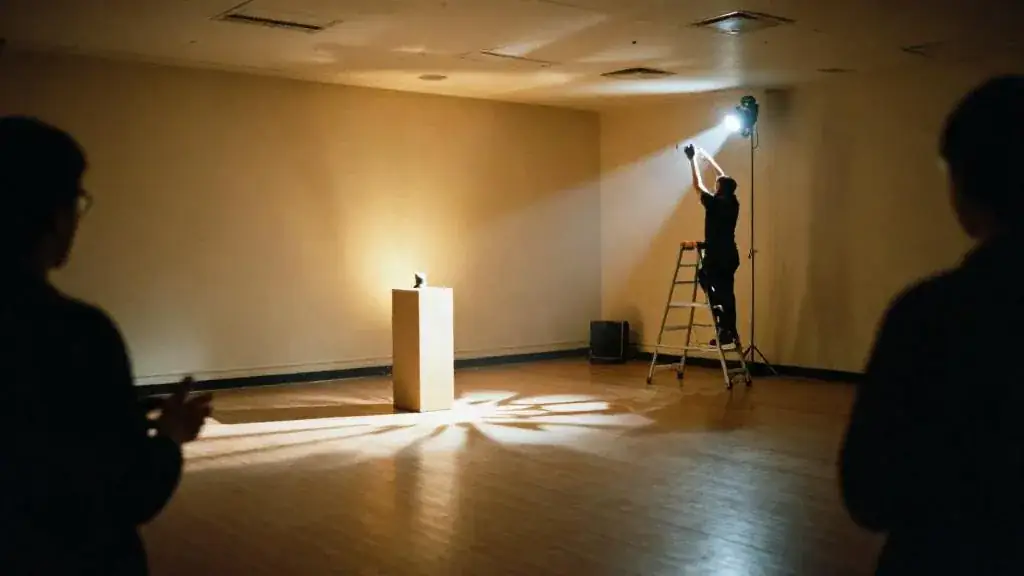
| Tool | What it does | Where it goes | Typical GTA range, 2026 |
|---|---|---|---|
| Uplights | Battery or cabled LED fixtures on the floor, shining up a wall, pillar or drape; colour-changeable | Every 2–3 m along the walls, at pillars, behind the stage | 20 fixtures $600–$1,200 |
| Pin spots | A narrow beam from the ceiling or a truss onto one centrepiece or one cake | One per table you want to glow; the head table first | Priced per fixture plus rigging labour |
| Wash | A broad, even light over the stage or dance floor so faces are visible and cameras can work | Front of stage, from a truss or stands | Part of most stage packages |
| Gobo | A metal or glass stencil in a fixture that projects a logo or pattern | On the backdrop, the dance floor or a blank wall | Custom gobo plus a projector fixture |
| Dance look | Moving heads or colour chases over the dance floor, usually run by the DJ or lighting operator | Dance floor only | Bundled with DJ or band packages, or separate |
| House lights and blackout | The venue’s own dimmable lighting, and the ability to take it to near-dark for a reveal | Controlled from the venue’s panel; ask who holds the key | Included with the room; find out what it can and cannot do |
Those six cover roughly everything a dinner, a product launch or a wedding needs. Festivals and concerts need a real designer; this lesson is about rooms.
Specifying uplighting and pin spots
Uplighting is sold by fixture count. Count the wall length of the room, divide by 2.5 metres, add two fixtures per pillar and four for the backdrop. For a 420 m² ballroom roughly 21 by 20 metres, that is about 30 to 34 fixtures to cover every wall, or 20 if you light three walls and the pillars and leave the kitchen wall dark, which nobody photographs anyway.
Specify the colour by name and by moment: “deep amber for arrival and dinner, shift to the foundation’s blue for the paddle raise, white at the end of the night for strike.” Battery fixtures avoid cables across the floor and are what most GTA suppliers now bring; ask how long the batteries last at full brightness and whether that covers your event from set-up to strike.
Pin spots need a mounting point above each table. In a hotel ballroom that usually means the ceiling grid, a truss, or clamped to existing fixtures, all of which need the venue’s approval and a supplier who is insured to rig. Ask at the site visit whether the ceiling can take pin spots and whether the venue charges for the lift. If the answer is no, light the centrepieces from the tables instead with small battery fixtures tucked into the arrangements.
Lighting cues follow the program
A lighting cue is a change in the look of the room at a named moment. Each cue needs a time, a trigger, a description and an owner. Here is how to build them.
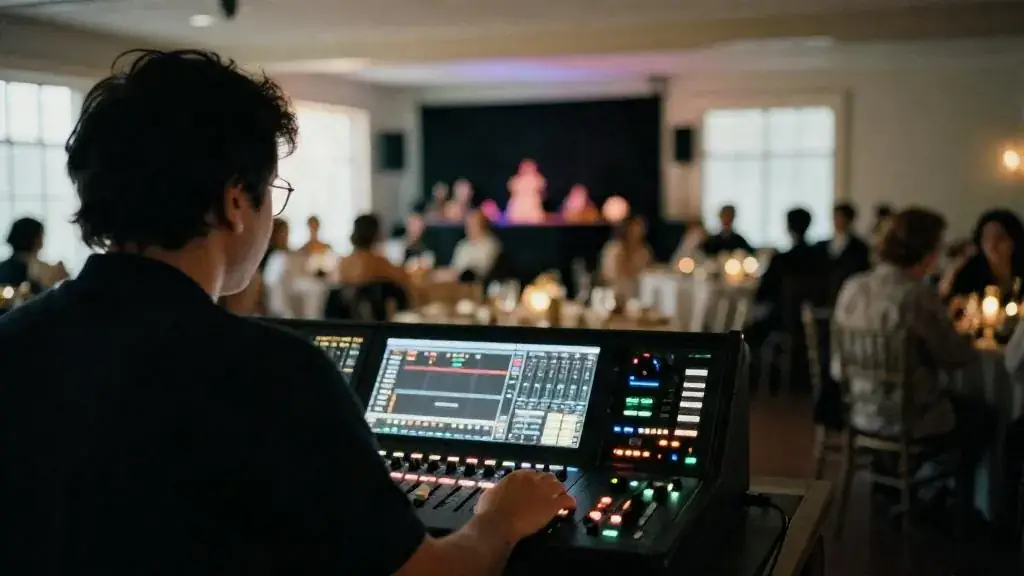
- Take the run of show and mark every moment where the room changes purpose: doors open, guests are seated, the program begins, a speaker takes the stage, the ask, the dance floor opens, last call.
- For each moment write what the room should look like in one plain sentence. “Warm and bright enough to find your seat.” “Dim, stage lit, attention on the podium.”
- Decide the trigger. Most cues are called by the stage manager or MC over radio (“standby lights, go lights”). Some are clock-based (doors at 6:00). Never leave a cue to be triggered by “when it feels right”.
- Assign one owner. The lighting operator executes; the stage manager calls. Two owners means nobody.
- Rehearse the two or three that matter most during the afternoon of the event. A reveal that goes to black while the MC is still walking to the podium is the one everyone remembers.
Write the cues into the run of show template in their own column so the lighting supplier can read only their column and still know everything they need.
Briefing the supplier
Send the supplier the room dimensions and ceiling height, the floor plan with tables and stage marked, the venue’s power and rigging rules, the load-in window and curfew, the fixture count you want, the colours by moment, and the cue list. Ask for a quote that separates equipment, labour and the operator’s hours. An operator who stays until 10 p.m. for the ask costs more than one who sets and leaves at 6; decide which you need and say so.
Worked example: the Harbour Gala
The gala’s cue list has seven lines. Doors at 6:00: uplights amber at 70 percent, house lights at 60 percent, stage wash off, cocktail area bright enough for the strolling magicians to be seen working. Seating at 7:00: house to 40 percent, pin spots on all 20 tables, stage wash to half. First course served, 7:15: hold. Program begins, 8:15: house to 20 percent, stage wash full, podium lit, gobo of the foundation logo on the backdrop. Mentalist set, 8:25: house to 10 percent, one tight spot centre stage, the mentalist has asked for the audience to be as dark as the hotel will allow. Paddle raise, 8:45: house back to 40 percent so the auctioneer and the spotters can see every paddle, uplights shift from amber to the foundation’s blue. Close, 9:30: house to 70 percent, uplights amber, stage wash off.
The supplier quoted 20 battery uplights, 20 pin spots clamped to the hotel’s ceiling grid with the hotel’s approval, a two-fixture stage wash, one gobo projector and an operator from 2 p.m. to 10 p.m. The two pillars on the north wall, which the committee had worried about for months, got two uplights each and vanished into the colour.
Numbers to remember
- One uplight every 2 to 3 metres of wall; two per pillar; four behind a backdrop.
- Twenty uplights typically run $600 to $1,200 in the GTA in 2026, before HST and before any operator time.
- Bring the house lights up for any moment when people must see each other or read: the ask, the auction, the dessert course, departure.
- Every cue needs a time, a trigger, a one-sentence look and one owner.
Worksheet
Download the worksheet, complete it for your own event (or the running gala example), and keep it in your course binder. It takes about 10 minutes.
Check your understanding
Related guides, venues and vendors
Site visits: the 25 questions
Module 4: Venues · 15 min
Walk a venue with the tour checklist. Learn what to photograph, what to measure, and which answers change the budget.
Read more
Guest journey mapping
Module 6: Design & Guest Experience · 15 min
Eight beats from invitation to the ride home. Find the moments guests remember, fix the ones they complain about.
Read more
Crowd management and emergency plans
Module 8: Legal, Safety & Risk (Ontario) · 15 min
Occupant loads, egress, crowd density, weather, medical, security ratios, and the one-page emergency plan every event needs.
Read more