How many staff per guest, roles, the 30-minute pre-event briefing, and radios.
Read the transcript
Staffing and briefings.
How many staff per guest, roles, the 30-minute pre-event briefing, and radios.
Staffing by ratio.
How many people does it take to run a 200-guest dinner?
More than the client expects and fewer than a nervous planner books.
The 30-minute briefing.
Thirty minutes before doors, everyone on the floor stands in one place with a printed run of show, and the planner walks the evening.
This is not a pep talk.
Radios and escalation.
Radios go to the people who move: planner, stage manager, dock lead, runners, venue captain and banquet manager, AV lead, lighting operator, head of security if there is one.
Greeters and coat check do not need them.
Worked example: the Harbour Gala.
The hotel supplied ten servers for 20 rounds, three bartenders for cocktail hour dropping to two once seated, a captain and a banquet manager, two coat check attendants, and its own door security per house policy.
The planner brought a stage manager (from the AV company, with the run of show), two greeters from the foundation's volunteer list trained that afternoon, one paid runner, a dock lead for 1:00 to 5:30 who became the second runner after doors, and herself.
Numbers to remember.
Roughly one server per 20 to 25 guests for plated service; ask the venue for their ratio.
Two greeters for 200; one more per additional 100.
That is the lesson. The worksheet and the quiz are just below this video.
What you will be able to do
- Staff an event by ratio
- Run a pre-event briefing
- Use radios and escalation
Staffing by ratio
How many people does it take to run a 200-guest dinner? More than the client expects and fewer than a nervous planner books. The venue supplies most of them: servers, bartenders, a banquet captain, a banquet manager, security at the door if the hotel requires it. The planner supplies the rest: the stage manager, the greeters, the coat check if the venue does not, the floor runners, and the person at the dock.
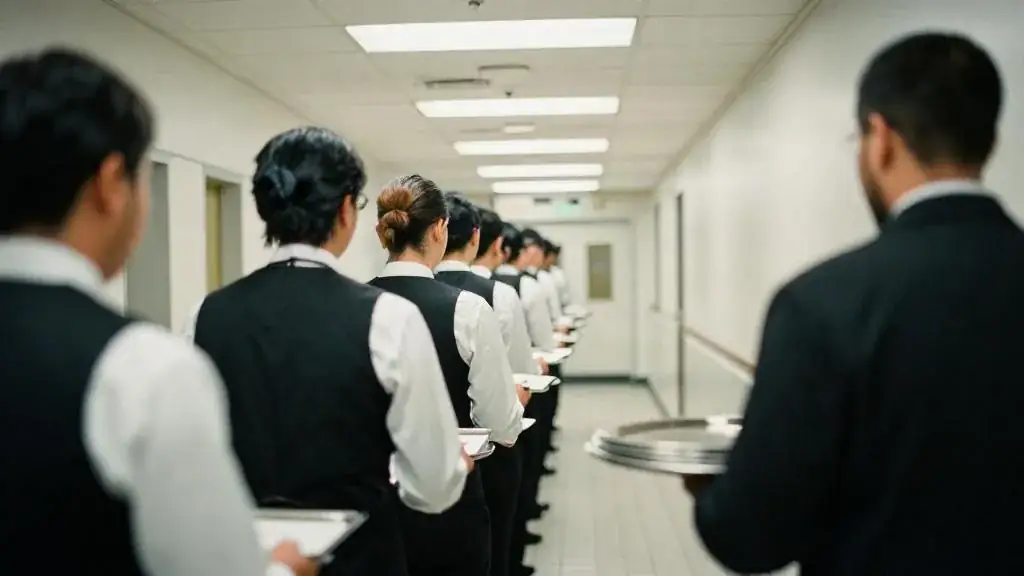
Ratios vary by venue and service style, so ask the venue for theirs and compare with the rough numbers below, which are typical in our experience for plated hotel service in the GTA.
| Role | Typical ratio or count | Supplied by | Notes |
|---|---|---|---|
| Servers, plated dinner | Roughly one per 20–25 guests; one per two rounds is common | Venue or caterer | Fewer for buffet, more for synchronized service or tableside |
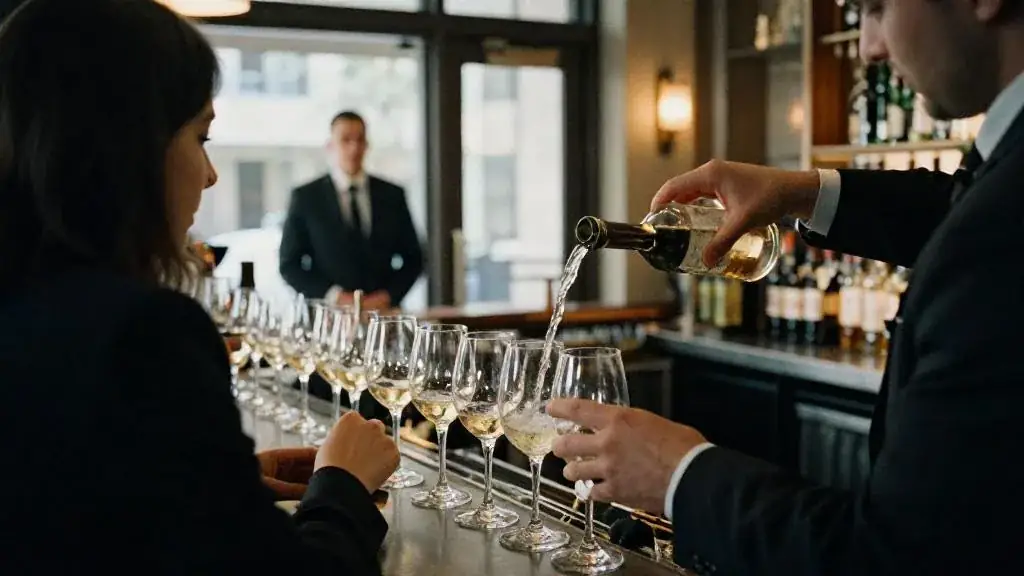
| Bartenders | Roughly one per 75–100 guests at cocktail hour; fewer once seated | Venue or caterer | All must be Smart Serve certified in Ontario |
| Banquet captain | One per event, plus a manager on larger floors | Venue | Your single point of contact for service cues |
| Greeters and check-in | Two for 200 guests; add one per 100 beyond that | Planner | Busy for 40 minutes, then redeploy to the floor |
| Coat check | Two at the surges, one in between | Venue or planner | Confirm who supplies it |
| Stage manager | One | Planner, or the AV company | Calls every cue; carries the run of show |
| Floor runners | One or two | Planner | Everything from a missing microphone to a lost guest |
| Dock and back of house | One during load-in and strike | Planner | Radio, list, keys |
| Security | Per venue policy and risk; typical GTA rate $35–$50 per hour | Venue or licensed provider | Required at some venues for licensed events or over a size |
| First aid | Per risk and size; typical GTA rate $45–$70 per hour for registered responders | Planner | A hotel may have its own protocol; ask |
For a 200-guest hotel gala, the planner typically brings five to seven people of their own: stage manager, two greeters, one or two runners, a dock lead for the afternoon, and themselves. The venue brings the rest.
The 30-minute briefing
Thirty minutes before doors, everyone on the floor stands in one place with a printed run of show, and the planner walks the evening. This is not a pep talk. It is the moment every hand-off is said aloud so that nobody discovers at 8:24 that they were supposed to do something.
- Introductions by role (two minutes). Name, role, where you will be. The venue captain and the AV lead are introduced to the planner’s team and vice versa.
- The evening in order (ten minutes). Doors, cocktails, seating call, service windows, program, ask, dessert, close, strike. Stop at every hand-off and ask the owner to say their cue back.
- Accessibility and dietary (three minutes). Where the step-free route is, where the quiet room is, which tables have accessible seating, how dietary codes reach the kitchen, who to call if a guest raises something.
- Escalation (three minutes). Who makes which decision. A spilled drink is the captain’s; a medical incident goes to first aid and the planner; a guest who should not be served is the bartender’s call, backed by the captain; a program change is the planner’s with the client. Nobody else decides anything with the client directly.
- Radios (two minutes). Who has one, which channel, how to speak.
- Questions (five minutes). Then everyone to position with ten minutes to spare.
Keep the day-of emergency kit at the stage manager’s position and say where it is.
Radios and escalation
Radios go to the people who move: planner, stage manager, dock lead, runners, venue captain and banquet manager, AV lead, lighting operator, head of security if there is one. Greeters and coat check do not need them. One channel for production (cues and logistics), a second for the venue’s own staff if they use their own. Earpieces for anyone on the floor during the program; a radio squawking during the mentalist’s set is the kind of thing guests remember.
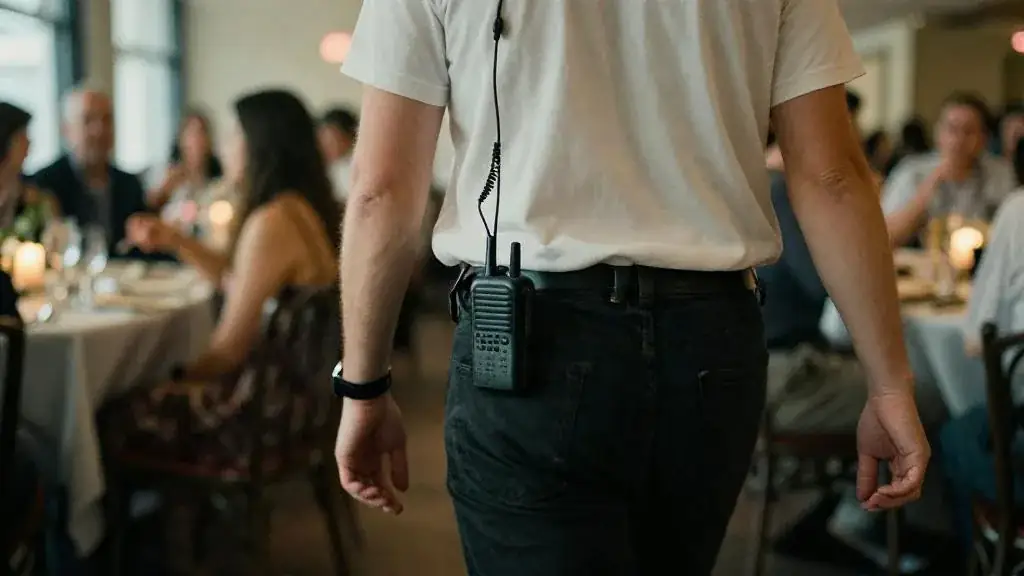
Radio discipline is simple: say who you are calling, then who you are, then the message, then wait. “Stage manager, this is dock, florist is on site.” Cues follow the theatre form: “Standby cue 5” and, when the moment comes, “Cue 5, go.” Nothing is said on the radio that would alarm a guest if overheard, because guests do overhear.
Escalation runs through the stage manager during the program and through the planner at all other times. The client talks to the planner only. Vendors talk to the planner or the stage manager, not to the client. That is not about control; it is about the client enjoying their own event.
Worked example: the Harbour Gala
The hotel supplied ten servers for 20 rounds, three bartenders for cocktail hour dropping to two once seated, a captain and a banquet manager, two coat check attendants, and its own door security per house policy. The planner brought a stage manager (from the AV company, with the run of show), two greeters from the foundation’s volunteer list trained that afternoon, one paid runner, a dock lead for 1:00 to 5:30 who became the second runner after doors, and herself. First aid was covered by the hotel’s protocol, confirmed in writing, with the nearest emergency department noted in the kit.
The briefing ran 5:15 to 5:45 in the ballroom with 22 people. The hand-offs said aloud were: captain confirms main cleared to stage manager by 8:12; MC warns the room before cue 5; dessert holds until the stage manager calls it after the ask; florist does not strike until the planner says the last donor has left. Radios: eight on channel one, earpieces for everyone in the ballroom from 8:10. The one escalation of the night was a guest at table 11 who had not listed a shellfish allergy and asked at the table; the server told the captain, the captain radioed the planner, the kitchen plated the vegetarian alternate, and the guest was eating within six minutes. Nobody asked the client anything.
Numbers to remember
- Roughly one server per 20–25 guests for plated service; ask the venue for their ratio.
- Two greeters for 200; one more per additional 100.
- Thirty minutes before doors; ten minutes in position before the first guest.
- Everyone serving alcohol holds Smart Serve.
- Security typically $35–$50 per hour and first aid $45–$70 per hour in the GTA in 2026; book per venue policy and risk, not per hope.
Worksheet
Download the worksheet, complete it for your own event (or the running gala example), and keep it in your course binder. It takes about 10 minutes.
Check your understanding
Related guides, venues and vendors
Contracts, deposits and substitutions
Specialist · Entertainment Booking · 15 min
Booking terms, cancellation, illness, and insurance.
Read more
Production for the camera
Specialist · Virtual & Hybrid · 15 min
Studios, lighting, audio, switching, graphics and rehearsal.
Read more
PR and media for GTA events
Module 9: Marketing & Promotion · 15 min
Which outlets cover events in Toronto, how to pitch, media passes, and what makes a story.
Read more