RSVP tools, cut-offs, name tags, QR check-in, seating charts with dietary codes, and the 10% who show up unannounced.
Read the transcript
Registration, check-in and seating.
RSVP tools, cut-offs, name tags, QR check-in, seating charts with dietary codes, and the 10 percent who show up unannounced.
The RSVP is a production document.
Most planners treat the RSVP as a headcount.
It is more than that: it is the source for the seating chart, the dietary codes, the accessibility list, the name tags, the transport plan, and the final guarantee to the venue.
Cut-offs and the chase.
Work backward from the venue's final-numbers date in the contract.
If the hotel wants the guarantee five business days out, the RSVP cut-off is at least a week before that, because the last week is spent chasing and reconciling, not collecting.
Fast check-in.
Check-in exists to confirm who arrived, hand them what they need, and point them to the bar.
It should take under 20 seconds per guest.
Seating charts with codes.
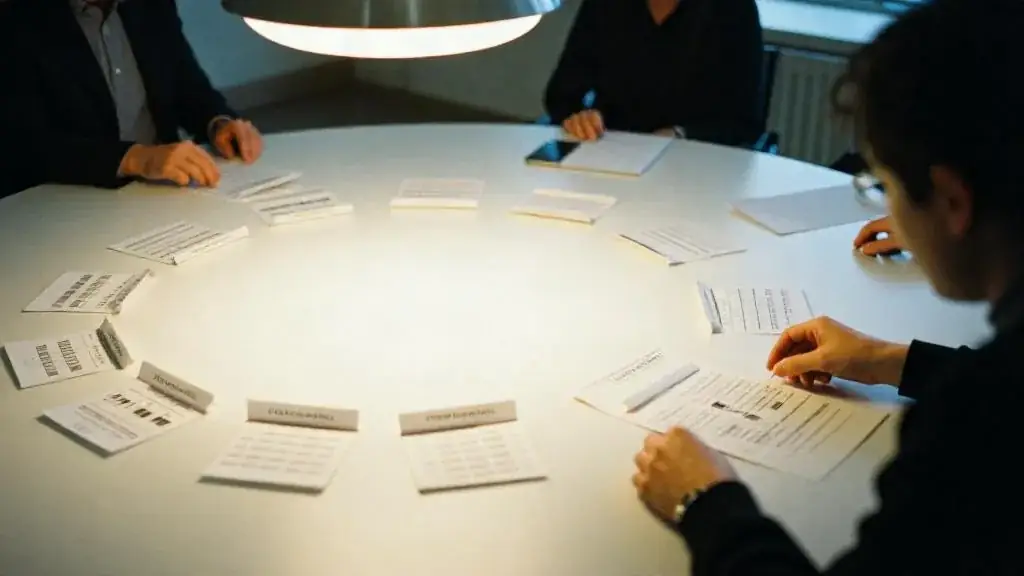
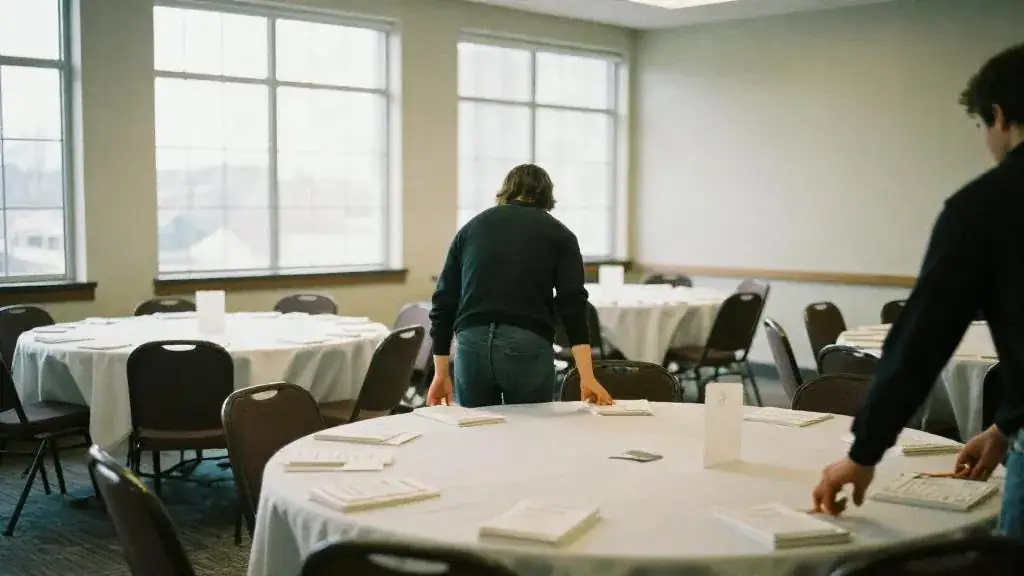
The chart is a table-by-table list with one row per seat.
Columns: table, seat, name, affiliation or sponsor, dietary code, accessibility note, and a column for anything the captain should know.
Worked example: the Harbour Gala.
Invitations went out the first week of September to 420 names, including 12 sponsor tables of 10 whose seats the sponsors filled themselves.
The RSVP form collected name, email, dietary needs with a structured list plus a free-text line, an accessibility question, and the sponsor affiliation.
That is the lesson. The worksheet and the quiz are just below this video.
What you will be able to do
- Set RSVP cut-offs and chase
- Run fast check-in
- Build a seating chart with codes
The RSVP is a production document
Most planners treat the RSVP as a headcount. It is more than that: it is the source for the seating chart, the dietary codes, the accessibility list, the name tags, the transport plan, and the final guarantee to the venue. Every one of those downstream documents is only as good as the RSVP data and the cut-off that locks it. Set the RSVP up as a production tool from the start, and the final week gets much quieter.

Collect only what you need, say why, and delete it when the event is done; that is what PIPEDA asks of private-sector organizations collecting personal information in Canada, and it is good practice anyway. Name, email, dietary needs, accessibility needs, a plus-one name, and for a gala the table or sponsor they belong to. Not birthdays, not home addresses unless you are mailing something.
Cut-offs and the chase
Work backward from the venue’s final-numbers date in the contract. If the hotel wants the guarantee five business days out, the RSVP cut-off is at least a week before that, because the last week is spent chasing and reconciling, not collecting.
- Invitation out at event minus 8 to 10 weeks for a dinner. The RSVP page is live the same day.
- First reminder at event minus 4 weeks to everyone who has not replied.
- Cut-off at event minus 14 days, stated on the invitation as a date, not “as soon as possible”.
- Chase from cut-off to event minus 10 days: a personal email or call to every invited guest without a reply, with a yes-or-no question. For a gala, the sponsors chase their own tables; give each sponsor a list of their seats and a deadline.
- Reconcile at event minus 8 days: the list is frozen, duplicates removed, plus-ones named, dietary codes assigned, accessibility requests confirmed by reply.
- Guarantee to the venue on the contract date, with the seating chart and dietary counts by table.
The 10 percent who show up unannounced are real, in our experience: sponsors fill a seat at the last minute, a plus-one becomes two, a board member brings a guest. The 10 percent who do not show are also real, and they roughly cancel. Guarantee at the reconciled count, ask the venue what overage they prepare above the guarantee, and hold two or three unassigned seats at the back of the room so an unannounced guest has somewhere to go without a scene.
Fast check-in
Check-in exists to confirm who arrived, hand them what they need, and point them to the bar. It should take under 20 seconds per guest. Anything longer builds a line in the foyer, and lesson 3 of Module 6 covered what lines do to the evening.
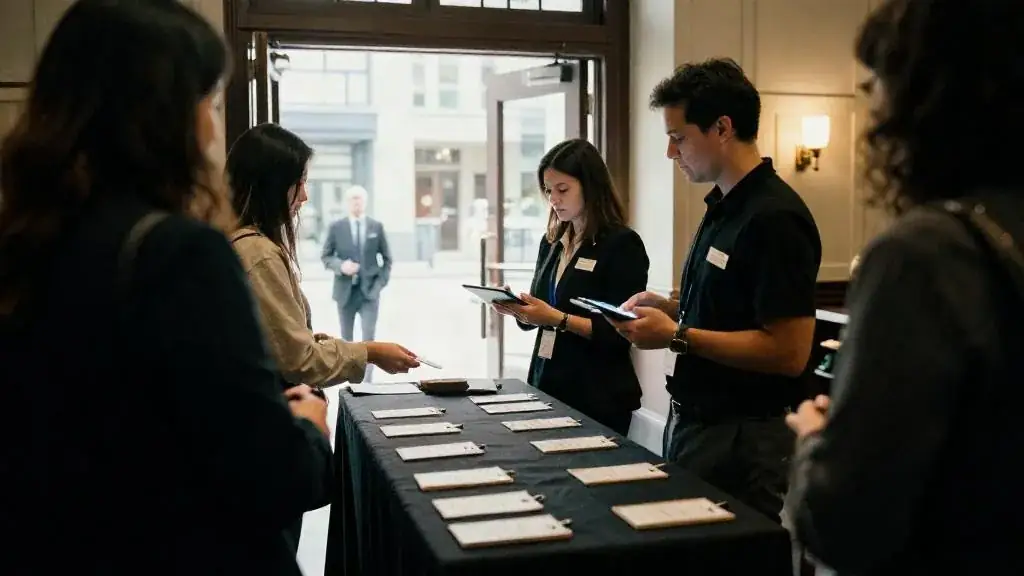
| Method | Speed | Good for | Watch for |
|---|---|---|---|
| Alphabetical printed list, two staff | Adequate for under 150 | Small events, no tech | One list means one line; split A–L and M–Z |
| Tablet search by name | Fast | Dinners, galas | Needs wifi or an offline app; have a printed backup |
| QR code on the confirmation email, scanned at the door | Fastest | Conferences, large events, ticketed events | Guests who did not open the email; always have a name search beside the scanner |
| Pre-set name tags on a table, no check-in | Instant for the guest | Corporate and networking events | No arrival count unless staff watch the table; unclaimed tags show who did not come |
For a seated gala, the name tag is usually replaced by an escort card or a seating screen. The greeter confirms the name, says the table number, and gestures to the bar. Dietary codes do not travel with the guest; they travel with the seating chart to the kitchen and the captain.
Seating charts with codes
The chart is a table-by-table list with one row per seat. Columns: table, seat, name, affiliation or sponsor, dietary code, accessibility note, and a column for anything the captain should know. Use short codes that the kitchen agrees to: V, VG, GF, DF, H, K, NUT, plus a free-text column for the rare case.
The chart goes to three places: the kitchen (counts per code by table), the captain on the floor (the full chart), and the greeters (name to table only; the dietary and accessibility columns stay with the planner and the people who need them). Build it in the event budget sheet workbook or your RSVP tool’s export; what matters is that it is one source, versioned, and that the version sent to the kitchen is the one on the floor.
Worked example: the Harbour Gala
Invitations went out the first week of September to 420 names, including 12 sponsor tables of 10 whose seats the sponsors filled themselves. The RSVP form collected name, email, dietary needs with a structured list plus a free-text line, an accessibility question, and the sponsor affiliation. First reminder at four weeks out. Cut-off at event minus 14 days, with 178 confirmed. The chase, split between the planner and the foundation’s coordinator, with sponsors chasing their own tables, brought it to 203 by event minus 10 days. Reconciled list at event minus 8: 200 seats, 19 full tables and one of 10 made up of foundation staff who could stand if needed, three accessible seating requests confirmed, dietary codes: 22 V, 6 VG, 9 GF, 11 H, 3 NUT, 1 shellfish allergy in free text.
Guarantee of 200 to the hotel at event minus 5 business days with the chart. Check-in: two greeters with tablets searching by name, a printed alphabetical list as backup, the seating screen behind them, and the bar in sight. Peak arrival between 6:05 and 6:25 cleared at about 15 seconds per guest. Final count: 194 seated, of whom 6 were not on the reconciled list (a sponsor’s late additions, two plus-ones), absorbed by the three held seats and the staff table. Twelve confirmed guests did not come.
Common mistakes
- “RSVP by October 15” buried in small print, or no date at all.
- Collecting dietary needs in free text only. The kitchen needs counts; use a list plus a free line.
- One check-in line for 200 people.
- Dietary and accessibility information on the public seating board or the greeter’s tablet. It stays with the planner, the captain and the kitchen.
- No held seats. The unannounced guest is coming; give them a chair before they ask.
Worksheet
Download the worksheet, complete it for your own event (or the running gala example), and keep it in your course binder. It takes about 10 minutes.
Check your understanding
Related guides, venues and vendors

Décor that photographs: where money shows
Module 6: Design & Guest Experience · 15 min
Lighting, the backdrop, the head table, tablescapes. Where décor dollars appear in photos and where they vanish.
Read more
Writing the performer brief
Specialist · Entertainment Booking · 15 min
Audience, message, timing, do-not-mention list, and the MC intro.
Read more
Typical cost splits by event type
Module 3: Budgeting · 15 min
A holiday party, a gala, a kids' party and a conference spend differently. Memorise the four shapes and you can sanity-check any…
Read more