Dock times, elevator sizes, union rules, sequencing (AV before décor), and strike by curfew.
Read the transcript
Load-in, strike and dock logistics.
Dock times, elevator sizes, union rules, sequencing (AV before décor), and strike by curfew.
The dock is the bottleneck.
Everything that makes an event happen arrives through one door, usually at the back of the building, usually with a ramp, a buzzer and a security guard who has seen it all.
The loading dock, and the freight elevator behind it, is the single most constrained resource on the day.
What to ask the venue.
Sequencing the load-in.
The order is almost always the same, and the reason is physical: whatever goes highest or furthest from the door goes first, and whatever is most fragile goes last.
Rigging and anything in the ceiling. Pin spot clamps, truss, aerial points if there are any.
Strike by curfew.
Strike is load-in in reverse, faster and in the dark, with tired people.
Plan it to the curfew.
Worked example: the Harbour Gala.
The hotel ballroom was released at 1:00 p.m. after a lunch flip.
The dock was shared with the kitchen's afternoon deliveries, so the hotel gave the gala two dock windows: 1:00 to 3:30 and 4:30 to 5:30.
That is the lesson. The worksheet and the quiz are just below this video.
What you will be able to do
- Sequence a load-in
- Book dock and elevator time
- Plan a strike that meets curfew
The dock is the bottleneck
Everything that makes an event happen arrives through one door, usually at the back of the building, usually with a ramp, a buzzer and a security guard who has seen it all. The loading dock, and the freight elevator behind it, is the single most constrained resource on the day. Venues book it in windows. Suppliers want the same window. The planner’s job is to sequence them so that nobody is waiting on the street with a truck full of chairs while the AV crew is still rolling cases through the only door.
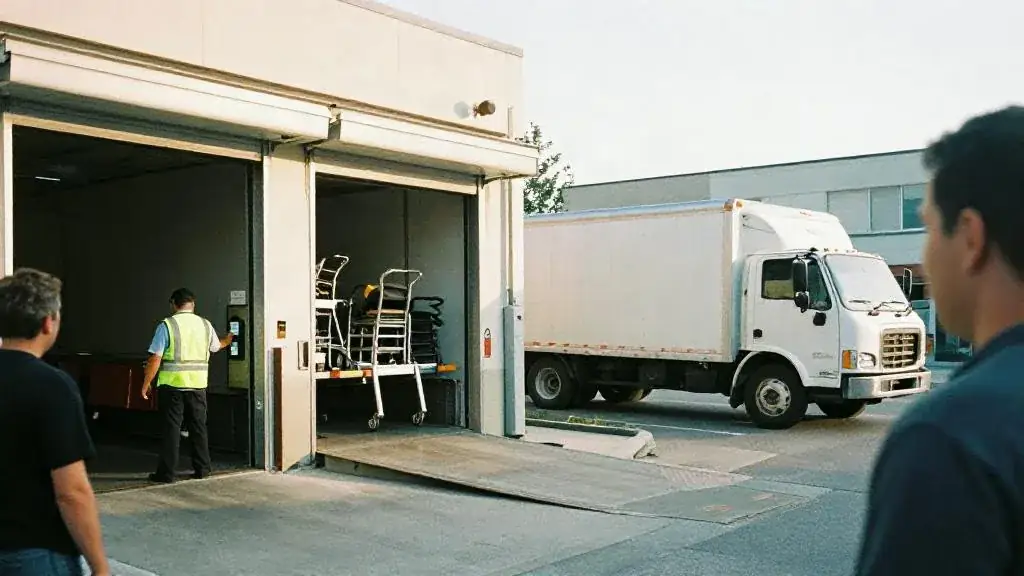
Three questions at the site visit settle most of it: when is the dock ours, how big is the freight elevator, and what are the venue’s labour rules?
What to ask the venue
| Question | Why it matters |
|---|---|
| Dock window: what hours is the dock booked to us, and who else shares it that day? | Hotels run breakfasts, lunches and other ballrooms; your window may be two hours in a six-hour afternoon |
| Dock height and truck access: can a 5-ton truck back in? Is there a lift gate requirement? | A truck that cannot reach the dock unloads on the street, which doubles labour time |
| Freight elevator: interior dimensions, door width, weight limit, who operates it, and whether it is shared with housekeeping or the kitchen | A 3-metre draping frame, a staging deck or a truss section that does not fit must be broken down or carried up stairs |
| Room release: what time is the ballroom empty and ours? | Lunch in the same room until 2 p.m. means your set-up starts at 2:30 after the venue flips it |
| Labour rules: does the venue or convention centre require its own staff or union labour for any task (electrical, rigging, moving house equipment)? | Some venues, especially convention centres, restrict who may plug in, rig or move house items; ask, get it in writing, and budget for it |
| Power: where are the circuits, what amperage, and who connects? | AV and lighting need to know before they arrive; some venues require their own electrician to tie in |
| Curfew and strike: what time must the room be empty and the dock clear, and what are the overtime charges? | Strike is planned to the curfew, with overtime understood in advance |
| Protection: does the venue require floor or wall protection for anything rolled or rigged? | Carpet protection and corner guards add time and are often the venue’s rule |
Sequencing the load-in
The order is almost always the same, and the reason is physical: whatever goes highest or furthest from the door goes first, and whatever is most fragile goes last.
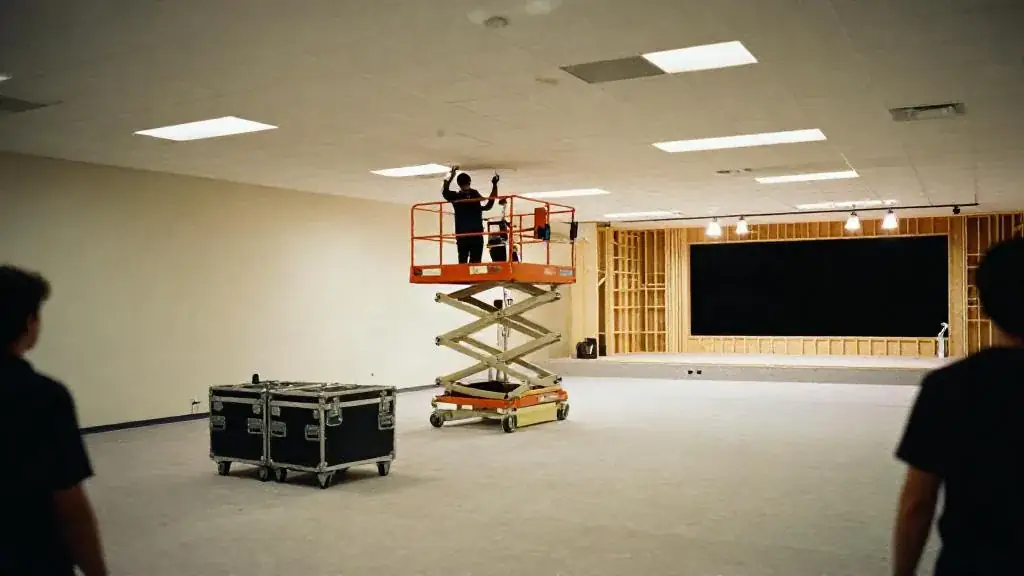
- Rigging and anything in the ceiling. Pin spot clamps, truss, aerial points if there are any. Needs an empty floor and a lift.
- Staging and backdrop frame. Heavy, in the back of the room, needs the floor clear to roll.
- AV and lighting. Cases roll in, cable runs are laid and taped before tables cover them, fixtures placed, power connected. Sound check before the room fills with soft furnishings and florals.
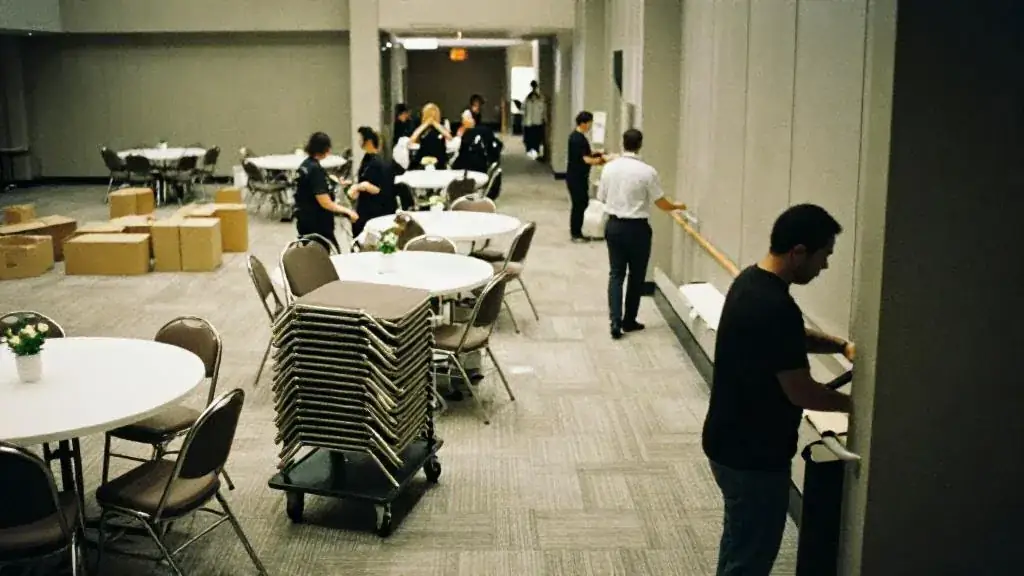
- Tables and chairs. Usually the venue’s own staff, set to the floor plan. In a hotel this can happen in parallel with AV if the AV crew works from the stage end.
- Linens, place settings, centrepieces. The caterer and the florist. Last, because they are fragile and because they hide the cables.
- Signage, registration, coat check, bars. Front of house, often while the ballroom is still being dressed.
- Sound check and lighting cue rehearsal with the MC and the stage manager, with the room dressed.
Give each supplier a dock slot, an elevator slot and a room slot, in writing, in the run of show. Thirty minutes between slots is a reasonable buffer in a hotel; convention centres and lofts with one small elevator may need more. Have one person at the dock from the first slot to the last with a radio and the list.
Strike by curfew
Strike is load-in in reverse, faster and in the dark, with tired people. Plan it to the curfew. Work out how long each supplier needs to pack, add the dock and elevator sequence, and set each supplier’s start time so the last truck leaves before the venue’s cut-off. Fragile items first (florals, rentals, glassware), then AV, then staging, then rigging. Nothing is struck while guests are in the room; the florist waits until the last donor has left, not until the program ends.
Assign someone to walk the room at the end with the venue’s manager and sign off that it is clear and undamaged. Ask the venue what overtime costs if strike runs past curfew, and put that figure in the budget notes so the client knows what a 20-minute slip costs.
Worked example: the Harbour Gala
The hotel ballroom was released at 1:00 p.m. after a lunch flip. The dock was shared with the kitchen’s afternoon deliveries, so the hotel gave the gala two dock windows: 1:00 to 3:30 and 4:30 to 5:30. The freight elevator is 2.4 by 1.8 metres with a 2.1-metre door, which meant the 6-metre draping frame came in four sections and the staging decks fit flat on a dolly. The hotel requires its own electrician to tie in anything over a standard outlet, and that was booked for 1:30.
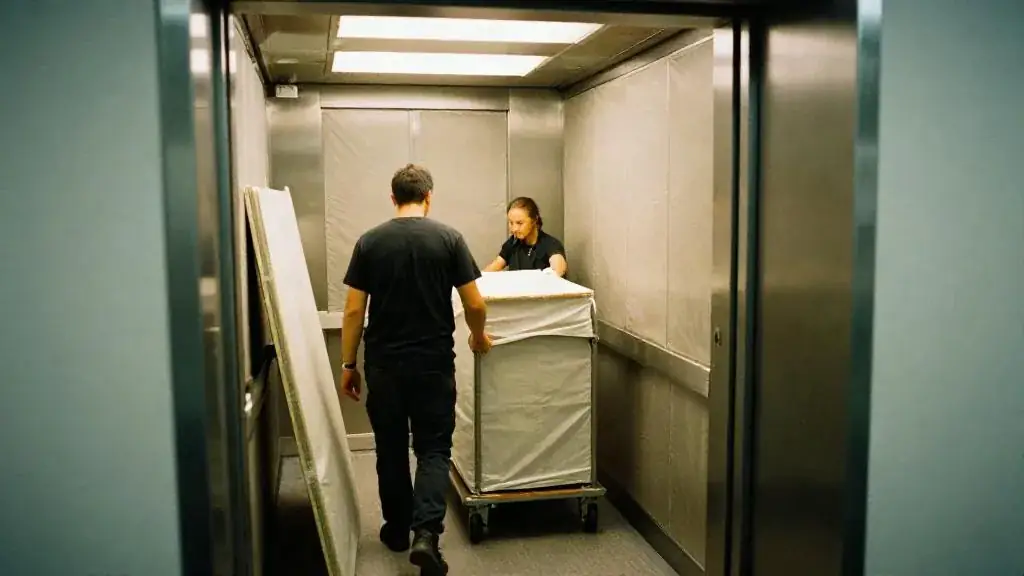
Sequence: 1:00 lighting supplier rigs 20 pin spot clamps to the ceiling grid from a lift, with the hotel’s approval already on file; 1:30 staging and backdrop frame; 2:00 AV cases and cable runs, electrician tie-in; 2:30 hotel sets 20 rounds and chairs from the stage end back while AV works the front; 3:00 lighting places uplights and the gobo projector; 3:30 dock closed for the kitchen; 4:30 florist and rentals through the second window, centrepieces last; 5:00 registration, coat check and bars set in the foyer; 5:15 sound check with the MC, run the seven lighting cues; 5:15 staff briefing; 5:45 doors.
Strike: curfew midnight. Guests out by 10:00. Florist and rentals 10:30 to 11:00 through the dock; AV packed and rolled 10:15 to 11:15; staging 11:00 to 11:30; lighting pulled the pin spots last, 11:15 to 11:45; room walk with the banquet manager at 11:50. The hotel’s overtime rate past midnight was in the contract and in the budget notes, and nobody needed it.
Common mistakes
- Not measuring the elevator. A frame that does not fit is a frame carried up a stairwell.
- Décor before AV. Cables under centrepieces means cables taped over linens, or centrepieces moved twice.
- Assuming the dock is yours all afternoon. It is shared; get the window in writing.
- Finding out about labour rules on the day. Ask at the site visit and budget for them.
- Striking with guests in the room. Sponsors notice when their centrepiece leaves before they do.
Worksheet
Download the worksheet, complete it for your own event (or the running gala example), and keep it in your course binder. It takes about 10 minutes.
Check your understanding
Related guides, venues and vendors
The entertainment market in the GTA
Specialist · Entertainment Booking · 15 min
Act categories, agencies vs direct booking, price ranges and lead times.
Read more
Managing vendors on the day
Module 10: Event Day · 15 min
Arrival checks, the pre-event briefing, problem escalation, and paying balances on site.
Read more
Contracts, deposits and substitutions
Specialist · Entertainment Booking · 15 min
Booking terms, cancellation, illness, and insurance.
Read more