Formats by team size, GTA venues and activities, and measuring whether it worked.
Read the transcript
Team building and offsites.
Formats by team size, GTA venues and activities, and measuring whether it worked.
Decide what the day is for.
Team-building events fail when nobody can say what they were for.
Before you choose a venue or an activity, get the sponsor to pick one of four purposes: get people who do not know each other to talk; reward a team after a hard stretch; work on a real problem away from the office; or bring remote staff together in person.
Formats by team size.
Activities with a built-in facilitator (a chef, an instructor, a performer teaching a skill) carry the group so that the planner does not have to.
A magician teaching a 45-minute "learn three tricks" session, or a circus coach running juggling and plate-spinning stations, gives mixed teams a shared task and a laugh without forcing anyone onto a stage.
GTA venues and activities.
Within the city: cooking schools and restaurant kitchens, escape rooms, axe-throwing and climbing gyms, curling and bowling clubs, rowing and sailing clubs on the waterfront, the islands by ferry, breweries and distilleries with event spaces, and hotel meeting rooms when the day is mostly a working session.
Outside the city: conservation areas and parks (permit required for groups and for any amplified sound or tent), farms and orchards in York and Durham, resorts in Muskoka and the Kawarthas for overnight offsites, and wineries in Niagara.
Budget and the tax question.
An offsite with a working agenda is a business expense; a purely social event is an employee benefit, and the CRA treats a social event as non-taxable only if it is open to all employees and costs 150 dollars or less per person including taxes (transport home and overnight accommodation excluded), up to six events a year.
A team-building day usually mixes the two.
Measuring whether it worked.
Write the purpose on the first page of the brief.
Pick one measure that matches it: for connection, the number of people who met someone new (ask on the survey); for reward, satisfaction and attendance; for a working offsite, the decisions made and written down by the end of the day; for remote teams, whether people say they would come again.
That is the lesson. The worksheet and the quiz are just below this video.
Decide what the day is for
Team-building events fail when nobody can say what they were for. Before you choose a venue or an activity, get the sponsor to pick one of four purposes: get people who do not know each other to talk; reward a team after a hard stretch; work on a real problem away from the office; or bring remote staff together in person. Each purpose points to a different format, a different budget and a different measure of success.
Formats by team size
| Team size | Formats that work | Watch for |
|---|---|---|
| Up to 15 | A cooking class, an escape room, a workshop with a facilitator, a long lunch with one structured conversation | Do not over-produce; one good activity and a meal is enough |
| 15–50 | Rotating stations (three activities, three groups), a half-day offsite with a facilitated session plus an activity, a scavenger hunt across a neighbourhood | Mixed teams across departments; assign groups, do not let people self-select |
| 50–150 | A full-day offsite at a conference venue, a challenge-style event in a park or on a waterfront, a volunteering day with a charity partner | Transport, washrooms, weather plan, and a program that does not depend on everyone being in one place at once |
| 150+ | Zoned festival-style day: activity areas, food, a stage moment, team competitions with scoring | Production becomes a real event: site plan, first aid, security, permits if in a park |
Activities with a built-in facilitator (a chef, an instructor, a performer teaching a skill) carry the group so that the planner does not have to. A magician teaching a 45-minute “learn three tricks” session, or a circus coach running juggling and plate-spinning stations, gives mixed teams a shared task and a laugh without forcing anyone onto a stage. Find such acts in the entertainment finder; listings owned by the site founder carry a visible disclosure and no ranking preference.

GTA venues and activities
Within the city: cooking schools and restaurant kitchens, escape rooms, axe-throwing and climbing gyms, curling and bowling clubs, rowing and sailing clubs on the waterfront, the islands by ferry, breweries and distilleries with event spaces, and hotel meeting rooms when the day is mostly a working session. Outside the city: conservation areas and parks (permit required for groups and for any amplified sound or tent), farms and orchards in York and Durham, resorts in Muskoka and the Kawarthas for overnight offsites, and wineries in Niagara. For any park, apply for the permit well ahead; Toronto park permits for special events go through the city’s Parks special event permit process and summer weekends go months in advance.
Alcohol changes the day. A licensed venue carries its own licence. A park, an office or a dry-hire space needs an AGCO Special Occasion Permit, applied for at least ten days ahead for a private event, with Smart Serve certified servers and liquor bought under the permit with receipts on site. Many sponsors decide the simplest answer is a licensed venue for the social portion.
Budget and the tax question
An offsite with a working agenda is a business expense; a purely social event is an employee benefit, and the CRA treats a social event as non-taxable only if it is open to all employees and costs $150 or less per person including taxes (transport home and overnight accommodation excluded), up to six events a year. A team-building day usually mixes the two. Ask finance how they want it classified before you build the budget in the event budget calculator, and keep the social portion separable in the invoice if they ask.

Measuring whether it worked
- Write the purpose on the first page of the brief.
- Pick one measure that matches it: for connection, the number of people who met someone new (ask on the survey); for reward, satisfaction and attendance; for a working offsite, the decisions made and written down by the end of the day; for remote teams, whether people say they would come again.
- Survey within 48 hours with the post-event survey template, five questions maximum.
- Report the measure, the cost and three things to change next time to the sponsor within a week. That report is why you get the next booking.
Worked example: the tech company’s summer offsite
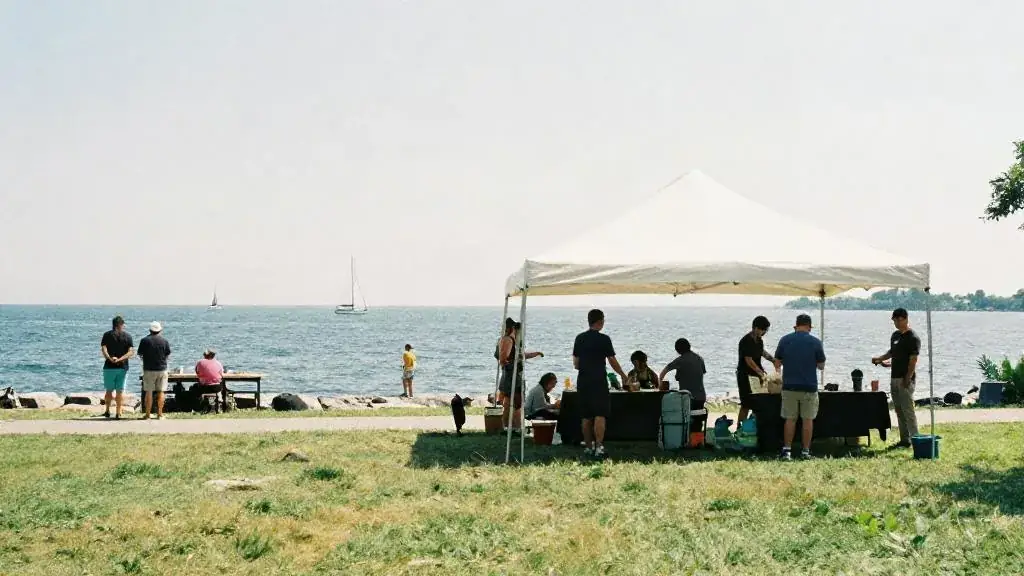
The 180-person software company wanted a summer day for all staff, half of them hybrid workers who rarely meet, with the stated purpose of getting people to know colleagues outside their teams. We chose a waterfront park with a permitted picnic site and a licensed restaurant nearby for the evening, so no SOP was needed for the social portion. The morning was a 30-minute all-hands under a 20×40 frame tent (over 60 m², so a building permit and flame-resistant fabric certification were required, booked through the permit process with the park application), then six rotating stations in mixed teams: a juggling and plate-spinning station run by a circus coach, a learn-three-tricks session with a magician, a boat race with cardboard and tape, a photo challenge, a cooking relay and a trivia round. Scores were kept and announced before lunch. The afternoon was free time with a food truck, and the evening moved to the restaurant. The survey asked one question that mattered: did you spend meaningful time with someone you had not worked with before? That answer, with the per-head cost, went to the HR lead the following Tuesday.
Common mistakes
- No stated purpose, so no way to say whether it worked.
- Letting people self-select into groups; teams stay in teams.
- Competitive physical activities with no non-physical option.
- Parks without a permit, tents without a permit, and alcohol without a permit.
- No survey, no report, no second booking.
Worksheet
Apply this lesson to a real or practice event using the worksheet, then mark the lesson complete to track your progress toward the certificate.

Related guides, venues and vendors
The Great Hall
Toronto · 300+ guests
Near transit
The Great Hall is at Queen Street West and Dovercourt Road and contains four function rooms totalling about 20,000 sq ft.
Read more
Holiday party venue guide
Corporate Holiday Parties
How to choose a corporate holiday party venue in Toronto and the GTA: venue types by headcount, the December calendar, capacity math,…
Read more
Team building venue guide
Team Building
GTA venue types for team building: activity venues, breweries, private rooms, studios, parks and ravines with permits, conservation areas, and offsite retreats…
Read more