Power trips, rain, no-shows, drunk guests, medical incidents, double-booked rooms, missing cake. The fix for each, in the order you do it.
Read the transcript
Real-time problems: the fifteen most common.
Power trips, rain, no-shows, drunk guests, medical incidents, double-booked rooms, missing cake.
The fix for each, in the order you do it.
The fix sequence.
Every day-of problem gets the same five steps, in the same order, no matter what it is.
Safety first: is anyone hurt or in danger?
The fifteen.
Deciding what the client needs to know.
Clients hired you so they would not have to carry the evening.
Telling them every problem defeats the purpose; hiding a problem that later costs money or embarrasses them is worse.
Worked example: the Harbour Gala.
Three of the fifteen show up on the night.
At 6:40 a guest at table 7, a long-time donor, becomes faint during cocktails.
Numbers to remember.
Five steps, always in order: safety, contain, fix, inform, record.
Fifteen minutes past load-in with no call: phone the vendor. Thirty: phone the backup.
That is the lesson. The worksheet and the quiz are just below this video.
What you will be able to do
- Recognise the fifteen common problems
- Apply the fix sequence
- Decide what the client needs to know
The fix sequence
Every day-of problem gets the same five steps, in the same order, no matter what it is. Safety first: is anyone hurt or in danger? Contain: stop it getting worse. Fix or route around: solve it or make the program not depend on it. Inform: tell the people who need to know, in the order they need to know, and only them. Record: time, what happened, what you did, what it cost. Planners get in trouble when they skip to step three and forget one and four. The risk register you built in Module 7 should already name a response and an owner for most of what follows.
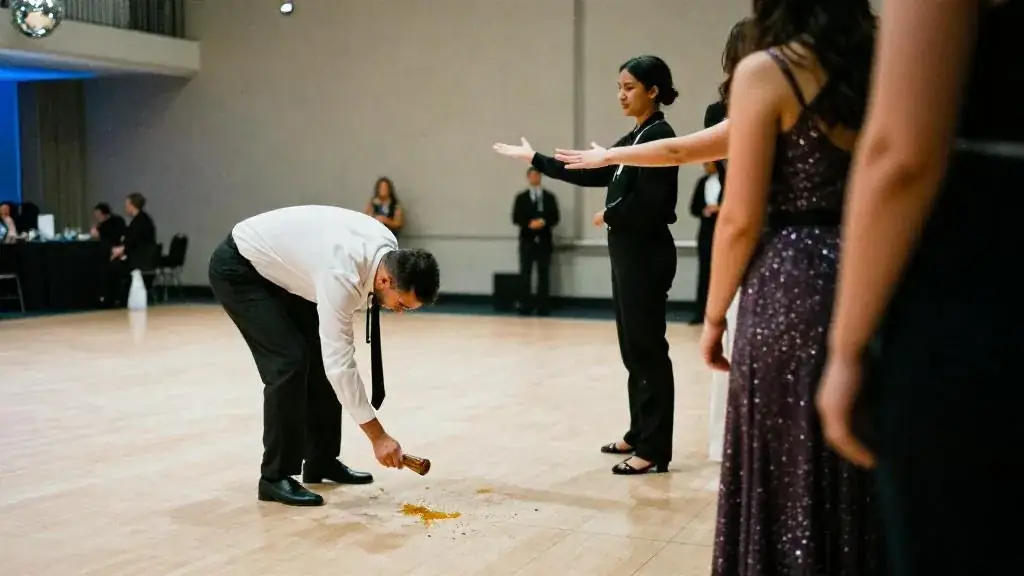
The fifteen
| Problem | First move | Then | Client needs to know? |
|---|---|---|---|
| 1. Power trips on the stage circuit | AV lead resets the breaker; house lights are usually on a separate circuit | Move the band or AV load across two circuits; the venue engineer knows which outlets share one | Only if the program changes |
| 2. Rain at an outdoor event | Call the weather decision at the time you set in the plan, not later | Move to the tented or indoor backup; guests under cover before vendors | Yes, before the call is made, with your recommendation |
| 3. Vendor no-show | Call, text, call the office, call the backup from the register | Adjust the program to not need them; document times | Yes, once you know the fix |
| 4. Headline act late | Get an honest ETA from them; move the set later and fill with something you already have (band, DJ, MC) | If they will not make it, the MC goes to the next cue and you tell the client before the room notices | Yes |
| 5. Intoxicated guest | Smart Serve staff stop service; your front-of-house position stays with the guest | Water, food, a quiet seat, a safe ride home arranged through the host; security if there is any aggression | Yes, quietly; the host usually knows who it is |
| 6. Medical incident | Call 911 if there is any doubt; send someone to meet the ambulance at the door | Clear a space, keep guests back, use the first-aider or the defibrillator you located on the walk-through; the program pauses only if it must | Yes, immediately |
| 7. Double-booked room or late previous event | Venue manager, in person, now | Negotiate the load-in time back; shorten set-up by cutting décor, never safety or food | Yes, with what you have negotiated |
| 8. Missing cake or key item | Call the supplier; find out where it is | Buy a substitute from the nearest grocery or bakery; nobody has ever noticed a cake was different from the sketch | Only if the substitute is visibly different |
| 9. Guest count well over the guarantee | Count at the door, not by guess | Captain adds tables if the posted occupant load allows; the kitchen can usually add 5% on short notice | Yes, because it costs money |
| 10. Speaker runs long | Hold the next cue; MC ready at stage edge | Visible time card from your position; the cushion absorbs it | No |
| 11. Fire alarm | Everyone leaves by the exits you walked; no exceptions, no “it is probably a test” | Count staff at the muster point; re-enter only when the venue and fire service say so | Yes, at the muster point |
| 12. Sound failure mid-program | AV lead checks battery, then cable, then the board | MC unamplified from the floor for two minutes if needed; a strong voice carries a 200-seat room | No |
| 13. Lost child or vulnerable guest | Describe the person to every staff radio; one person at each exit | Venue security and, after a short search, police | Yes, immediately |
| 14. Spill, breakage or damage | Captain and housekeeping; cordon the area | Photograph it and note who caused it before anyone argues about the damage charge | Only if there is a charge |
| 15. Client wants to change the program at 7 p.m. | Listen, then say what it costs in time and money | If it is safe and affordable, do it and record it; if not, say no with the reason | They are the one telling you |
Deciding what the client needs to know
Clients hired you so they would not have to carry the evening. Telling them every problem defeats the purpose; hiding a problem that later costs money or embarrasses them is worse. The test has three questions. Will it change what the guests experience? Will it cost money beyond the budget you were given authority over? Would they be upset to learn it from someone else? If any answer is yes, tell them in one sentence, with the fix already in hand: “The florist was late, the centrepieces are in, you will not see a difference.” If all three are no, it goes on the problem sheet and into the debrief.

Choose the moment. Not while they are on stage, not while they are with a donor. Catch them between things, say it, and leave. Clients remember planners who made the evening feel easy, and that feeling comes from short, calm, complete sentences.
Worked example: the Harbour Gala
Three of the fifteen show up on the night. At 6:40 a guest at table 7, a long-time donor, becomes faint during cocktails. Safety first: the front-of-house position sits her down and the hotel’s first-aid-trained supervisor is on radio. She recovers with water and food; no ambulance, but the lead tells the executive director at once and notes the time. At 7:50 the stage circuit trips when the band’s amp and the AV rack share one outlet; house lights stay on, the AV lead resets the breaker and moves the amp to the east wall circuit, two minutes of silence covered by the MC thanking the sponsors. The client is not told because the program did not change. At 8:10 the executive director asks whether the board chair can say “a few words” before the paddle raise. The lead says yes, three minutes, and takes them from the band’s closing set, which nobody will miss, rather than from the mentalist, whose set warms the room for the ask. The problem sheet at midnight reads three entries, each with a time and a decision.
Numbers to remember

- Five steps, always in order: safety, contain, fix, inform, record.
- Fifteen minutes past load-in with no call: phone the vendor. Thirty: phone the backup.
- Three questions decide whether the client hears about it: guest experience, money, embarrassment.
- A fire alarm is never a test until the venue says so.
- Smart Serve staff decide when a guest is cut off; you decide how the guest gets home.
Worksheet
Download the worksheet, complete it for your own event (or the running gala example), and keep it in your course binder. It takes about 15 minutes.
Check your understanding
Related guides, venues and vendors
The wedding-day run of show
Specialist · Weddings · 15 min
A real 14-hour run of show from hair and makeup to last dance, with vendor cues.
Read more
Engagement design
Specialist · Virtual & Hybrid · 15 min
Segments under 20 minutes, chat moderation, polls, breakout rooms and remote entertainment.
Read more
Building a project write-up
Module 11: After the Event · 15 min
The ten-section template, what to include honestly (including what went wrong), photo rights and anonymisation.
Read more