The ten-section template, what to include honestly (including what went wrong), photo rights and anonymisation.
What you will be able to do
- Write a project write-up with the template
- Secure rights and permissions
- Publish and share it
What a project write-up is for
A project write-up does two jobs. It tells the next client what working with you is like, in enough detail that they can picture their own event. And it forces you to say, in writing, what you did and what you would do differently. Planners who skip the second job write brochures; planners who do both write project write-ups that bring in work. The audience is a committee chair or a marketing manager who has never hired a planner and wants to know whether you can be trusted with a room full of their people and their money.
The ten sections
Use the same ten headings every time. Readers who have seen one of your project write-ups can find what they need in the next one in seconds, and you will never stare at a blank page.
| Section | Length | What goes in it |
|---|---|---|
| 1. The brief | 3 to 4 sentences | Who the client was, what they needed, the measure of success agreed up front |
| 2. The constraints | 3 to 5 sentences | Budget, date, room, anything that made it hard; the pillars, the hard stop, the F&B minimum |
| 3. The plan | One short paragraph | The two or three decisions that shaped the event and why you made them |
| 4. The team | A list | Venue and vendors by name with permission; a line on why each was chosen |
| 5. The program | A compact timeline | Doors to last call, in five or six lines |
| 6. What happened on the night | One paragraph | Including at least one thing that went wrong and how it was handled |
| 7. The results | Numbers | From the ROI report: attendance, revenue or leads, survey scores, with sample sizes |
| 8. What we would change | Three lines | Honest and specific |
| 9. Client’s words | A quote | With name and title, approved in writing |
| 10. Photos | Four to eight images | Rights secured; captions that say what is happening |
Including what went wrong
Section six is where most planners flinch, and it is the section clients read most carefully. An evening where nothing went wrong did not happen, and a project write-up that says so is not believed. Choose a problem that was real, that was handled, and that does not embarrass the client or a vendor you want to keep. A tripped circuit covered by the MC is perfect. A drunk sponsor is not, even anonymised. The structure is the fix sequence from Module 10: what happened, what you did first, what the room noticed (usually nothing), and what it cost. Three sentences. The reader learns that things go wrong at your events and that you handle them, which is the only promise a planner can honestly make.
Rights and permissions
Three sets of rights are involved and all three must be in writing before anything is published.
- The client’s permission to name them. Many organizations are happy to be named; some corporate clients are not, and a hospital foundation will want the wording approved. Send the draft, ask for approval of the name, the numbers and the quote, and keep the email.
- The photographer’s licence. The photographer owns the copyright to the images unless the contract says otherwise. Your contract with them, or the client’s, needs a line granting you the right to use selected images on your website and in proposals, with credit. If it does not, ask now; most photographers agree in exchange for a credit and a link.
- The people in the photos. Guests were given notice at registration and by signage, under the PIPEDA approach from Module 8, and anyone who opted out was not photographed. For a public project write-up, prefer images of the room, the stage and the performers over close-ups of identifiable guests. For any image where a guest is the subject, ask them; it takes one email and avoids a complaint later.
Performers and vendors are usually pleased to be named and linked. Ask anyway, and ask how they want their name written.
Anonymising
When the client will not be named, the project write-up still works if you keep the specifics and remove the identity. “A Toronto hospital foundation” instead of the name; “a downtown hotel ballroom” instead of the hotel; real numbers rounded to the nearest thousand; the quote attributed to “Executive Director” with no name. Never change a number to make a point; round it and say it is rounded. Never fabricate a quote. If the client declines the quote, the section says “Client testimonial withheld at the client’s request”, which itself tells the reader you keep your word.
Worked example: the Harbour Gala
The brief: a hospital foundation needed a 200-guest November dinner to net at least $75,000 with a program that finished the ask before 9 p.m. The constraints: a $25,000 envelope later raised to $40,000, a 420 m² ballroom with two pillars on the north wall, and an $18,000 F&B minimum that reached about $24,000 all-in. The plan: stage on the east wall for sightlines, table sponsorships to fund the program, a mentalist placed directly before the ask and two strolling magicians to fill the dead 25 minutes before first plate. The team is listed with links. The program is six lines from 6 p.m. doors to 10 p.m. last song. What happened: the chair ran long and the kitchen held; the stage circuit tripped at 7:50 and was reset in two minutes while the MC thanked sponsors; nobody at the tables knew. Results: 203 guests, gross $137,700, net $87,015, 37 cents to raise a dollar, overall survey 4.5 on 51 responses. What we would change: fourteen servers, a five-minute cap on the chair, a second coat check. The executive director’s quote is approved by email on day sixteen. Eight photos: the room from the stage, the mentalist mid-set, paddles in the air from the back of the room, the magicians in the foyer; the photographer is credited and linked under the contract clause the planner added in Module 5.
Publishing and sharing
The project write-up lives on your website as a page of its own, with the ten headings as subheadings so it can be skimmed. Share the link with the client and every vendor named, and ask them to share it. Add a two-line version to your proposal template. Put the single best photo and the headline number in your directory listing on /directory/. Then write the next one; a planner with five project write-ups in a niche is the obvious choice in that niche.
Common mistakes
- A project write-up with no problem in it.
- Publishing photos the photographer did not license.
- Naming a client who did not approve the draft.
- Rounding numbers without saying so, or inflating them.
- Writing it three months later when the detail is gone. Draft it in the fourteen-day close.
Worksheet
Download the worksheet, complete it for your own event (or the running gala example), and keep it in your course binder. It takes about 10 minutes.
Check your understanding
Related guides, venues and vendors
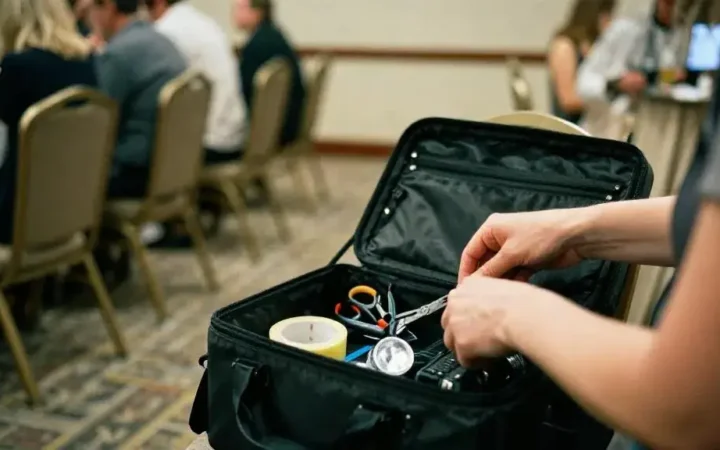
The day-of kit and the first hour
Module 10: Event Day · 15 min
What is in the bag, when to arrive, who to meet, and the walk-through that catches 80% of problems.
Read more
Accessibility by design (AODA)
Module 6: Design & Guest Experience · 15 min
Step-free routes, accessible washrooms, seating, captions, quiet space, dietary and sensory needs. The AODA checklist for events in Ontario.
Read more
Module 2 workshop: discovery to proposal in a week
Module 2: Discovery & Concept · 15 min
Take a mock client (a tech company, 180 guests, holiday party, $35,000) from discovery call to signed proposal.
Read more