Take a mock client (a tech company, 180 guests, holiday party, $35,000) from discovery call to signed proposal.
Read the transcript
Module 2 workshop: discovery to proposal in a week.
Take a mock client (a tech company, 180 guests, holiday party, 35,000 dollars) from discovery call to signed proposal.
The exercise.
A mock client: a 180-person technology company in Liberty Village wants a holiday party on a Friday in the second week of December, "somewhere cool, open bar, something people will actually talk about", with a budget of 35,000. dollars
Discovery call (15 minutes).
The morning-after answer turns out to be "people who work remotely come in and say it was worth it".
The decision-maker is the chief of staff; the payer is the chief executive; the landmine from last year was a 45-minute speech and a venue in Vaughan nobody could get home from.
Follow-ups you should have asked.
How many of the 180 are remote, and where do they live? A Friday in December for staff in Hamilton and Oshawa is a GO train question before it is a venue question.
Is the budget before or after HST? At 35,000 dollars that difference is about 4,000. dollars
The brief (5 minutes).
Goal: 85 percent attendance including remote staff, survey 8+.
Audience: 180, ages 24 to 45, mixed dietary needs, a loud fun crowd.
The proposal (10 minutes to outline).
Venues: a King West loft (bring-your-own caterer, rigging for an aerial moment) versus a Distillery District event space (in-house catering, simpler). Trade-off: the loft is 6,000 dollars more once rentals are added but allows the aerial act.
Entertainment: two roaming magicians during the first hour, a 20-minute aerial-and-LED spectacle at 9:30 as the shared moment, a DJ to close.
That is the lesson. The worksheet and the quiz are just below this video.
What you will be able to do
- Run discovery, write the brief, produce the proposal
- Set measures you can report on afterward
- Present and defend the fee
The exercise
A mock client: a 180-person technology company in Liberty Village wants a holiday party on a Friday in the second week of December, “somewhere cool, open bar, something people will actually talk about”, with a budget of $35,000.

Discovery call (15 minutes)
The morning-after answer turns out to be “people who work remotely come in and say it was worth it”. The decision-maker is the chief of staff; the payer is the chief executive; the landmine from last year was a 45-minute speech and a venue in Vaughan nobody could get home from. Non-negotiables: downtown, transit-accessible, no speeches over ten minutes. The envelope flinch happens at $45,000, so $35,000 is real.
Follow-ups you should have asked

- How many of the 180 are remote, and where do they live? A Friday in December for staff in Hamilton and Oshawa is a GO train question before it is a venue question.
- Is the budget before or after HST? At $35,000 that difference is about $4,000.
- Does finance know about the CRA rule? A staff social event is a non-taxable benefit only if it is open to all employees and costs no more than $150 per person including taxes; over that, the whole amount is taxable. At $35,000 for 180 the per-head figure is already over before the open bar.
- Are plus-ones invited? That changes the headcount, the per-head and the taxable-benefit arithmetic.
- What time does the company want people home by, and is there a budget line for rides home? Transport home is excluded from the $150 calculation.
- Who speaks, for how long, and who will tell the chief executive the ten-minute rule applies to them?
The brief (5 minutes)
Goal: 85 percent attendance including remote staff, survey 8+. Audience: 180, ages 24–45, mixed dietary needs, a loud fun crowd. Feeling: electric, generous, easy to get home from. Palette: black, brass, neon accent. Non-negotiables: downtown, transit, open bar, speeches under ten minutes total. Must photograph: a shared moment everyone is in.
The proposal (10 minutes to outline)
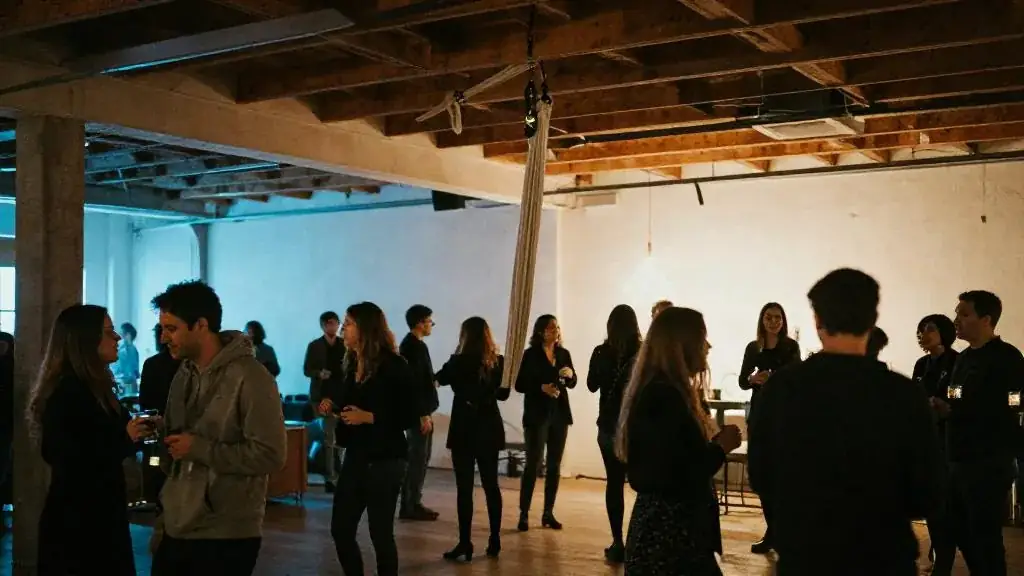
- Venues: a King West loft (bring-your-own caterer, rigging for an aerial moment) versus a Distillery District event space (in-house catering, simpler). Trade-off: the loft is $6,000 more once rentals are added but allows the aerial act.
- Entertainment: two roaming magicians during the first hour, a 20-minute aerial-and-LED spectacle at 9:30 as the shared moment, a DJ to close.
- Budget: $35,000 split corporate-style with 10 percent contingency and HST shown; per head about $194 all-in, which is over the CRA’s $150 threshold, so the proposal flags the taxable-benefit question for the finance team.
- Fee: flat $3,500 as its own line.
Checking the venue choice against the rules
The aerial act is the reason the loft is in the proposal, so the loft has to pass the rigging test before it goes on the page. Ask the venue for the location and rated load of its rigging points (an aerial duo needs a certified point, typically rated for 1,000 lb or 450 kg working load and engineer-confirmed), the ceiling height under the point (at least 4.5–5 m for lyra or silks, 6 m or more preferred), whether the venue requires its own rigger, and whether the rigger is insured. If any answer is no, the aerial moment moves to a ground-based spectacle and the Distillery space is back in play at $6,000 less. Also ask whether the loft is licensed; if it is not, the open bar needs a Special Occasion Permit, applied for at least 10 days ahead for a private event, every bartender needs Smart Serve, and the liquor must be bought under the permit with receipts kept on site. The hourly rate for a licensed bartender and the LCBO run both go on the budget.
The budget shape at $35,000
| Category | Corporate holiday share | Approximate all-in |
|---|---|---|
| Venue | 22 percent | $7,000 |
| Food and open bar | 33 percent | $10,500 |
| Entertainment and AV (magicians, aerial duo plus rigging, DJ) | 18 percent | $5,700 |
| Décor and rentals | 8 percent | $2,500 |
| Photo | 5 percent | $1,600 |
| Print, gifts, misc | 6 percent | $1,900 |
| Planner fee | 8 percent | $2,600 (quoted at $3,500; the shape flexes) |
| Contingency | 10 percent | $3,200 |
The entertainment line is tight: typical GTA ranges put two close-up magicians at $600–$1,500 each for two hours, an aerial duo at $1,500–$4,000 plus rigging, and a DJ at $900–$2,500. At the low end it fits; at the high end it does not, which is the first conversation with the chief of staff. The open bar at 180 for four hours is the second; a hosted bar for the first two hours with a drink-ticket system after is the usual compromise.
Defending the fee
The chief of staff asks why the fee is $3,500 when “we could just book the venue ourselves”. The answer in one sentence: the fee covers the venue search, the rigging and permit checks, the vendor contracts and insurance, the run of show and twelve hours on the night, and it is its own line so finance can see exactly what planning costs. Then offer the alternative honestly: a consulting package at an hourly rate for the venue and vendor shortlist, with the company managing contracts and the night itself. Most clients take the full fee once they see what the hourly version leaves them holding.
What this teaches
Every section of the proposal traces back to a line in discovery. The aerial moment exists because of “something people will talk about”; the transit line exists because of Vaughan. Complete the worksheet with a client of your own.
Checklist for the worksheet
- Discovery: all seven questions asked, the decision-maker and payer named, the flinch point recorded.
- Brief: goal with a number, feeling in three words that each rule something out, non-negotiables traceable to discovery.
- Proposal: two venues with a one-line trade-off, entertainment with alternates, budget with HST and contingency shown, the CRA question flagged, fee as its own line.
- Rules checked: rigging, licensing or SOP, Smart Serve, the per-head taxable-benefit figure.
- Presentation: twenty minutes planned around the decisions, not the slides.
Worksheet
Download the worksheet, complete it for your own event (or the running gala example), and keep it in your course binder. It takes about 21 minutes.

Check your understanding
Related guides, venues and vendors

Matching acts to events
Specialist · Entertainment Booking · 15 min
Format, audience, room, program position and budget; the entertainment finder in depth.
Read more
Bar: packages, permits and Smart Serve
Module 5: Vendors & Entertainment · 15 min
Open, consumption and toonie bars; AGCO Special Occasion Permits; Smart Serve; last call and safe rides. The bar calculator in practice.
Read more
Vendors, sponsors and revenue
Specialist · Festivals & Public Events · 15 min
Vendor fees, sponsorship tiers, ticketing vs free, and the festival budget shape.
Read more