Themed serving points guests visit, often with chefs preparing to order.
Read the transcript
Food stations.
Themed serving points guests visit, often with chefs preparing to order.
How it works in practice.
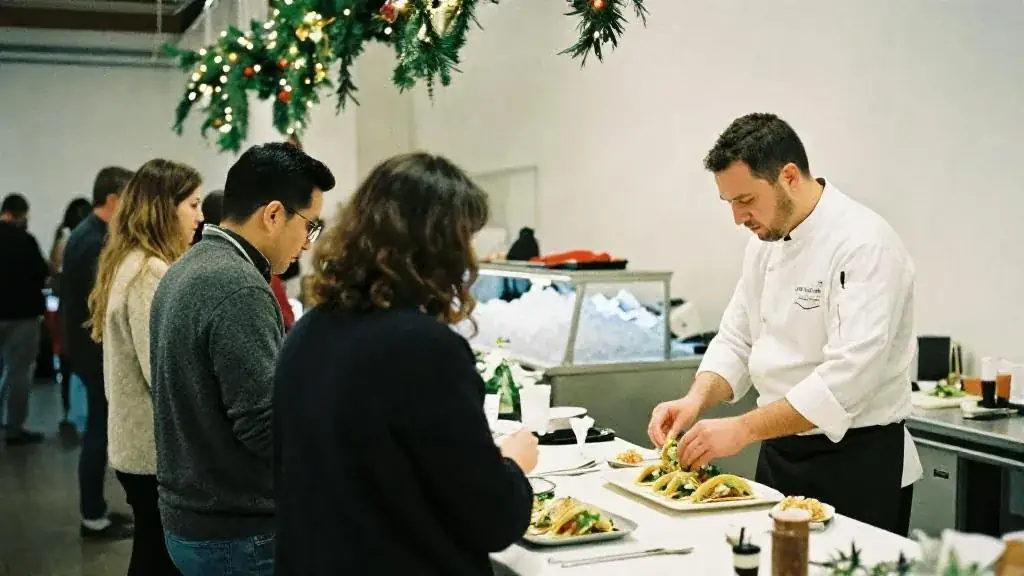
A station is a table or counter with one theme and, usually, one attendant: a chef carving, a cook tossing pasta, a server building tacos.
Guests queue, chat, take a small plate and move on.
Worked numbers.
Stations replace a seated dinner well, but guests eat in waves, so expect food to be needed over two to three hours rather than one.
Questions to ask.
Is the chef attendant fee per station charged on top of the food, and is it subject to the service charge?
How many portions per guest does the caterer plan per station, and when does each station close?
More detail, examples and common mistakes are on this page, below the video.
How it works in practice
A station is a table or counter with one theme and, usually, one attendant: a chef carving, a cook tossing pasta, a server building tacos. Guests queue, chat, take a small plate and move on. That queue is the point and the risk. A station that serves one guest every 30–60 seconds (typical for made-to-order food) moves only 60–120 people an hour, so a single pasta station for 250 guests becomes a line that fills the room.
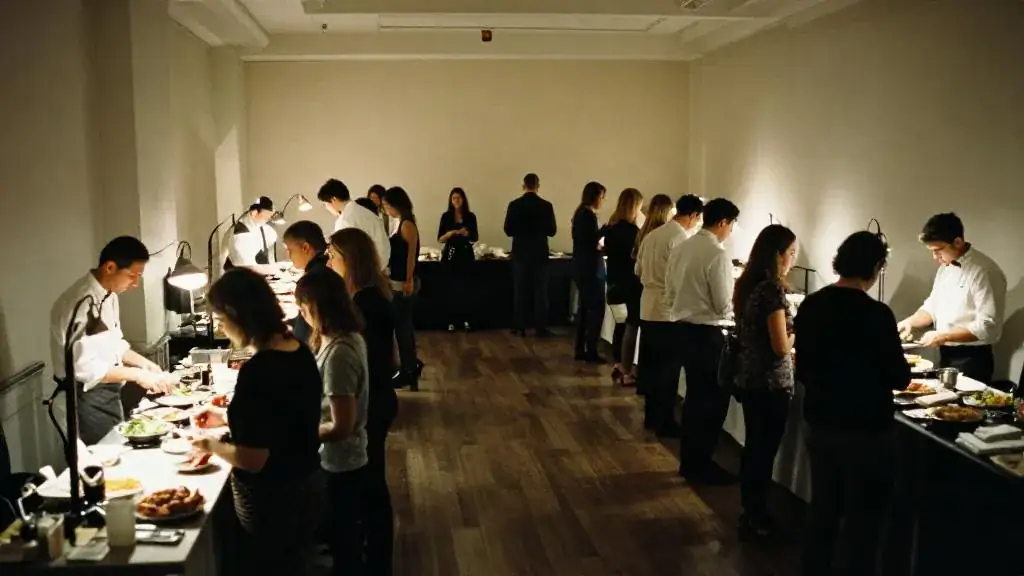
Plan one station per 50–75 guests as a typical starting point, double-sided where the menu allows it, and spread them around the room instead of along one wall. Put the slowest station farthest from the entrance so the line does not block arrivals. Keep stations away from the stage and the bar, and leave aisles wide enough for servers carrying trays.
Worked numbers
| Corporate holiday party, 300 guests | Typical planning figure |
|---|---|
| Stations | 4–6 (taco, pasta, raw bar, carving, dessert) |
| Double-sided stations | Count each side as one serving point |
| Floor per station including queue | Roughly 10–15 m² |
| Extra space against a buffet | About 20% more floor |
| Seating | Seats for 50–60% of guests plus cocktail rounds |
Stations replace a seated dinner well, but guests eat in waves, so expect food to be needed over two to three hours rather than one.
Questions to ask
- Is the chef attendant fee per station charged on top of the food, and is it subject to the service charge?
- How many portions per guest does the caterer plan per station, and when does each station close?
- Which stations can be fully gluten-free, vegan or halal without cross-contact?
- Do the stations count toward the F&B minimum at the same rate as a plated menu?
- Where will dirty plates go? Stations without bussing stations fill every ledge in the room.
Label each station with the dietary codes used on your guest materials, so a guest with a nut allergy can read the sign instead of interrogating the chef.
Related tools
Use the venue capacity calculator to check that the room still works once stations and queues take their share, and the food quantity calculator for portion counts. A buffet is the cheaper comparison point.
Why it matters
Stations encourage mingling and handle mixed diets; they need 20% more floor space than a buffet.
Example
A taco station, a pasta station and a raw bar at a corporate holiday party.
Common mistakes
- Placing all stations on one wall, creating a single queue
Related guides, venues and vendors

Set length
Entertainment
The duration of a performance segment.
Read more
Comp ratio
Business & Legal
The number of complimentary rooms or tickets a venue grants per number booked.
Read more
Processional
Weddings & Cultural
The entrance of the wedding party and the couple at the start of a ceremony.
Read more