Toronto, Mississauga, Vaughan and Hamilton processes for park bookings, tents, amplified sound, road closures and food vendors.
Read the transcript
City permits: parks, tents, noise, road closures.
Toronto, Mississauga, Vaughan and Hamilton processes for park bookings, tents, amplified sound, road closures and food vendors.
One event, several desks.
An indoor event in a licensed venue touches the city almost not at all.
Move the same event outdoors, or into a park, or across a street, and you are dealing with three or four municipal desks at once: parks, buildings (for the tent), the noise bylaw office, transportation (for a road closure), public health (for food vendors) and, for anything large, police and fire.
The permits most outdoor events need.
Tents: what the code actually requires.
Tent rules are where planners get caught, because the rental company is happy to install whatever you order and the inspector arrives after it is up.
In Ontario, tents over 60 square metres aggregate need a building permit.
Noise: the bylaw and the neighbours.
Toronto's Noise Bylaw (Chapter 591) sets limits on amplified sound, and those limits are stricter between 11 p.m. and 7 a.m.
If your event has outdoor speakers at any volume, or indoor sound that will reach the street, apply for a noise exemption permit.
A permit calendar you can trust.
At booking, list every permit the site and program could trigger. When in doubt, include it.
Call the municipality's special events office and ask which apply. Write down the name of the person you spoke to and the date.
That is the lesson. The worksheet and the quiz are just below this video.
What you will be able to do
- Identify required municipal permits
- Apply with realistic timelines
- Manage noise bylaws
One event, several desks
An indoor event in a licensed venue touches the city almost not at all. Move the same event outdoors, or into a park, or across a street, and you are dealing with three or four municipal desks at once: parks, buildings (for the tent), the noise bylaw office, transportation (for a road closure), public health (for food vendors) and, for anything large, police and fire. Each has its own form and its own clock. The planner’s job is to know which desks apply and to file with every one of them early enough that none of them becomes the reason the event is cancelled.

Every municipality in the GTA runs its own version of this. Toronto, Mississauga, Vaughan and Hamilton each have a special events office or coordinator who acts as the front door and routes your application to the right departments. The names, forms and fees differ and change, so this lesson gives you the structure and tells you to check the current fee with the city. It is not legal advice.
The permits most outdoor events need
| Permit | Triggered by | Lead time (plan for) | What they will ask for |
|---|---|---|---|
| Park or public space booking | Any organised event in a city park or square | Months, especially summer weekends in Toronto; apply as soon as the date is set | Site plan, attendance, insurance certificate naming the city, washroom and waste plan |
| Building permit for tents | Tents over 60 m² aggregate in Ontario (OBC 3.14) | Several weeks; your tent company often files it | Tent layout, flame-resistance certificate (CAN/ULC-S109), anchoring details; engineer’s review for tents of 225 m² or more |
| Noise exemption | Outdoor amplified sound, or any sound outside the bylaw’s normal hours | About 4 weeks in Toronto; apply early | Hours, speaker locations and direction, contact person on site |
| Road closure | Closing or partially closing a street, or placing anything on a sidewalk or lane | Months; involves transportation, transit and emergency services | Traffic management plan, detour signage, notification of residents and businesses |
| Food vendor approval | Any food prepared or served to the public | Weeks; each vendor usually files their own | Public health documentation per vendor, handwashing, refrigeration, grease and grey water disposal |
| Special Occasion Permit | Alcohol in an unlicensed space | 30 days for public events, plus the municipal resolution | Covered in the previous lesson |
Tents: what the code actually requires
Tent rules are where planners get caught, because the rental company is happy to install whatever you order and the inspector arrives after it is up. In Ontario, tents over 60 m² aggregate need a building permit. Aggregate means all your tents added together, so three 10×20 tents (each roughly 18.6 m²) are under the line, but a single 20×40 frame tent (roughly 74 m²) is over it. Tents must be at least 3 m from other structures. Tents of 225 m² or more need an engineer’s review of the structure and anchoring. The fabric must carry flame-resistance certification (CAN/ULC-S109), and exits and clearances must meet code.
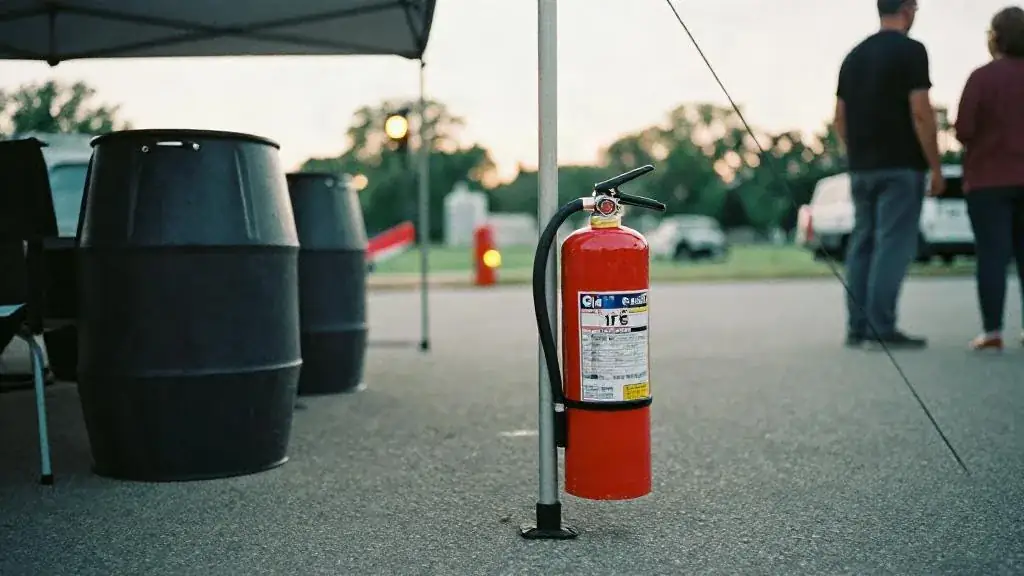
Ask the tent company, in writing, who is filing the permit and when. Ask for the flame-resistance certificate and the engineer’s letter before the install date. Use the /tools/tent-size-calculator/ early so the aggregate area is known when you book, not when the inspector measures it. Typical GTA range, 2026: a 20×40 frame tent installed is $1,200–$2,500, and the permit, engineering and ballast are usually extra.
Noise: the bylaw and the neighbours
Toronto’s Noise Bylaw (Chapter 591) sets limits on amplified sound, and those limits are stricter between 11 p.m. and 7 a.m. If your event has outdoor speakers at any volume, or indoor sound that will reach the street, apply for a noise exemption permit. In Toronto that takes about four weeks to process. Other municipalities have their own bylaws and exemption processes; ask the special events office.
A permit does not stop a complaint. Neighbours who were told in advance complain less, so hand-deliver a one-page notice to every address within earshot a week before, with the hours and a phone number that will be answered. On the night, point speakers away from residences, keep a sound meter reading log if the permit requires one, and have a person whose job is to turn things down the moment the bylaw officer arrives. Cooperation ends the visit; argument ends the event.
A permit calendar you can trust

- At booking, list every permit the site and program could trigger. When in doubt, include it.
- Call the municipality’s special events office and ask which apply. Write down the name of the person you spoke to and the date.
- Work backward from the event date using the longer of the published lead time or your own experience, and add two weeks.
- Put each filing date, fee and contact on the master timeline (the /tools/timeline-generator/ has a permits row) and in the risk register.
- Keep copies of every approval in the on-site binder and on your phone.
Worked example: the Harbour Gala
The Harbour Gala in its hotel ballroom needs no municipal permits at all, which is one of the quiet reasons hotels charge what they charge. So take the foundation’s next request: a summer donor appreciation picnic for 300 in a Toronto waterfront park, with a 20×40 tent, a DJ and a food truck. The list grows immediately. The park booking goes through the city’s Parks special event permit process, and for a summer weekend you file months ahead. The 20×40 tent is roughly 74 m² aggregate, over the 60 m² line, so a building permit is needed; the tent company files it, you collect the CAN/ULC-S109 certificate, and you confirm the tent sits at least 3 m from the nearest structure. The DJ means outdoor amplified sound, so a noise exemption goes in about four weeks before, and you plan to end music by 9 p.m. in any case. The food truck files its own public health paperwork and you ask for proof. Alcohol would mean a public event SOP with a municipal resolution, so the committee decides on a dry picnic. Each of these goes onto the calendar with a filing date, a fee marked “confirm current with the city”, and an owner.
Common mistakes

- Booking the park and assuming it includes the tent, the sound and the food. It includes the grass.
- Adding tents up wrong. The 60 m² threshold is aggregate.
- Filing the noise exemption three weeks out. Toronto needs about four, and that is not a guarantee.
- Letting a road closure be a surprise. Any sidewalk or lane use needs transportation’s sign-off and takes months.
- Quoting last year’s fees. Check the current fee with the city for every line before it goes in a client budget.
Worksheet
Download the worksheet, complete it for your own event (or the running gala example), and keep it in your course binder. It takes about 12 minutes.
Check your understanding
Related guides, venues and vendors

Ethics, kickbacks and disclosure
Module 1: Foundations · 15 min
Vendors offer commissions; venues offer favours. Decide now how you handle them, and how you disclose relationships to clients, the way this…
Read more
Accessibility by design (AODA)
Module 6: Design & Guest Experience · 15 min
Step-free routes, accessible washrooms, seating, captions, quiet space, dietary and sensory needs. The AODA checklist for events in Ontario.
Read more
Module 11 workshop: debrief and report
Module 11: After the Event · 15 min
Produce the gala's survey, ROI report, project write-up and portfolio entry.
Read more